Earlier this week on Ian Bick’s Locked In Podcast in Danbury, CT, I said something I avoided for years:
“I am not a prison expert or fixer. I served one year in 2008.”
I wish I had said it sooner. I wish I had said it the first week I walked that dusty track at Taft with Michael Santos and tried to compress his 26 years into the 388 days I would serve inside.
For too long, I wanted to be the guy with the map; every turn, every angle, every answer. I didn’t lie, but I blended my experience with lessons I learned from Michael without always saying whose experience it really was.
From the beginning, Michael told me to embrace 100% of the truth: “JP, be authentic, be yourself. That is enough. Own that your strength is telling the truth about your experience, and showing how you’re applying what you’ve learned, like Plato and Socrates. The truth will set you free.”
I worried that if I did not accept the “fixer” title, it would make me look small. I mean, if you’re getting hired, you’re supposed to fix things, no? I worried people would assume I didn’t know enough to help. I worried that acknowledging how much I learned from him would overshadow my own work.
“It ain’t what you don’t know that gets you into trouble. It’s what you know for sure that just ain’t so.” – Mark Twain
I “knew” protecting an image would help. I “knew” taking full, public ownership of my limits would hurt. I “knew” fully crediting my mentor would make me look like an apprentice instead of a leader. All of that “just ain’t so.”
I’ve read Twain off and on since prison (I was reintroduced to him by Arthur, who I wrote about last week). Twain’s humor and wit cut down my excuses.
“If you tell the truth, you don’t have to remember anything.” – Mark Twain
When I finally admitted what I knew and what I didn’t, when I stopped trying to sound like the authority and started sounding like the student who did the work, my life got simpler, my conscience got lighter, and our business grew significantly.
While I credit Michael for being my mentor, he credits others for mentoring him. In his books, he shares the lessons he learned from leaders like Frederick Douglass, Nelson Mandela, the Trial of Socrates, and from friends like Greg, Lee, or Bill.
If I say something he thinks is worth keeping, he’ll say, “Greg taught me that story,” or “Bill told me that in ’97.” He passes lessons forward without seeking credit. It isn’t branding or humility: just honesty and the way he lives his life.
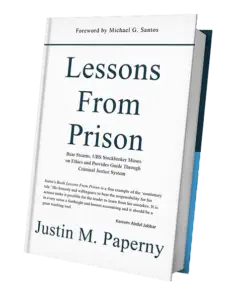
That’s how he taught inside, and it’s how he continued after his release. When Michael came home in August 2013, we started working more closely again, like we did in prison. I led White Collar Advice as a boutique consulting practice in 2009, one-on-one work, high touch, focused on helping individuals navigate a government investigation, sentencing, prison, reputation, and reentry. He supported it, and we built it together.
At the same time, his vision was never limited to just one-on-one guidance. He had been building something bigger since 1987: a body of work designed to change the system, the idea that rather than just letting calendar pages turn, you could earn your way home.
Just after his release, he began teaching at San Francisco State University, a course on the Architecture of Incarceration. He lectured at Stanford Law School and challenged future lawyers to think differently about sentencing, confinement, and release.
In 2012, while still in prison, he contributed to a book written by Stanford Professor Joan Petersilia. He presented at UC Berkeley on sentencing and prison reform. The Bureau of Prisons invited him to test a program, Preparing For Success After Prison (which is now in every BOP facility). He joined the Robina Institute to work alongside scholars on research aimed at changing how our country sentences and releases people. He published in the UC Hastings Law Review, writing for the exact audience, judges, lawyers, and policymakers, whose decisions influence policy.
Then he worked with the DOJ in Guam. In response to the “Smart on Crime” Initiative announced in 2013 by then–Attorney General Eric Holder. As part of that effort, Michael worked with leadership from the U.S. Attorney’s Office to conduct 25 training sessions on Earning Freedom and Reentry in both Guam and the NMI. The training sessions were widely attended, with over 300 attendees in Guam and more than 80 in Saipan.
Those steps, layered on decades of daily documented progress, helped open doors that led to the First Step Act. And that work hasn’t stopped.
Recently, Michael spent time in Washington, D.C., with BOP leadership. He’ll return next month. I’ve sat with him as he outlined practical changes: merit-based programming, making sure everyone is eligible to get earned time credits under the First Step Act, expanding furloughs, and more. White Collar Advice was the initial funder of PrisonProfessors.org, and we continue to support the mission with a percentage of every sale.
Michael’s authenticity and his “I will never ask you to do what I do not do” message led to this progress with the BOP and elsewhere. By 2019, I felt the full weight of what he had been telling me. Our work went viral: Dr. Phil, Fox News, Netflix, and The Washington Post. Hundreds of calls. More than 100 million views. Attention changes you if you let it. The Post profiled me.
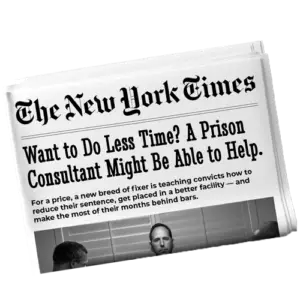
The headline wasn’t what I would have written. The piece painted a picture of someone who had every answer. I saw myself in the article, but not the full story. After it ran, I sat with Michael. I told him parts of it I loved and parts of it bothered me.
Michael was supportive, recognizing, “We are all works in progress.” Then he asked questions: “What are you trying to build? What record do you want people to see?” This isn’t about credit. It’s about authenticity. Tell people how you learned what you know. Show them your body of work and help them understand how we engineered this plan.
“When you find yourself on the side of the majority, it is time to pause and reflect.”
– Mark Twain
The majority in this space positions themselves as the one with secret keys, the fixer. I did that for a while. It didn’t last. The moment I fully owned the level of support, including what I knew and did not know, everything changed. At the end of the day, people in our community just want to know if we can help them. It’s always easier if you’re authentic.
I’ve written in earlier newsletters about Plato’s Allegory of the Cave. People stare at shadows so long that they confuse movement on a wall for reality. When the light hits, it hurts. Turning around takes work and humility. For me, the shadow was the idea that my authority depended on what I could claim for myself. The truth, blinding at first, was that my authority depended on what I could prove, what I could credit, and what I could build in public.
I’ve written about The Stranger. Meursault refuses to fake emotion for comfort and pays for it. There is a cost to living honestly. You lose support. You keep your night’s sleep. You keep your integrity. And you build a record people cannot ignore.
Early in the Civil War, Abraham Lincoln appointed General George McClellan to lead the Union Army. McClellan delayed, over-prepared, and missed critical opportunities. Lincoln removed him, knowing the political and personal cost. He filled his cabinet with rivals (people who disagreed with him, sometimes publicly), and he let them be as strong as they could be because the work demanded it. He wrote letters taking blame when the Union failed. He changed course when evidence demanded it. He credited others when they were right. He did not pretend or lie. That humility didn’t make him smaller. It made him credible.
That’s the same lesson Michael modeled for me, and it’s the lesson I’m encouraging you to adopt. If a judge asks, “Where did this insight come from?” answer directly. If a probation officer asks, “Why did you write this?” tell them. If your lawyer asks, “Why are you doing this work?” tell them whose shoulders you’re standing on. Then prove it with a record that doesn’t depend on anybody’s spin.
Why do I write these newsletters? Because I’ve been in the spot you’re in, under investigation, awaiting sentencing, serving time, coming home, trying to figure out how to live with what happened, and doing my part to help you build a record that shows why you’re a candidate for leniency, trust, and more opportunities. I want to shorten your learning curve. And to do it well I must be authentic.
That’s how I’ll close…
If you’re in the middle of this storm, ask yourself:
What are you pretending to know?
Who did you learn from, and have you said so out loud?
Then take one step, today, that answers those questions with action.
Justin