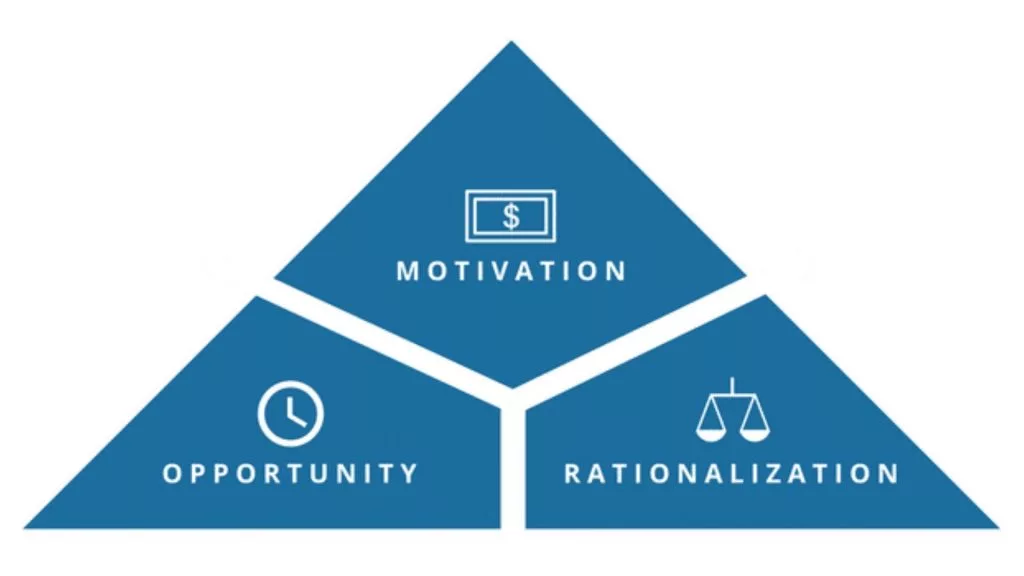
The Fraud Triangle: pressure, rationalization, and opportunity can derail the life we are meant to live, to put it lightly.
Note: The chapter below is reproduced exactly as I wrote it inside Taft Federal Prison Camp in 2008. The summaries, FAQs, and modern context appear after the chapter for clarity.
Table of Contents
How I Entered the Fraud Triangle
This chapter covers how my conduct fit the fraud triangle early on. I was making more money than I ever had, but I compared myself to others and decided I was underpaid. I didn’t stop to question whether that justified crossing written agreements.
Once I decided Kyle wasn’t treating me fairly, I used that as cover. I kept placing trades and collecting commissions. I didn’t pause or change course.
The sequence repeated. I felt pressure, accepted an explanation that worked for me, and continued once the opportunity existed. I later heard the same sequence from other inmates, with different details but the same steps.
Register for our Tuesday federal sentencing and prison webinar: Join Webinar
Also, grab a copy of our new book, 14 Costly Errors Leading to Longer Sentences.
The Fraud Triangle
I chose Crowell, Weedon and Co., the largest regional firm on the West Coast. Richard Jacobson was the manager of the Encino branch, and he welcomed me with open arms. Many of the other brokers were set in their ways, stodgy, too tired to chase new accounts. Jacobson saw hunger in my eyes and hired me on the spot. I was 24-years-old and he offered me a guaranteed salary that was three times as much as what I was earning at Merrill, plus a commission split that assured I would earn six figures in my first year. I was chasing the money.
I had been at Merrill Lynch for one year when I quit in a huff. At the time, I had built a book of business, which was just south of $10 million dollars under management, most of which came from family, friends, and acquaintances. The sum wasn’t a large amount in the brokerage world, yet it was sufficient to ensure that I could walk into any moderate sized brokerage house and negotiate an employment offer.
While at Crowell, Weedon I worked the phone and I worked the streets. By cold calling and cold walking I picked up every account I could find, adding tens of thousands to my assets under management each week. I had my spiel down, promising to deliver the world while not giving a thought to asset allocation or the client’s specific needs. My approach differed in remarkable ways from Todd Goodman, who cultivated long-term relationships by recommending slow and steady growth.
Within months, I became one of the top producing brokers in the branch office. I learned some sharp-elbowed practices from Keith Gilabert, a fellow broker. He taught me how to earn higher commissions by churning accounts, how to finagle free lunches out of mutual funds, and he introduced me to a few other tricks that would boost my monthly production to the long-term detriment of my career.
The branch manager loved my performance and encouraged the aggressive tactics. I felt experienced, ready to advance on to the bigger players by tapping into my network of professional athletes. I contacted my friend, Dan Lozano, from the well-known Beverly Hills Sports Council.
Dan was an alumnus of USC, and he had cultivated relationships with professional baseball players. Knowing that he represented such players as Mike Piazza, José Canseco, and Barry Bonds, I called him for a lunch date with hopes of persuading him to introduce me to his clients, so that I could sell them on my skills as a money manager.
“Here’s the deal,” Lozano told me during our lunch. “Kyle Smith is my close friend. We were fraternity brothers and roommates at USC. He’s a broker at Bear and he gets all my guys.”
We continued the discussion, and by the end of the meal, Lozano agreed to set up a meeting between Kyle and me. Kyle was a few years older, a fellow Trojan, and we both had grown up in Encino. Lozano thought an opportunity might exist for Kyle and me to partner. I sensed the upside of linking my business with Kyle’s. If he could open the door at a brand-name firm like Bear Stearns, and introduce me to the trade of managing money for professional athletes, I knew my career had more potential to rocket.
Kyle and I hit it off during our meeting. He introduced me to David Pollock, the branch manager of Bear Stearns in Century City. When David heard that Kyle wanted me to join Bear so that we could work together as partners, he agreed to grant an interview. I only had about $15 million under management, and less than two years experience as a broker. Those were not the types of credentials that opened doors at first-tier investment houses such as Bear Stearns. Nevertheless, during our interview, I let it pop that my cousin was Todd Goodman of Goodman Investments and that Richard Levy was another distant cousin.
Those family relationships erased any reluctance David Pollock may have had about hiring me. Goodman Investments would not accept accounts of less than $25 million and David understood that as Todd’s young cousin, there was an excellent chance that Todd would refer accounts to me if they did not meet his minimum criteria. Pollack offered a compensation package, and without giving Jacobson at Crowell, Weedon a chance to counter, I submitted my letter of resignation, taking all of my accounts with me. My loyalty, I felt, was to my career, not to the team of Crowell, Weedon and Co.
With only $15 million under management, I accepted the role of junior partner to Kyle Smith, who managed more than $40 million of investor assets. That relationship left me with a smaller portion of the revenue split when we were distributing commissions. Although I agreed to the terms of the partnership, I grew to resent my status as the junior partner.
I felt as if my contributions warranted a higher payout. I was on track to earn north of $200,000 during my first year with Kyle; our partnership agreement, however, entitled Kyle to rake in more than three times as much. The revenue split to which I had agreed was not sitting well.
I had brought in an incredibly lucrative hedge fund as an account. That fund was kicking off as much as $100,000 a month in trading commissions. Despite the efforts I made to win the account, and the work I was performing to manage the heavy volume of trades, the partnership agreement gave Kyle the lion’s share of the commission split.
My sense of being under appreciated and under compensated failed to move Kyle. As the senior broker, he felt entitled to the higher split. After all, he insisted, his influence was the reason Bear Stearns had hired me.
At 25, I was the youngest broker Bear had ever hired in its Los Angeles office. According to Kyle, that never would have happened without his sponsorship. He told me that I still had dues to pay, that both patience and gratitude would suit me well.
Although I agreed to continue with our arrangement, beneath the surface I could feel Kyle exploiting me. When I spotted an opportunity to even the playing field, I took it. Those actions, I now recognize, represented my succumbing to what others have called the fraud triangle. It’s a trap that can lead to moral failure, a slippery slope that frequently lands people in prison.
With the fraud triangle, the individual feels the pressure. He feels as if he is being cheated, or as if he needs to overcome some hurdle. The hurdle may present itself in the form of the need for a higher income to pay an obligation, or even some desire to advance one’s standing.
In my case, I resented the concept that I had to pay dues. I was bringing in the money. I felt entitled to respect and to more compensation. Without that perceived sense of fairness, I felt as if my colleague was taking advantage of me. In my mind, that injustice could not stand.
The second prong of the fraud triangle was the rationalization. In my case, since I felt as if I were being cheated, it only seemed fair that I take what was rightfully mine.
As an athlete, if I ever felt the manager wasn’t recognizing my performance, I could work harder. My stats would easily convince him that I deserved a higher position in the batting order. Either way, I recognized the importance of the team first, and accepted that our team’s manager had a reason for his decision.
As a cynical money manager on the other hand, that sense of fair play I had learned through sports didn’t mean as much. The partnership agreement I had made with Kyle failed to reflect my performance. With his response that I needed to pay my dues, I rationalized that he was looking out for himself rather than for my interest as a contributing team player. Since he wasn’t interested in being fair to me, I rationalized that I would look out for myself.
The third prong of the fraud triangle was opportunity. I felt pressure by the perceived lack of fairness.
Even though I was earning an income far beyond the grasp of most young men, I felt my performance entitled me to more. I rationalized the unfairness. The opportunity presented itself to bank some full commissions, in total violation of the partnership agreement I had made with Kyle. In my mind it was all fair. That type of thinking differed in remarkable ways from the values of a sportsman, but it seemed acceptable with my sliding scale of ethics. It was the strangling triangle of pressure, rationalization, and opportunity that eventually led me to fraud.
As a prisoner in a minimum-security federal prison camp, I met and interacted with hundreds of men who served time for white-collar crimes. Some engaged in securities fraud. Others launched businesses that turned into Ponzi schemes. I knew men who manipulated records in transparent and ultimately futile attempts to evade taxes. The crimes may have varied, but the motivation for each, without exception, followed the familiar pattern of pressure, rationalization, and opportunity, the fraud triangle. I came to this conclusion as I began to think of a neighbor in an adjacent cubicle.
Steve and I had walked around the dirt track earlier that evening. He told me that he had been the controller for a moderately sized and privately held company, which distributed industrial parts. He’d been with the company for more than a decade and thought that his contributions enabled the firm to grow its customer base exponentially. The owner relied on Steve to manage the operations, but Steve felt as if the owner neglected to share in the profits. Steve told me that he was entitled to a higher percentage of the annual bonus pool, yet the owner of the firm declined to offer an equitable distribution.
Steve controlled both the billing and receivables. He also prepared the monthly income statement and balance sheet. Those responsibilities offered Steve ample opportunity to cheat his employer.
He launched his fraud by opening a straw business with a name that was eerily familiar to his employer’s. Steve also opened a bank account with the straw company’s name. Each month, he would deposit checks that rightfully belonged to his employer into this straw account. Over time, those thefts amounted to hundreds of thousands of dollars. As the financial controller of a private company with millions in monthly revenues, Steve had the opportunity to execute his fraud easily.
Auditors eventually detected his crime and he served a four-year sentence. The irony was that as Steve told me the story, he remained adamant that he didn’t take anything to which he wasn’t entitled. Despite the prison term, Steve was still stuck in the fraud triangle. In my opinion, that refusal to accept responsibility kept Steve locked in a negative adjustment pattern. We as individuals had to learn and grow from our decisions.
By diverting commissions from Kyle’s and my joint account and routing them to my personal account, I was able to even the short-term score. With an extra ten thousand here, an extra fifteen thousand there, I could take care of myself even if the partnership wouldn’t. Those types of decisions violated a code of ethics that led to long-term success. Worse, they made it easier to succumb further into the fraud triangle.
FAQ
What is the fraud triangle?
It’s the mix of pressure, rationalization, and opportunity that leads people into crime.
How does pressure show up in white collar careers?
It can look like feeling overlooked, underpaid, or pushed to produce more.
Why is rationalization dangerous?
Because once you believe you’re fixing a wrong, it becomes easy to justify crossing lines.
What role does opportunity play?
You cannot break the law if you do not seize an opportunity.
Did I understand what I was doing at the time?
No. I told myself I was balancing the scales, not breaking an agreement.
Why do many defendants tell similar stories?
Because the sequence is almost always the same — pressure, rationalization, opportunity, the fraud triangle.
What should someone facing a case notice from this chapter?
How quickly frustration can turn into decisions that later bring charges.
Top Misconceptions
Misconception: Fraud starts with a big decision.
Correction: It usually starts with a small justification that feels harmless.
Misconception: High income prevents fraud.
Correction: Pressure can come from resentment, not financial need.
Misconception: Opportunity is the main driver.
Correction: Rationalization is usually the real trigger.
Misconception: People who commit fraud see themselves as criminals.
Correction: Most see themselves as “fixing” something unfair.
If You’re Facing a Federal Investigation or Prison…
- Notice how quickly frustration can become an excuse.
- Watch for moments when you tell yourself you’re owed something.
- Be honest about the opportunity in front of you and how you justify using it.
- Pay attention to the small decisions — they’re usually the ones that create the bigger problem.