Table of Contents
What Security Levels in Federal Prison Mean for Housing
Security levels in federal prison determine where people sleep, how much movement they have, and how much privacy they sacrifice. Higher levels bring stricter control and smaller spaces. Lower levels bring more freedom but less privacy. Understanding these differences helps people prepare realistically and avoid unnecessary mistakes early in confinement.
How Federal Prison Security Levels Are Decided
My personal experience with living in prison comes from the time I served at the Taft Federal Prison Camp. That experience limits what I saw firsthand. My friend, partner, and co-author, Michael Santos, lived in prisons at every security level. Through his experience, along with years of working with clients across the system, I developed a working understanding of how security levels in federal prison affect housing and daily life. That collective experience shapes what we share with people preparing for confinement.
All prison systems rely on scoring formulas to determine where a person will serve a sentence. Factors such as documented violence, escape attempts, and sentence length influence placement. People with longer sentences or violent histories are more likely to serve time in higher-security institutions. Those with fewer risk factors and shorter sentences generally serve time in lower-security facilities.
Our team has experience in prisons at every level. We have seen that regardless of where a person is placed, daily decisions are vital to establishing a good routine. Understanding what lies ahead helps people make fewer mistakes early.
Admissions, Orientation, and Initial Placement
In larger prisons, most people begin their term in a housing unit reserved for Admissions and Orientation. After completing the A&O process, administrators reclassify people and move them into permanent housing.
Smaller prisons may not have a separate A&O unit. In those facilities, people are often placed directly into general population upon arrival. As a general rule, permanent housing assignments happen within the first few weeks. In overcrowded penitentiaries, however, people may wait in A&O or segregation for extended periods until space opens.
Once placed in general population, people remain there unless staff determine they pose a security risk. In that case, isolation may follow for an indefinite period.
Two aspects of prison life consistently affect adjustment:
- Housing assignments
- Job assignments
Staff have broad discretion over both. Those decisions influence daily stress levels. Sharing quarters or working alongside someone who struggles with anger can quickly create problems. There is no shortage of hostility inside prison walls.
Housing in High and Medium Security Levels in Federal Prison
Living conditions change significantly depending on security levels in federal prison. United States Penitentiaries and medium-security Federal Correctional Institutions house people serving long sentences, including life terms. Many have histories of violence, gang affiliation, or repeated disruption. In response, staff strictly control movement and routines.
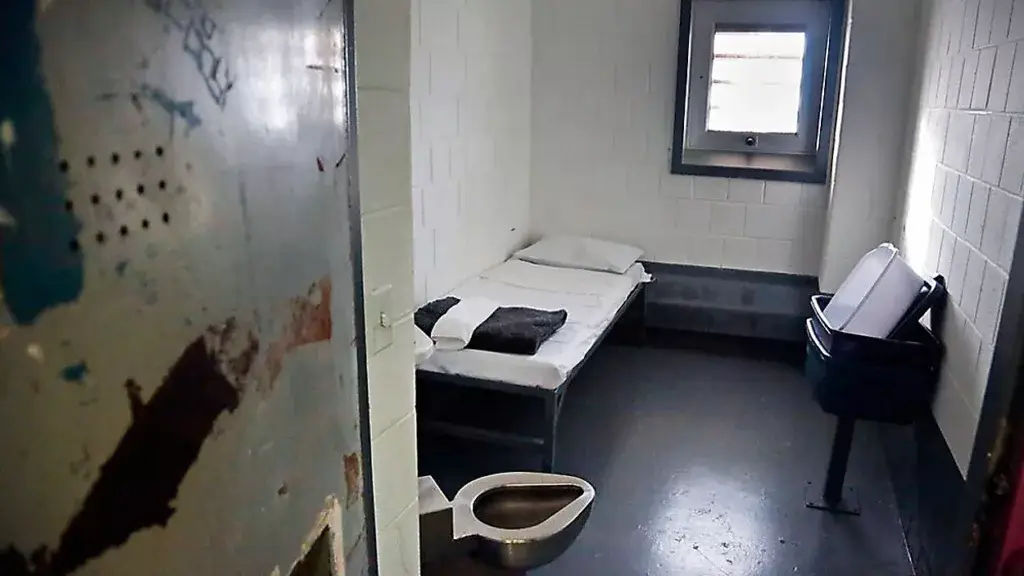
Housing units in USPs and most medium-security FCIs consist of two-man cells. These rooms are sparse, typically about eight feet by ten feet. Walls are concrete block. Floors are unfinished concrete. Each cell contains a steel bunk frame attached to the wall, a thin sleeping mat, and a combination toilet and sink made of metal. Toilets have no seat or lid.
Windows, if present, are narrow and frosted. They do not open and offer no real view. The room contains no wood or soft materials. Everything is steel and concrete.
Each cell has two small lockers for all personal property. Items left outside lockers during daytime hours can result in discipline. Violations often lead to time in the Special Housing Unit. While in SHU, people lose access to property, movement, phones, and clothing exchange. In crowded penitentiaries, even short disciplinary stays can result in months of waiting before returning to general population.
Rules prohibit hanging photographs or decorations. Lighting consists of a single fluorescent fixture. Some cells include a small steel desk bolted to the wall with a fixed stool. These rooms are functional and restrictive.
Steel doors include narrow windows. Staff routinely look inside, even when a person is using the toilet. Privacy does not exist. Officers may search property at any time.
Doors also include a slot used to pass meals during lockdowns. When locked down, people are often handcuffed whenever they leave the cell, including trips to the shower. Lockdowns occur regularly and can last days or weeks.
Radios and MP3 players are allowed with headphones only. Personal televisions, musical instruments, and typewriters are prohibited. Most facilities limit people to five books in their possession.
Medium-security FCIs largely mirror USP housing. Some prisoners transfer from penitentiaries to FCIs after years of clear conduct. In both settings, administrators may designate an “honor dorm.” Admission typically requires a clean disciplinary record and seniority. These units are quieter and more orderly, which many people value.
Housing in Low-Security FCIs and Federal Prison Camps
People housed in low-security FCIs and camps generally present fewer risk factors. They often have shorter sentences remaining and little or no history of violence. Some arrive there directly. Others earn transfer eligibility after years of clean conduct in higher-security prisons.
Low-security FCIs usually require fewer than 20 years remaining to serve. Camps generally require fewer than 10. In addition to time remaining, custody scoring must qualify.
Operations in lower-security facilities are less rigid than in higher-security institutions. These prisons cost less to operate and require fewer staff. People typically live in dormitory-style housing rather than two-man cells.
Dormitories may hold dozens or even hundreds of people. Layouts vary. Some resemble large open rooms with rows of bunks. Others use two- or four-man cubicles with partial partitions. Each area includes lockers and sometimes a small writing surface.
Lower-security housing offers more freedom of movement but less personal space. Bathrooms are communal. Toilets are usually separated by thin partitions. Showers are individual stalls. Privacy, as most people understand it, still does not exist.
Staff can conduct strip searches at any time. Nighttime inspections occur periodically, especially after incidents involving violence.
Some people prefer higher-security housing because of the two-man cells and private toilets. Others prefer lower-security environments despite shared bathrooms and constant noise. Each setting involves trade-offs.
Volatility Across Security Levels in Federal Prison
Higher-security institutions experience more frequent disturbances. Food strikes, work stoppages, and riots occur more often. Group pressure can interfere with personal goals.
Lower-security facilities have their own problems. Some people still face long sentences and carry anger or despair. Camps generally experience less volatility. Violence is rare and typically isolated.
A former client shared this account from a camp environment:
Jay, a former lawyer, reported kitchen theft to staff. Other prisoners retaliated by vandalizing his belongings and stealing his commissary items. While he was ostracized, the response stopped short of the severe violence seen in higher-security prisons.
Prison culture differs sharply from life outside. Every decision carries consequences.
Initial Housing Assignments and Conflicts
Initial housing assignments often occur based on availability. Compatibility is not guaranteed. In higher-security prisons, conflicts escalate more quickly.
Some institutions allow unit officers to approve bed changes. Others require counselor approval. Filing complaints often creates friction with staff.
With the First Step Act, participation in programs may eventually influence housing decisions, though application remains inconsistent.
Stories From Inside
Joseph’s Experience
Assigned to a hostile cellmate at a medium-security FCI, Joseph deferred early. That decision escalated tensions. Unable to secure a bed change, he entered protective custody. Upon return, the label followed him.
George’s Experience
Assigned to a noisy 12-man room, George observed which prisoners had influence. Through informal channels, he secured a quieter housing assignment.
Texas Red’s Experience
Some prisoners resolve conflicts directly. Red described asserting himself immediately upon arrival. That approach carries risks and consequences.
Final Thoughts on Housing and Security Levels in Federal Prison
Housing assignments affect daily stress. No prison offers solitude. Everyone experiences periods of frustration and loss. Adjusting becomes easier when housing conditions are manageable.
You cannot control every assignment. You can control how you respond.
For those preparing to surrender, understanding housing conditions early helps reduce avoidable stress and discipline issues. Join our webinar.
Thank You
Justin Paperny is an ethics and compliance speaker and founder of White Collar Advice, a national crisis management firm that prepares individuals and companies for government investigations, sentencing, and prison. He is the author of Lessons From Prison, Ethics in Motion, and the upcoming After the Fall. His work has been featured on Dr. Phil, Netflix, CNN, CNBC, Fox News, The Washington Post, and The New York Times.
FAQ
How are security levels determined in federal prison?
The Bureau of Prisons uses scoring based on violence history, sentence length, and escape risk.
Do all federal prisons use two-man cells?
No. Two-man cells are common in high and medium security. Lower levels use dormitories.
Is privacy available in federal prison?
No. Staff may search or inspect at any time, regardless of security level.
Can housing assignments change?
Sometimes. Changes depend on staff discretion, institutional policy, and conduct.
Are camps safer than penitentiaries?
Camps generally experience less violence, though incidents still occur.
Does the First Step Act affect housing?
Participation in programs may influence classification, but implementation varies.