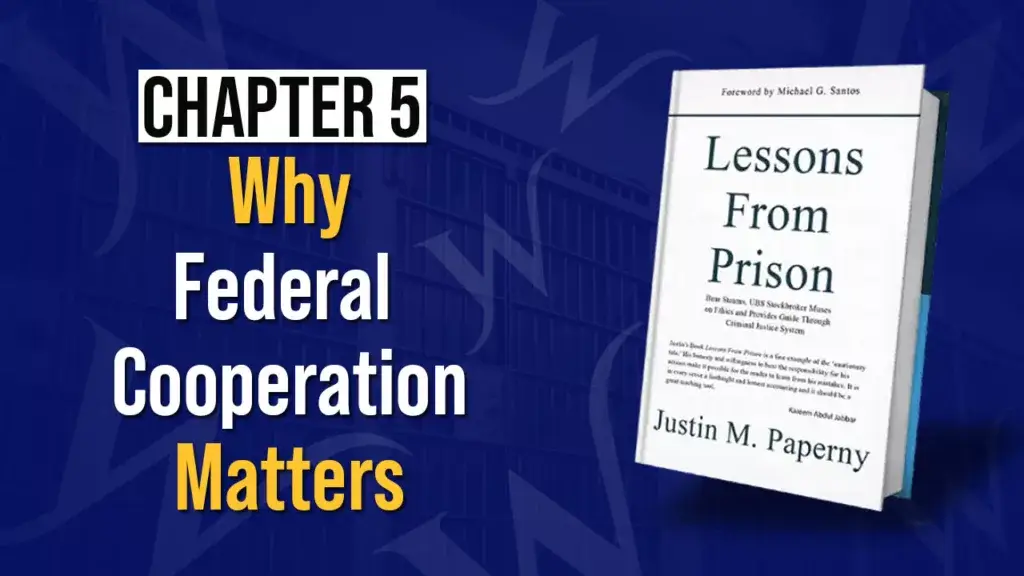
A firsthand look at how denial, secrecy, and silence led to bigger problems once federal investigators became involved.
Note: The chapter below is reproduced exactly as I wrote it inside Taft Federal Prison Camp in 2008. The summaries, FAQs, and modern context appear after the chapter for clarity.
Table of Contents
Lessons From Prison Chapter Summary
This chapter covers how I delayed telling the truth and how that delay compounded the case. It started with a false statement to a civil attorney. After that, I repeated the same story to avoid changing my account once investigators became involved.
I kept describing my role as limited to placing trades for the GLT Fund and pointing to Keith as the decision-maker. I gave the same explanation in different settings and stuck with it as more questions came. By the time federal agents were involved, the record already reflected multiple versions that didn’t align with documents or timelines.
The pattern was consistent. I avoided direct conversations, waited, and let time pass. That delay added two years, increased legal costs, and narrowed what I could do once cooperation began.
Register for our Tuesday federal sentencing and prison webinar: Join Webinar
Also, grab a copy of our new book, 14 Costly Errors Leading to Longer Sentences.
Self-Delusions, Lies, and Attorneys

In my capacity as a broker for UBS, I knew that Gilabert lost investors’ money with nearly each individual trade. Motivated by the exorbitant high commissions the account generated, I had a myopic interest in keeping the fund alive. The lax oversight violated the rules of ethics and the principles of good business. The greed, however, was not yet a violation of the law.
When I sat in on that meeting with Keith Gilabert, his client Abe, and Abe’s advisors, I had indisputable evidence that Gilabert had been conning Abe. My presence at the meeting bolstered Gilabert’s credibility, which contributed to the fraud. Then, I clearly perpetuated the fraud when I allowed Abe and his advisors to believe that Abe’s asset balance had a $3 million valuation. At that point, I became more than an unscrupulous broker. My failure to act and set the record straight violated the law.
Upon losing my employment at UBS, I wasn’t prepared to own up to the full magnitude of my problems. Kyle, my partner, was more savvy, or Machiavellian about such matters. He retained counsel and began negotiations to protect his position with UBS and immune himself from all liabilities associated with the GLT Fund.
Likewise, Keith Gilabert had lawyered up. He had cut a cooperation agreement with prosecutors to minimize his exposure to prison time. I had not yet reached my 30th year, and was not wise or cynical enough in the ways of the world to appreciate the depth of my troubles.
Rather than consult with a criminal attorney, I hired a civil attorney upon my termination from UBS. Losing my job had exposed me to potential financial penalties in relation to prepaid bonus money I had received. I wanted counsel to advise me through those employment issues. When the lawyers began a thread of inquiries into the reasons behind my termination, however, I dissembled. I feigned ignorance of the fraud to which I knew had occurred, and to which I had come to play a peripheral role.
My lack of honesty with the civil attorney was the first in a long series of bad decisions I made following my termination from UBS. I paid a steep price for my refusal to come clean and accept responsibility. Being ignorant of the consequences, I tried to cover up my culpability with lies. One lie led to another.
I took that ridiculous approach in a futile attempt to spare myself the embarrassing and humiliating consequences of my actions. I didn’t want my mother to know that her son had been complicitous in a fraud nor did I want my reputation to suffer. Clinging to my denial only exacerbated my struggles. Inside, I felt myself a cipher.
In lying to the civil attorney I hired to counsel me, I deprived him of the ability to advise me properly. I had paid him a $5,000 retainer initially to represent me on potential civil litigation related to my employment. As the complexity of the case blossomed, with the reviewing of emails that numbered in the hundreds, with the discussions behind every transaction of the GLT Fund, with the consultations over the purposes behind the disclosure letters we generated to protect UBS from liability, my legal expenses grew to surpass $50,000 with the civil attorney. With all the lies I had told him, however, the guidance he provided was not what my predicament warranted.
As the months dragged on, my civil problems that I had mistakenly believed related to my employment, escalated to inquiries from the SEC and FBI. Because of the lies I had told my attorney, he assured me that I didn’t have to worry about the federal investigators of the GLT Fund. “Just be honest,” my attorney advised. “Tell them everything you’ve told me and you will be fine.”
When I met with the Department of Justice attorneys, I told the same lies that had been sustaining me from the beginning. I had lied so often that I almost believed the lies myself. I couldn’t have been at fault, I reasoned. Gilabert was the criminal, not me. I simply executed the trades at his direction. In telling both half-truths and some outright lies to the government attorneys, I was committing new criminal conduct. Prosecutors, I later learned, could charge me with lying to officers of the court, and obstructing justice. Those criminal charges could have been in addition to the sanctions I faced for violating securities laws.
In time, prosecutors notified me through my civil attorney that they intended to indict me on a number of criminal charges. With that news, he told me that I would have to retain new counsel. The $50,000 that I had paid to keep the lies alive with my civil attorney had been a total waste. In paying for criminal attorneys to represent me, I burned through more than $200,000.
On a personal level, as I lay on my prison rack, with only concrete and steel around me, I came to realize how my irresponsible actions ripped my core asunder. In time I became unrecognizable from the type of person my parents had tried to groom. Rather than a man of character, temperance and integrity, I was undisciplined. I was a liar and I was a cheat. When events beyond my control threatened to expose me, I made decisions that sunk me deeper. As a consequence, I paid a heavier price for my wrongs. Worse than that, the decisions I made brought both pain and shame to those who loved me.
During those 12-plus months of reflection, I realized that my struggles began long before I ever met Keith Gilabert. I had been honest and disciplined as a child. My commitment to baseball instilled those traits in me. They brought a sense of confidence and self-pride. After ending my baseball career and graduating from USC, however, I moved away from my comfort zone. That was when my ethical slide began. Eventually, that ends-justified-the-means attitude led to my criminal conviction.
Within months, I had fallen off course. Away from home to launch my career in the high-stakes game of money management, I felt levels of stress that challenged my sense of security. I began unhealthy eating habits that led to weight gain. I smoked a pack of cigarettes each day. I didn’t exercise at all. My values deteriorated as I was exposed to the worst elements of the brokerage business.
By the time my superiors at UBS fired me, my moral compass was so far askew that I could not bring myself to terms with my predicament. Instead, I created a series of elaborate lies to explain the changes in my life.
When I met with my parents, I lied and said that I had chosen to resign from UBS to pursue a career in real estate. The abrupt change startled them for obvious reasons. They knew that I had obligations and responsibilities. I was 30-years-old. Investments had boosted my net worth to roughly a million dollars. My monthly living expenses exceeded $6,000, and my parents knew that making a change in my career at that stage seemed awfully shaky.
“Why would you take a job in real estate?” My mother was skeptical. “You’re a stockbroker.”
“I just felt that this was time for me to make a change,” I lied. “The whole hedge fund industry was under pressure, and I really grew tired of chasing accounts. I was the junior partner with Kyle, and with the downturn in the market, someone was going to take some blame. Since I wanted to move in a different direction, I just decided to leave UBS.”
“But what about the advance bonus you were paid?” My father expressed concern about my financial stability. “Will you have to return the money?”
“Oh no,” I lied. I didn’t have any clarification regarding that complication. “I parted ways amicably and I’ll keep the bonus. This has been a good thing.”
My mother looked at me as if she knew I was lying, but she didn’t press. Perhaps she instinctively understood that I was under severe stress, and in her love she didn’t want to break me. I felt as if I were a four-year-old who had been caught stealing. Not wanting to acknowledge that her angel of a son had committed an act of theft, however, my mom stood silent to accept my story.
Besides my family, I lied to friends. Brad Fullmer had been my closest friend since childhood. Presumably, there was not a single subject I could not discuss openly and honestly with him. Even with Brad, though, I lived in total denial. I just couldn’t bring myself to admit to anyone that I had been fired.
Inside, however, I was falling apart. I quit shaving, ate like a glutton and smoked like a fiend. I would lie in my bed at night, traumatized by the rapidly escalating severity of my problems. It seemed as if every week brought more evidence that I was going down. Like an ostrich, however, I ignored all the signs and continued to perpetuate the lie.
At nearly midnight several times each week, I would throw back the covers from my bed. Unable to sleep, I pulled on some sweats and slippers, and then drove to the local In-and-Out Burger. I’d order two double cheeseburgers, a chocolate milkshake, and two orders of large fries. Then I would return home and chow down while I played online chess matches until the early hours of the morning.
To boost my spirits during the day, I deluded myself by playing golf as if I didn’t have a care in the world. Ryan, one of my close friends, was from a distinguished Southern California family. We had played baseball together since we were six-years-old and played through USC together. I asked Ryan and his family to sponsor me for membership in the prestigious Lakeside Country Club. I was clinging to the hope that I could erase my troubles by creating a façade of respectability.
As a federal prisoner, I came to understand that living in denial was a common response for white-collar offenders. It seemed that no man wanted to accept that he had engaged in behavior that legislators deemed criminal. While in prison, I met mortgage brokers, bankers, lawyers and businessmen who initially responded to signs that their world was about to implode with decisions that compounded their troubles. Had I known more about how their dramas unfolded, I would have acted differently.
This utter incapability to accept responsibility was like lying on a table with the sword of Damocles swinging back and forth above my neck. I wanted to change the direction of my life, but I couldn’t bring myself to acknowledge that I had participated in actions that I knew were fraudulent. People had been hurt as a consequence of my blind pursuit of higher commission earnings. I appeased my conscience by denying that I owed a fiduciary responsibility to the clients Keith had solicited for the GLT Fund. I couldn’t bring myself to accept that on account of my misrepresentations, a 90-year-old rabbi had lost more than $3 million.
Even after retaining new counsel, who specialized in white-collar crime, I tried to minimize my exposure to the fraud that I knew had taken place. After lengthy debriefing sessions consumed tens of thousands in legal fees, my lead attorney sent an email to my Blackberry. He insisted that I fly to San Francisco the following week to sit for a lie detector test. He said the strategy was to obtain something tangible we could use as leverage to open negotiations with the government.
“Answer all the questions truthfully,” my attorney admonished me. “Don’t try to fool the machine. For one thing, it won’t work. For another, lies will only bring you more problems.”
With the civil attorney I had retained initially, I lied from the start. That approach resulted in burning through $50,000 in legal fees for counsel on irrelevant matters, and my committing new felonies by lying to attorneys who worked for the Department of Justice. The consequences of those lies, however, were not enough to shake me free from the haze of denial. I continued clinging to the illusion that I could somehow manage this disaster. While working with the new criminal attorneys, I again offered half-truths, trying to dance around questions that would portray me negatively.
Upon learning of the upcoming lie-detector test, I immediately Googled for information on polygraph examinations. I found a treasure trove of content, all promising quick-study courses that would teach anyone how to fool the machine. Despite my attorneys’ warning on the perils of prevarication, lying, I believed, would help me stay alive. Eagerly, I charged $350 to my credit card to download the course.
For several hours each day, preceding my scheduled exam, I studied through ostensibly proven techniques to beat the test. By tightening my sphincter when answering questions, I supposedly could manipulate the machine’s findings of truth to suit my purpose. I had worked through the course so methodically, and practiced so fervently, that when I walked into the San Francisco office where my test had been scheduled, I felt totally confident.
When the questions began, I performed brilliantly. I tensed where I was supposed to tense; I squeezed my innards when appropriate. In the end, the former FBI agent who presided over the exam gave me disappointing results. He said the machine indicated with an accuracy measurement of better than 99.99 percent that I was lying. As I deflated into my chair, my attorney looked at me with concern, and then told the polygraph administrator that he wanted a moment alone with me.
“Justin,” he said while sitting across from me, “you’re going to prison. It’s time to wrap your mind around that reality. You’re on incredibly weak ground here. The government prosecutors are prepared to charge you with numerous felonies, including obstruction of justice.”
“What does that mean?”
“That means ten years in prison. This is not a game. If you don’t come to terms with the seriousness of these problems, we can’t help you. You must trust us to look after your interests, and you must give us complete honesty.”
At that moment, I suddenly realized how suicide seemed a viable option for so many. I didn’t think I could serve a single day in prison. Ten years, for me, was not an option.
Following my return home, I began drowning in depression. An ordeal that could have been resolved much more painlessly with honesty had blown out of proportion. For months, the complications with my case consumed me. My mother sensed my deteriorating spirits and insisted I see a psychiatrist. I began a series of therapy sessions and medication that cost me $1,200 a month. Had I been truthful from the start, I could have responded to my problems much more effectively.
Top Misconceptions
Misconception: You can outsmart investigators with careful wording.
Correction: They already have documents, statements, and timelines. A lie only adds charges.
Misconception: If you explain the situation “your way,” you’ll stay safe.
Correction: Investigators treat inaccuracies as dishonesty, not interpretation.
Misconception: Lying to your attorney has no legal consequences.
Correction: It prevents proper defense planning and leads to poor decisions.
Misconception: Denial buys time.
Correction: It creates bigger problems that surface later with more force.
If You’re Facing a Federal Investigation or Prison…
- Notice where you’re avoiding the truth; denial grows quickly.
- Be honest with your attorney, even if it’s uncomfortable.
- Don’t assume investigators know less than you—they often know more.
- Understand that lies become new problems, separate from the original conduct.
- Pay attention to early signs you’re hiding from reality.
FAQ
Why did I lie to federal investigators in the first place?
I didn’t want to face what I had done. Admitting my role felt humiliating, so I convinced myself I could talk my way out.
How did lying affect my case?
It made everything worse. It opened the door to obstruction charges, increased legal fees, and destroyed any chance of early cooperation.
Did my attorneys know I was lying?
My civil attorney didn’t. He used my false statements to guide me, which only added to the problems. My criminal attorneys figured it out quickly.
Why didn’t I hire a criminal attorney sooner?
I misunderstood the seriousness of the situation. I thought my issues were limited to employment and bonus disputes.
What happens when you lie to your own lawyer?
They can’t defend you. Every decision they make rests on information you provide, and lies push them in the wrong direction.
How does lying to federal investigators become a separate crime?
Federal law treats false statements as obstruction. Even without underlying fraud, the lie itself can trigger charges.
Why didn’t I stop lying once things escalated?
I felt trapped by the earlier lies. Backtracking felt impossible, and I didn’t want to face the fallout with my family.
What should a defendant learn from this chapter?
Don’t hide anything from your attorney and don’t lie to investigators. Delay and denial increase the damage. Introspect and create a mitigation plan early.