“Dr. Sachs, may I speak directly?” I asked as we sat drinking coffee at the Coffee Bean in Calabasas.
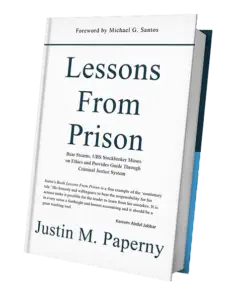
“Please,” he said—kind, almost overly deferential. He had mentioned Lessons From Prison in his first voicemail, saying how much he enjoyed it. Hearing that fed my ego more than I wanted to admit.
Two days earlier, I had cold-walked into his office.
Before that, he had called me three times and left two voicemails. I didn’t pick up. At the time, I wasn’t consulting, and I let the calls go to voicemail.
Weeks—maybe months—before that, he had come across the book through his lawyer, Alan Eisner. Alan is excellent. To this day, he’s also a good friend and a golf buddy.
I met Alan a year earlier while giving a presentation at El Caballero Country Club. The room that day was restless. One broker I had worked with at Merrill Lynch interrupted and called me “a psychopath for talking openly about your crimes.”
Most of the room deferred to him. Everyone did—except Alan.
Alan spoke up and lauded my courage for speaking openly, with the hope of helping people. I loved him for that. Loved him.
When I walked into Dr. Sachs’s office, it wasn’t to sell. It was to apologize.
As I described in Chapter 6, I hadn’t been picking up potential consulting calls. I was letting them go to voicemail. After my meeting with Michael in San Francisco, shortly after his release, everything changed. I made a decision to call every prospect back. I had more than one hundred numbers sitting there—enough, I realized, to actually start a business.
Dr. Sachs lived and worked close to my office in Calabasas, so I decided to walk in.
By then, I had been cold-walking for years. I was immune to criticism. After all, he had called me.
“Justin Paperny to see Dr. Sachs, please,” I said at the front desk.
“Do you have an appointment?” the receptionist asked.
“Negative,” I said. “But I promise you—I won’t say guarantee, because that feels slimy—that he’ll be interested in seeing me. If I’m wrong, I’ll humbly apologize and walk out.”
She thought I was strange. I could tell. She also wanted to see what would happen.
A few minutes later, I was inside.
“Hey, Doc,” I said. “Can I call you Doc? My grandpa was a doctor. He hated being called ‘Doc.’”
“Tom is better,” he said.
Within seconds, I could see it. He wanted to purge. He wanted to talk about the investigation. The exhaustion showed up immediately. His shoulders slumped as he spoke. His words came out fast, then stopped, then started again. It was clear his case lived in his head twenty-four hours a day.
“In prison,” I said, “life is easier in one respect. It’s clearly defined. There’s a beginning and an end. Waiting is the hardest part.”
He nodded.
“Long story short,” I said, “I wasn’t consulting when you called. I am now. My friend Michael Santos is home, and we’re going to work together.”
“The Kingpin,” he said.
I knew exactly what he meant. Chapter 10 of Lessons From Prison is about Michael—The Kingpin.
“Yes,” I said. “You look busy. Can we meet tomorrow morning at 10 a.m. to talk?”
“Yes,” he said.
He didn’t waste time the next morning. It felt as if he’d been counting the minutes until our meeting.
“A former employee turned whistleblower turned me in five months ago,” he said. “They’re alleging I overbilled.”
I waited to see what came next—I did it or a justification.
“Medicare changed a code,” he said.
There it was.
The code changed. The patients needed care. There weren’t better options. Saying no didn’t feel ethical. Asking patients to pay out of pocket wasn’t realistic. He wasn’t stealing. He was helping.
“I served my patients well,” he said. “Now I can hardly sleep. I don’t eat. I can’t work. My wife tells me I haven’t been affectionate in months. All I know is I’m under some civil investigation with the DOJ that could take months to resolve.”
He stopped. The pain in his face was familiar.
“Alan is doing his best to keep it civil,” he said. “The government even told him my early response helped—for now. Whatever happens, I’ll have to come up with a million dollars to pay Medicare back if I want to keep my license.”
Nothing in his life had prepared him for this. I could hear how the words “come up with” stuck in his throat. A million dollars wasn’t abstract to him. It was years. It was pressure. It was working into his eighties.
“Tom,” I said, “your voicemail mentioned how much you loved Lessons From Prison. Why?”
“The philosophy,” he said. “You explain it in a way I can understand.”
“That was my favorite part as well,” I said. “Michael introduced me to those thinkers. I didn’t want another prison book that put people to sleep. I wanted to understand how people like us end up here. Studying dead thinkers helps.”
“Speaking of dead thinkers,” I said, “want to talk about one I studied while I was in the halfway house in Hollywood?”
“Is that where I’m going?” he asked, half-smiling.
“I hope not. But if you do, you’ll be fine. If a Jewish kid from the hills of Encino can do it, so can you.”
“Okay,” he said. “Who?”
“Ovid,” I said.
Ovid was at the center of Roman life. Wealthy. Famous. Protected. His poetry was read publicly, quoted often. He lived in Rome at the height of its power and assumed—like most people in his position—that mistakes would be handled inside the system that had rewarded him.
Until they weren’t.
In 8 A.D., Augustus banished him.
No trial. No hearing. No explanation. That was it. That’s a wrap. Leave town.
Ovid later said his exile came from carmen et error—“a poem and a mistake.” The poem (Ars Amatoria) wasn’t criminal; it clashed with Augustus’s public morality campaign and made the emperor look hypocritical. The “mistake” was likely knowing or witnessing something involving the imperial family. Ovid wasn’t punished for what he did wrong. He was removed because he no longer fit the story power wanted to tell.
He was sent to Tomis, a remote port city on the Black Sea—cold, violent, linguistically foreign. He didn’t speak the language. The people there didn’t read Latin poetry. They didn’t care who he had been.
Rome didn’t confiscate his books.
They ignored him.
Ovid wrote letter after letter back to Rome—to friends, patrons, the emperor. He explained. He apologized. He argued proportionality.
Nothing changed.
Years passed. Seasons passed. Augustus died. Ovid remained.
That’s when he wrote, “Here I am the barbarian, because they do not understand me.”
Not because he had become one.
Because that’s what Rome decided he was.
“On a scale of one to ten,” I asked, “can you see the similarities?”
“Pretty, pretty good,” he said. I loved the Curb Your Enthusiasm reference. A little wittiness in the middle of a crisis isn’t a bad thing.
“In a way,” I said, “you’re experiencing the same thing. You’re being judged by the worst decision you ever made. They may not brand you a barbarian, but they label you a thief, crook. Like Ovid, you didn’t have bad intentions. But the people investigating you aren’t trained to consider your whole life. Their job isn’t to understand you. It’s to get a win and move on.”
He sipped his coffee. Let it sit.
“They’re acting like this defines me,” he said. “Like I deliberately bilked the government.”
“You said I could speak directly,” I said.
“Yup.”
“Then let’s not live in the land of make-believe,” I said. “Parts of what they’re saying are right. You did it. Own it. That’s the only way you can make more progress.”
“And the best possible outcome if I own it all?” he asked.
“The best possible outcome—never a guarantee,” I said, “is never going to prison. You pay the money back. If your kids have to help you later in life, so be it. You put them through college and medical school. You raised them with values. They love you. I’d do the same if I had to. For now, let’s build a plan to keep you out.”
“You mean really own all of it?” he asked.
“I spoke at the FBI Academy in 2011,” I said. “I got a full tour. These agents sit in what I would describe as a small cave reading everything—emails, texts. They already know a version of you, Tom. The only way you ever get to say, ‘but I didn’t do that,’ is by first agreeing to what you did do.”
“I think you’re right,” he said.
“I’m not telling you to accept their entire story,” I said. “Some of it is fiction. I’m telling you to start where they’re right. Once they know they’re on their way to a win, they become willing to listen.”
When the conversation focused too much on the reality of the situation, he pivoted.
“So after his exile, Ovid just kept writing letters?” he asked.
“Yes,” I said. “He kept appealing to the people who had already erased him.”
I paused.
“You can’t disappear. You can’t beg. You have to create assets that don’t exist yet.”
“Assets?” he said.
“Assets,” I said. “My book is one. I didn’t chase anyone with it. You found it, read it, and called. Ovid wrote letters hoping to be heard. You need to create work that exists whether anyone responds to it or not.”
“What I can’t do,” I said, “is let you see yourself the way they’re trained to see you. Ovid eventually internalized the word barbarian. That’s the trap.”
“My wife and boys love me and will support me,” he said. “What do I tell them if this doesn’t work?”
“A moment ago I told you they may not respond” I said. “I can’t predict the future, and I can’t change what led you here. If I were you, I’d tell them what you’ve always told them—you did your best to put yourself in a position to succeed.
“When you went to college, there was no guarantee you’d get into medical school. When you went to medical school, there was no guarantee you’d graduate. When you studied for your boards, there was no guarantee you’d pass. At every stage, you did the work.
“It would be out of character for you not to try now.”
“My God,” he said. “You get it.”
“Prison was a blessing for me,” I said. “I got help. Like you, I’m a work in progress. We’re in the same boat. I’m just further ahead.”
He sat quietly.
Then he asked, “Like Ovid, what if this defines me forever?”
“That’s the right question,” I said. “Some people will always define me as a felon. That’s fine. I don’t feel like a thief or a criminal or a felon—no different than I no longer consider myself a baseball player.
“If I had five at-bats in a high-school game tomorrow, I’d go 0 for five. That part of my life is over. Temptation isn’t what it used to be. I’ve seen the other side.”
I paused.
“Ovid didn’t lose himself because he was exiled,” I said. “He lost something when he started seeing himself only through Rome’s eyes—as a barbarian. That’s the danger—for him, and for you.”
“You can let other people call you whatever they want,” I said. “Or you can decide who you are by what you build next.”
“What’s the difference?” he asked.
“The difference,” I said, “is that labels fade. Records remain.”
I told him, “We’re still talking about Ovid two thousand years later. Not the emperor who banished him. In your case, whatever happens, I want your kids, your grandkids, your wife—everyone—to talk about your response long after this is over. That’s the part you control.”
He nodded.
“Yes,” he said. “When do we start?”
“I’ll text Michael,” I said. “He’ll respond after he’s done teaching his class at San Francisco State.”
“The Kingpin!” he said, more excited than I could describe.
I smiled. “I think he prefers to be called Michael.”
Discussion Questions
- What’s the “letter to Rome” you keep writing?
- What asset should you create next?
- Which label bothers you the most—and why that one?
- If this does define you forever, what do you want people to say about how you responded?