Learning the Ropes documents the first nights, intake procedures, schedules, and daily routines inside Taft Federal Prison Camp.
Note: The chapter below is reproduced exactly as I wrote it inside Taft Federal Prison Camp in 2008. The summaries, FAQs, and modern context appear after the chapter for clarity.
Table of Contents
Learning the Ropes in the First Days at Taft
This chapter covers my first full days at Taft Federal Prison Camp, starting with housing, sleep arrangements, and the exchange of issued property. It records daily schedules, meal timing, intake processing, and the volume of time spent waiting in lines.
Here. I describe the intake process, including clothing allotments, counselor meetings, phone limits, visiting approvals, and job assignments. I document specific limits such as 300 phone minutes per month, meal times, and the process for submitting visitor forms. The chapter also records daily routines observed in others, including exercise schedules, work assignments, and writing habits, alongside conversations that explained sentence length, transfers, and housing placement.
Register for our Tuesday federal sentencing and prison webinar: Join Webinar
Also, grab a copy of our new book, 14 Costly Errors Leading to Longer Sentences.
Learning the Ropes
I was deep in sleep when I felt a tapping at my foot. I began stirring into consciousness, and I realized I was in prison. I knew I was on the top bunk. The tapping on my foot didn’t seem logical. I kept my eyes closed, wanting to ignore it. More tapping, the feeling was undeniable. I lifted myself to look.
“Dude.” Drew stood there whispering at the foot of my rack. He was speaking quietly so as not to wake the others in my cube. In the blackness of night, I couldn’t register why he had awakened me. “Dude, wake up. I’ve got your mattress.”
“What?” I felt groggy.
“I’ve got your mattress, Bud. Get up. We’ve got to make the exchange now while the guard’s not around.”
“No, no, I’m okay. I don’t want any problems.”
“Come on. It ain’t nothing. One guy just went home. We’re just going to exchange your mattress for his before somebody else does.”
“What? What do you mean a guy went home? Why did he get to go home?”
“He went home because his time was up, Dude.” Drew must have thought I was stupid. “Now, let’s switch the mattress.”
I climbed down from my rack, upset with myself that I had become drawn into a middle-of-the-night exchange with such a furtive feel. I didn’t know enough about my new environment to be working through deals with prison hustlers.
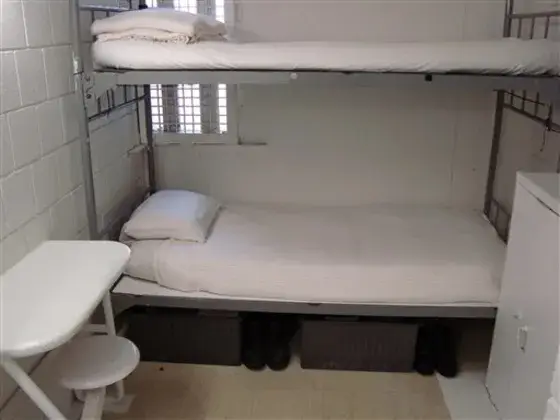
After stripping off the blankets and sheets, I picked up the mattress. It was really more of a mat than a mattress.
The rack that served as my bed was a sheet-metal slab supported by four steel posts. A long rectangular mat of thin foam covered in vinyl functioned as the mattress. I folded the mat in half and carried it as I followed Drew to another cube.
He picked up the new mattress, and I stretched the mat I had been issued originally on the lower bunk. Then I walked with Drew back to my cubicle. I saw a clock with hands at the right angle of three o’clock; we were the only visible movement in the unit. I felt like a prowler.
Drew set the mattress on my rack and walked out of the cubicle. I climbed up after I hastily wrapped my sheets and blankets around me rather than the mattress, and as I lay down, I realized that Drew had made me an excellent trade. Whereas my previous mat had been so thin that I felt the creases in the sheet metal of the rack, the one he had exchanged for me felt two or three times as thick. Despite the minor anxiety that came with thinking I may have done something wrong, I slept better on the heavier mattress.
I slept so well that I didn’t wake in time for the breakfast meal. The rigid schedule was a factor to which I would have to adjust. The morning meal began promptly at six, and in Taft Camp it concluded 20 minutes later. Those who were not in line by the time an officer locked the glass door leading into the chow hall went hungry.
With a growling belly, I began my first full day in prison. The laundry issued clothing to me in precise increments. My allotment included three pairs of trousers, three T-shirts, three pairs of socks, three pairs of underwear, and one pair of boots. I felt as if I were a soldier with all of the strict rules to follow.
I spent most of that first day waiting in lines. I waited interminably to see a nurse, a prison counselor, a staff member for the education department. After hours in the lines, a few superficial questions concluded my interview. The only meeting of any seeming relevance to me was with my prison counselor. Rather than dispensing any type of psychological counseling to cope with the blunt trauma of confinement, the counselor processed forms. Those forms would authorize my telephone and visiting access. The prison counselor also selected the prison job on which I would be required to work.
In federal prison, I learned, we could submit up to 30 telephone numbers that administrators would approve for us to call. The quantity was not too relevant, however, as we were allotted a limit of only 300 minutes per month. With an average of fewer than 10 minutes of phone time each day, I was forced to budget the calls by watching every minute.
To facilitate the possibility for visiting, the counselors issued several forms for me to send prospective visitors. The visitors were required to return the forms with personal information that the counselor would cross check with a criminal database. Provided the proposed visitor met the prison’s criteria, my counselor would add the name to my list of approved visitors.
My counselor then scheduled me for an A&O seminar, which stood for Admissions and Orientation. She explained that I should watch for my name on the daily call out for when I needed to attend.
“What’s a call out?” The counselor seemed to speak in a jargon that I didn’t understand, though one that she expected me to know. I felt a little bizarre and a bit overwhelmed with all of the prison structures.
“The call out? Ask around. Read your inmate handbook. You’ll get the hang of it.”
The counselor summarily dismissed me. I felt responsible for learning everything about prison on my own. Fortunately, there were other inmates like Drew around who helped me get a feel for things.
I realized that I had forgotten about the inmate handbook that an officer had given me as I was processed in. I returned to my cubicle to find and read through the collection of stapled pages describing prison life in bureaucrat-speak.
Later, Drew introduced me to a few inmates. I struck a bond with Arthur, a graduate of UCLA who was one year into a seven-year sentence. Arthur had an urbane demeanor and style. He was tall and obviously devoted to exercise, as he looked as fit as an Olympic gymnast. Committed to working myself into good shape, I accepted Arthur’s invitation to exercise with him.
The routine Arthur had set impressed me. Since he had begun serving his sentence, he lived as a model of discipline. Each morning he left his cubicle after the five o’clock census count had cleared. He sat alone at a table with his Webster’s dictionary and thesaurus, and he worked on a manuscript he was writing about the crimes that led him to prison.
Arthur was assigned to work in the chow hall. His responsibilities required him to sweep and mop the dining room floor after each meal. Following the morning work session, Arthur returned to write more on his manuscript. He gathered his work together at eight to prepare for the first of his twice-daily workouts.
The morning session lasted for two hours. Arthur alternated a run of between eight and ten miles with a vigorous ride on the stationary bicycle. Following the cardio work, he devoted a minimum of 30 minutes to his abdominals. In the afternoon Arthur returned to the track for another 90 minutes of strength training. His routine varied multiple sets of pull-ups, dips, pushups, and extensive training with the medicine ball.
“A lot of guys have tried to work out with me,” Arthur said. “The routine isn’t for everyone. I haven’t yet found anyone who could keep the pace day after day.”
After my first day of exercising with Arthur, I understood why. He was relentless. The man was in his mid-forties, yet he pushed himself as if he were 20. Not having exercised more than the leisurely games of golf I enjoyed each week for the past several years, I felt exhausted when we finally finished the routine. I was determined to stick with him.
Later that day, in the early evening, I went outside for a stroll with Drew. He and I were not as compatible as I felt with Arthur, though in prison I could see that I would coexist with people from every strata of society.
Like many of the men in prison, Drew was serving time for a drug offense. He told me that he had begun experimenting with methamphetamine during his late teens, and the drug abuse led him into drug trafficking. When I met Drew, he was 25 and nearly complete with an eight-year sentence. As we walked around the track, I listened as Drew told me about the camp and what he had learned through prison.
“What’s the story with that guy?” I was curious about a flamboyant prisoner who stood out like a neon sign on a dark night. All the other prisoners were wearing gray shorts and white T-shirts, but the man who caught my eye was wearing fluorescent orange shorts that were several sizes too small. He was middle aged, black, with a belly so big that his bright orange tank top could only cover halfway. The man wore his hair in the style of the 1970’s Afro. He was short, yet he seemed to be coaching a group of hulking white athletes as they alternated on the pull-up bar. I couldn’t help but hear his barking orders.
“Get your head up over those bars,” the man yelled.
“Don’t mind him,” Drew said. “That’s Big O.”
“Big O?”
“His name is Oscar, but everyone I know just calls him Big O.”
“What’s he in here for?”
“There’s a lot of rumors about that,” Drew said. “He’s supposed to be some kind of accountant from Orange County, probably pulling a few years for some funny paperwork or something. But word has spread around that he’s some kind of pervert, likes to get squirrelly with the hog.”
“You’re joking right? A sex offender? I thought there weren’t supposed to be any sex offenders or violent people in the camp.”
“Like I said, the stories about Big O are only rumors. His paperwork probably says he’s in for some kind of white-collar crime, but that don’t tell the whole story. Lots of dudes serve time for selling weed or blow or whatever. They might never have no record for violence. That don’t mean nothin’ though. There’s dudes walkin’ round here who sure enough peeled some caps all the way down to the white meat.”
“What do you mean, murderers?”
“No doubt. This may be a minimum-security camp, bro, but we’re not all campers. Got guys in here serving massive sentences. They been in the pen, been around riots, everything. They just been in so long without any problems, or they’re getting close enough to the end that they transferred down to the camp to chill out before release.”
“That’s good to know. Guess I better watch my step.”
“You’re cool, dude. It ain’t nothin’. Long as you show respect to everyone, you’ll skate through without a lick of problems.”
“So like, has anyone ever been in prison for more than ten years?”
“Ten years? That ain’t hardly nothin’. We got a grip a guys been down ten years. Now you start talking 15, that’s some black-belt time. Got a few a them.”
“People in here have been in prison for 15 years? That’s a long time.”
“Dead straight. See that dude on the elliptical machine?” Drew pointed to a guy who was exercising alone. He looked kind of oblivious to his surroundings. Kind of at ease in his own world.
“What’s up with him?”
“That’s the kingpin.”
“What do you mean?”
“Word has it that he was some kind of coke lord back in the day. He’s been down for more than 21 years. He’s in our unit. They say he writes about prison.”
“That’s a lot of time,” I said. “What’s a guy like that doing in a camp? I didn’t think I’d be around criminals like that. Could that be right, that he’s been in prison for so long?” I was skeptical.
“For real. Dude’s been down since the eighties. I ain’t never talked to him, but he seems all right, kind of burnt out. Always writing, watching the stock market or exercising. You’ll probably get to know him. Seems to only talk to white-collar types.”
“What’s his name?”
“That’s Michael Santos. Dude’s got a 45-year sentence.”
Top Misconceptions
- Everyone in a minimum-security camp is serving short sentences
- Camp placement guarantees uniform backgrounds
- Intake involves counseling rather than administrative processing
- Daily routines are flexible
- Exercise routines are informal or unstructured
If You’re Facing a Federal Investigation or Prison…
- How housing assignments and issued property are handled
- Where schedules are fixed and time windows are enforced
- How intake processing occurs across departments
- Where limits are set on communication and visitation
- How daily routines differ among people inside the same unit
FAQ
How many phone numbers were allowed for calls?
Up to 30 phone numbers could be submitted for approval.
What was the monthly phone time limit?
Calls were limited to 300 minutes per month. Now, thanks to the First Step Act prisoners have more than 500 a month, and the first 300 minutes are paid for by the prison, if the prisoner is enrolled in First Step Act programming.
How long did breakfast last?
Breakfast began at six and ended 20 minutes later.
What clothing was issued during intake?
Three trousers, three T-shirts, three pairs of socks, three pairs of underwear, and one pair of boots.
What did the counselor handle during intake?
Processing forms, phone access, visiting access, job assignment, and scheduling A&O.
What is A&O?
Admissions and Orientation, scheduled through daily call outs.
What work assignment is described?
Chow hall duties involving sweeping and mopping after meals.