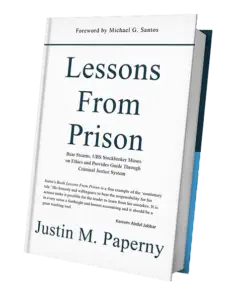
The Kingpin shows how daily routines, prison interactions, and conduct affect time served and transfers.
Note: The chapter below is reproduced exactly as I wrote it inside Taft Prison Camp in 2008. The summaries, FAQs, and modern context appear after the chapter for clarity.
Daily Routines, Conduct, and Social Structure in Federal Prison
This chapter documents how daily routines, social interactions, and conduct operated inside Taft Prison Camp. It records specific schedules around meals, exercise, writing, sleep, and recreation, along with how prisoners chose to spend or avoid communal time. The chapter also shows how conversations with other prisoners conveyed information about sentence length, transfers, security levels, and the consequences of fights.
The chapter also includes detailed examples of diet restrictions, workout schedules, writing habits, group activities, and informal education offered inside the camp. It also shows how information about transfers, disciplinary outcomes, and sentence completion circulated through direct conversation rather than formal instruction. Specific outcomes discussed include serving approximately 12 months of an 18-month sentence, conditions that trigger transfers, and how conduct affects remaining time.
The Kingpin
Over the days to follow, I settled into my own regular routine with Arthur. Each morning I joined him for breakfast. He disciplined himself with his diet as well as he disciplined himself with exercise. Arthur would limit his intake to black coffee, bran cereal or oatmeal in the morning. After our workout he ate a slice of whole-wheat bread with a thin layer of peanut butter for the protein. Then he would eat an apple. In the early evening, Arthur had a rapacious appetite for beans, brown rice and tuna. He would not touch chips, anything fried, or cheese. The man was fanatical about health and fitness.
Prison, I was learning, would bring me an opportunity to reevaluate the patterns of my life. With my childhood commitment to baseball, I grew up with an appreciation for the virtues of discipline, honor and a sense of ethics. As I matured, those values carried me through my college years at USC. Yet when I ended my baseball career, I lost sight of those values. Instead of thinking about how much I would have to invest in order to reach my highest potential, I started obsessing about making money.
As I was growing up, all I thought about was how I could make a better contribution to the team. I surrounded myself with friends who shared those same values. Before I slept at night, I’d begin thinking about what improvements I could make the following day. And when I played well on the field, I always felt as if the team as a unit had won the victory.
That attitude really began to wash away as I entered the brokerage industry. I still remember my cousin, Todd Goodman, advising me to continue my education through
graduate school. That eagerness to begin earning an income clouded my judgment. As a consequence, I found myself taking every shortcut possible. I had no loyalty to the profession. My interests were not in the building of a sterling reputation as a man of integrity, balance and discipline. My interests did not extend beyond the size of my check. I had no problem compromising the principles of good character if I believed I could advance my income.
My role models included my friend Brad Fullmer and my brother Todd. They lived differently. As a professional athlete, Brad worked harder than anyone I knew. He didn’t only focus on developing his fielding or hitting talents. Baseball was his life, so he worked exceptionally hard to develop his fitness. Brad ran hard, he lifted weights, and practiced and trained all year round to ensure that he could make the greatest contribution to his team.
My brother, Todd, worked equally as hard in developing the business he was taking over from our father, and in providing for his wife, Sunny. Together they intended to build a family, and Todd devoted himself to building an enduring prosperity. He worked 12-hour days at his store, and along with his wife, Sunny, Todd diversified by building a family empire of rental properties.
Both Brad and Todd understood a parable that has held true for centuries, and that I was reminded of in prison. As shown in the legendary race between the tortoise and the hare, slow and steady always won the race. Those who constantly worked to reach their highest potential, and remained true to a core set of values, never fell off course. The key to success came through an understanding of values in life, and staying relentless in a commitment to add value through daily pursuit of incremental goals.
As I spent time with Arthur, I saw a similar contentment. He had already spent his first year in prison, yet he wasn’t involved in any nonsense. He knew what he wanted and he pursued his goals with a deliberate focus.
Television or table games were not a part of his day. His exclusive interest was in fitness and writing his memoir. To that end, he applied himself to exercise. He restricted his diet and he devoted several hours each day to writing and reading. Arthur was in bed before eight each evening, oblivious to the pandemonium of the housing unit.
Arthur became my first role model in prison. I admired his discipline. As I lay in my rack at night, I thought about how I could emerge after my prison journey had concluded. Ever since I had finished college, my focus had switched from the long-term values that led to victory to short-sighted pursuits of higher commissions. I lived a penny-wise and pound-foolish life. I remember Todd Goodman telling me in disgust, “You mean you left Bear Stearns for a lousy bonus check at UBS? There’s a lot more to this profession than a quick buck.”
Brad was the same way. When I once asked him why he trained so hard during the off-season, he answered without hesitation. “I’m a major leaguer. The team pays me well to be the best I can be. The fans pay to see excellence. I owe it to them to work hard all year round. That’s what I do.”
Role models showed me that looking at the long term would lead to success. My life had spun into chaos as a consequence of losing focus. It led to unhappiness in my career, an unhealthy lifestyle, and an abandonment of good ethical conduct. While serving my time in prison, I resolved myself to live a more principle, centered life.
Like Arthur, I intended to discipline myself with a direct commitment to exercise. I pledged that I would drop the weight that had bogged down my body and mind for so many years. Conversations with other prisoners helped me understand that with the accumulation of credits for good conduct and a few months of halfway house placement, I could expect to serve approximately 12 months of my 18-month sentence in prison. When I finished, I intended to leave as a better man then when I had begun. My first goal was to improve my physical fitness.
I was well into my first week of confinement when I walked into the large room with three televisions. The middle television was broadcasting CNBC, and I stood there for a few minutes during the late morning for a glimpse of the ticker. The man Drew had referred to as the kingpin was sitting in a chair beside me. “How you doing, bud?” I was surprised to hear him speak, and looked around to ensure he was speaking to me before I shook my head in greeting and said I was fine.
“Just come in?”
Why was the Kingpin talking to me, I wondered. I felt a bit guarded, though he seemed friendly enough. “Yes, I self-surrendered this past Monday.”
“I’ve seen you around, figured you were new. Do you need anything to settle in?”
“No, no. Thanks for asking. I think I’m fine for now.” Although both Drew and Arthur had helped me out by lending a few necessities until I could shop in the commissary, I remembered that my friend, Walt, had warned me about accepting favors from people I met in prison.
“My name is Michael Santos,” he extended his hand in greeting as if we were colleagues of some sort. He didn’t have the mannerisms I would have expected from a man who had been locked in prison for 21 years.
“Justin Paperny.”
“How long are you going to be with us?”
“Not long. I’m serving 18 months.”
“Eighteen months,” he repeated. “You’ll see that the time passes really fast here. The sentence will be over before you know it. In fact, I’ll do the time with you.”
Obviously, he could sense that I was just getting myself together, and he was trying to set me at ease. He asked if I traded stocks. When I told him that I had been a broker, Michael opened a conversation about the state of the market. He didn’t sound like a man who had been in prison for decades. In fact, if he were wearing a suit and tie, I wouldn’t have been able to distinguish him from any businessman I’d ever met.

Michael was surprisingly open with me, and his candor had a charm to it, disarming my suspicions with tact. He told me that he had been convicted in his early 20s for leading a group that distributed cocaine and that he had been working hard ever since to redeem those bad decisions. The conversation that began in that television room of Taft Camp continued throughout my stay in prison. Surprisingly, it launched a new focus and growth in my life.
Later that evening, I took a few laps around the track with Bob, an inmate who was responsible for leading the Jewish community at Taft Camp. Bob coordinated the Friday gatherings and also presided over a discussion group. I found many social-type activities in the camp. On Monday mornings a public speaking group held meetings in the visiting room. Inmates with knowledge on individualized subjects offered other classes or workshops to introduce topics like investing, real estate or Eastern meditations. Such diversions, I learned, could help inmates cope with their separation from family and community while simultaneously educating or entertaining themselves.
“Do you know this guy they call the Kingpin?” I asked Bob as we walked the oval track.
“I know who he is, we haven’t ever spoken. He seems kind of standoffish, aloof.”
“What do you think of him? I mean, I wasn’t really expecting that I’d be serving time alongside real criminals. We spent a few hours talking today, and he seems like a normal guy.”
“I don’t buy it,” Bob said. “I’ve read one of his books. The guy’s been locked up since the 1980s and he served time in some of the toughest prisons. Think about it. A judge sentencing a kid in his early 20s to 45 years . . . doesn’t happen. Miami background? Cocaine? I hear he’s Cuban. Probably off’d some people. Maybe didn’t do it himself, but couldn’t you see him giving the order to have some guy clipped?”
My conversation with Bob shook me a bit. My experience had prepared me to interact with businessmen and professionals. I didn’t know much about judging the character of men in prison. Yet I was assigned to live in a housing unit with 150 other felons. We’d be sharing the same showers and toilets, eating at the same tables, watching television broadcasts side by side. I would have to get along.
“Do you play chess?” Michael caught me as I was walking into one of the unit’s quiet rooms where he was seated. He had a dictionary and a thesaurus open on the table and he appeared to be working alone.
“I do.”
“Care to sit for a game?” He gestured to another table with a chess set on the surface. “I need a break. Been writing all day.”
“Sure. I’ll sit for a game.”
“Have you played much chess?”
“While I was on bond waiting to come in, I played chess online for hours each day.”
“Wish I could do that. The Internet wasn’t in existence when I came in. I’ve never accessed the Web directly, but I’ve got a fairly active Web presence out there. I write about the prison experience for guys like you. Did you see any of my work before you came in?”
“No, I wasn’t looking for any information about prison. I just figured I’d learn about it when I came in.”
“That’s a real challenge for me. I know that I have a lot of valuable information to help people who are struggling through the criminal justice system. I’ve been living in prisons for my entire adult life, and I write about the experience as if I’m an open book. It’s tough for me to reach my audience from here.”
Our chess game advanced well, though I felt as if I had the upper hand. During those months prior to my imprisonment, I withered away hundreds of hours playing chess on my computer. Still, I moved my pieces with tentativeness. Despite Michael’s ease of conversation, Bob’s theory that the guy may have had someone clipped kept me vigilant about the possibility that I was playing with some kind of master criminal.
“How do you post your writings on the Internet if you don’t have access to the Web or computers?”
“I write the content out in longhand, then send it to my wife. She types and posts it for me.”
“You’ve been in prison for 21 years and you’re still married? How does that work out?”
“I haven’t been married the whole time. My wife and I came together in 2002. We married in a prison visiting room.” Michael told me his story while casually moving the chess pieces. I was already up a pawn and felt that I was close to stealing his bishop.
“How did you meet a woman who would marry you while you were in prison? I hope that’s not too personal, but that hardly seems possible.”
“Not at all. Prison has kind of become my life. I write about it and talk about it all the time. My wife’s name is Carole. We went to school together from fifth grade through high school. After graduation we kind of lost touch. It wasn’t until about 15 years later that she came back into my life. Carole read something about my work and that inspired her to write a letter. Her letter led to correspondence, and in time, a romance. I was incarcerated in New Jersey at the time and she moved in order to nurture our relationship through visits. We married in that prison’s visiting room, and she’s been moving around from prison town to prison town whenever administrators have transferred me.”
I knew I had Michael beat in the chess match. But I felt intrigued with the story he was telling. The thought of a guy spending his life in prison while still managing to build a family and an Internet presence made it sound as if conquering the system wasn’t anything at all. Still, he might not respond well to losing, I thought. I gave up a pawn to kind of even things out in the game.
“Why do administrators transfer guys from prison to prison?”
“There are all kinds of reasons. When Carole and I were married, I was being held in a low-security prison. Later, my security level dropped to minimum. With the new minimum-security classification, the administrators had to transfer me from inside the fences to a camp.”
“Do you think they’ll ever transfer me?”
“Your sentence is short, and like I told you before, the time is going to pass a lot faster than you think. You will likely serve your entire sentence here. The only reason administrators would transfer you would be if you got into some kind of trouble.”
“Like what? What could happen that would lead to a transfer?”
“You could get into a fight with someone.”
“Well, I suppose, but why would I get in a fight?”
“Come on,” Michael smiled. “You’re in prison. This may be a camp but anything can happen. Although you can control your own behavior, you can’t control the way the others behave. We’re sharing space with hundreds of guys, many of whom are high strung, not quite all there. They can’t handle the stress. Maybe a guy called home and heard a man’s voice. Maybe some guy’s wife just dumped him, or a family member died, or his kid won’t talk to him. Maybe he felt patronized by the system. Any number of things could make a guy lash out. Fights can sometimes begin without anyone expecting it. If anyone is caught fighting in the camp—and it doesn’t matter how it begins—both guys get transferred unless there are special circumstances.”
That was it. I decided right then that I was throwing the chess game. I made a move that I knew would result in the loss of my queen. I wasn’t about to aggravate a guy who had been in prison for so long.
“Have you been in many fights during all the time you’ve served?”
“You might want to rethink that move, bud. If you advance that knight, I’m going to get your queen for free.”
“Oh, you’re right, my mistake. Your game.”
“No, no. You’re playing well, you’re really ahead. Take the move back. Try something else.”
“It’s okay. The rules are the rules. I moved the piece already. We’ll just let it play out. I can still play without my queen.”
“You sure?”
“Yeah, go ahead.” I may have been giving up the most powerful piece on the chessboard, but at least I wouldn’t be feeding into any of the unexpected tension he was describing.
“To answer your question,” Michael said as he continued with the game, “I haven’t been in a single fight during all the years of my imprisonment. Not one.”
“How did you manage to avoid them?”
“By understanding my environment. I knew that I was serving a long sentence, but I wasn’t serving a life sentence. Someday these gates would open for me, and I wanted to ensure that I would feel ready for the challenges that would await me. I set clearly defined goals, and my commitment to achieve those goals required that I adjust in ways that would minimize my exposure to potential problems. I relied on that strategy from the beginning, and I continue to rely upon it today. Check.”
Michael had pinned me with a pawn. I saw the move coming, but I feigned surprise. One more move, I knew, and he would mate me with his rook. “It’s your game,” I said, while tipping my king over.
“Do you want to play again?”
“Not now,” I said. “I’d like to hear more about your experiences through prison, and the strategy that has guided you through so many years.”
Top Misconceptions
- Prison days are unstructured and dominated by television and games
- Long-term prisoners are disengaged from writing or planning
- Accepting favors is routine and without consequence
- Fighting only leads to discipline for the person who starts it
- Prison transfers happen randomly or without explanation
If You’re Facing a Federal Investigation or Prison…
- Where daily routines are described in detail
- How diet, exercise, writing, and sleep schedules are structured
- How conduct violations affect transfers
- How sentence length influences placement
- How information about prison rules is shared through conversation
FAQ
What activities were avoided by some prisoners?
Television viewing, table games, junk food, fried food, and cheese.
How did writing reach the Internet from prison?
Content was written by hand and mailed to a spouse, who typed and posted it online.
What causes a prisoner to be transferred from a camp?
Fighting, regardless of how it begins, unless special circumstances exist.
How are sentence length and transfers related?
Short sentences are usually completed at the same camp unless trouble occurs.
What group activities existed in the camp?
Public speaking meetings, religious gatherings, discussion groups, and topic-based classes.
How are security levels connected to transfers?
A change from low security to minimum security required transfer to a camp.