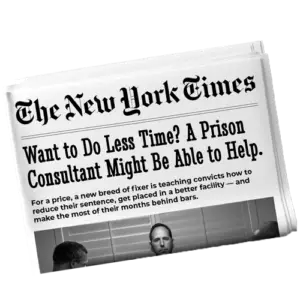
By Matt Bowyer, who reported to Lompoc Federal Prison Camp in October, 2025 and was released in March, 2026.
The morning I drove to Lompoc Federal Prison Camp, my wife and I did not say much. Simply said, I was ready to get started.
I learned pretty quickly that Lompoc Federal Prison Camp is not the worst place in the federal system. But it is still federal prison. Anyone who goes in thinking otherwise is already behind.
What Lompoc Federal Prison Camp Is (and Is Not)
Lompoc Federal Prison Camp is a minimum-security facility on the grounds of a larger complex that includes FCI Lompoc I and FCI Lompoc II, which are medium and low-security institutions. The camp is a separate building and population. People at the camp are not locked in cells. They move around. They work. They go to meals, the yard, and the library on a schedule. The perimeter is not fenced with razor wire the way higher-security prisons are.
None of that means it is easy or as some would say, “Club Fed”.
There are racial dynamics. There are unwritten rules. There are men who have been inside a long time and men who walked in last week and have no idea how to read the room. There are tensions that have nothing to do with you personally but can still pull you in if you are careless, naive, or trying too hard to fit in (this was a bigger problem than being naive).
I saw men make their time harder within the first week because they talked too much, bragged about the wrong things, or assumed the rules of the outside world applied inside. They do not.
Who Qualifies for Federal Prison Camp
This comes up constantly, and most of the answers online are incomplete. The Bureau of Prisons uses a point system called the Public Safety Factor scoring to determine where someone serves their sentence. A sentence to a camp is not guaranteed just because the judge did not order a higher-security placement.
Generally, to be designated to a federal prison camp, a person needs a low criminal history score, no history of violence or escape, and a sentence that falls below a certain threshold. But the BOP has discretion. So does the prosecutor, who can recommend against camp placement. And so does the judge, who can recommend camp but cannot order it.
If you are counting on camp make sure you fully understand the qualifications and implications of the probation report. Do not assume. Thankfully, I got my designation about 21 days after Judge Holcomb sentenced me to 12 months and one day in prison.
What People Get Wrong About Lompoc Federal Prison Camp
The word “camp” misleads people. They picture something between a retreat and a setback. They hear about men walking laps and doing push-ups and decide it sounds manageable. People presume it is party time.
That framing skips over what actually happens when you put hundreds of anxious men in a confined space.
Boredom is real. Idle time creates friction. Men who do not have a structure to their day drift into gossip, conflict, or just slow deterioration. I watched men spend months complaining about their cases, waiting for appeals that were not coming, and coming out of the experience weaker and more bitter than when they went in.
The men who moved through Lompoc Federal Prison Camp quietly usually had a few things in common. They showed up with a written plan. They kept a routine. They did not try to impress anyone. They thought about the day they were walking out before that day arrived. They put their family first.
How I Prepared Before Reporting to Lompoc Federal Prison Camp
I worked with Justin Paperny at White Collar Advice before I surrendered. Justin had served 18 months at a federal prison so he was not guessing at what I was about to experience.
The first thing he said to me was close to this: stop looking for someone else to blame. Not the lawyer. Not the judge. Not the market conditions. Me. I made the choices that put me in that car driving from Orange County to Lompoc. If I could not start from that place, the rest of the preparation was going to be useless.
After our first meeting in late 2023, Justin helped me think through each stage before it arrived: sentencing, surrender, the first days inside, daily life, halfway house, home confinement, and release. We talked about how to carry myself, how to stay out of nonsense, how to ensure the time served me.
I did not walk into Lompoc Federal Prison Camp hoping it would go well. I knew it would.
Daily Life at Lompoc Federal Prison Camp
The days have a rhythm. Count times, meals, work assignments, and movement are on a fixed schedule. Outside of that, you have time you can fill or waste.
I kept my mornings structured. I read in the early hours before the camp really got going. I took my work assignment seriously (I did it with pride) instead of looking for the easiest way to get through it. I stayed out of conversations that were going nowhere. I wrote letters to my family. I was not going to succumb to boredom.
What surprised me most in the first week was how much energy it took just to stay focused, calm, not get involved in utter non sense. Everything was unfamiliar, the sounds, the light, the people, the schedule. My instinct was to scan for threats. Justin had told me that would happen and to just let it pass without reacting. He was right. By week three, the environment felt less disorienting. By month two, I had a routine that kept me steady.
The men who struggled at Lompoc Federal Prison Camp were usually the ones who treated every day as something to endure rather than something to use. That approach is understandable. It is also expensive.
What Comes After Lompoc: Halfway House, Home Confinement, and Release
Most people focus on getting to prison and just getting through prison. They do not spend much time thinking about what happens after.
That is a mistake.
Halfway house is its own adjustment. Home confinement has its own restrictions. Coming home with a federal conviction is its own challenge. Work, money, restitution, relationships, reputation: all of it starts before you leave Lompoc Federal Prison Camp, not after.
Justin pushed me to think about those things while I was still preparing to surrender. By the time I came home, I had a plan for the first 90 days. I was not starting from zero. That made the transition less chaotic than it would have been if I had spent my sentence just waiting for it to end.
How White Collar Advice Is Different From Your Attorney
Your attorney handles your legal defense. That is their job and it matters. I had a great lawyer, Diane Bass.
White Collar Advice does something different. Justin and his team works with people to build the personal record that surrounds the legal case: the narrative the judge reads in the PSR, the way a person carries himself through the system, the preparation for prison and the preparation for coming home. That work does not replace legal counsel. It runs alongside it.
What Justin gave me was not useless talk about staying positive. It was a clear look at what I was about to face and a concrete way to approach each stage before it arrived. If you are headed to federal prison and you are still trying to figure all of this out on your own, that approach is probably costing you more than you realize.
My Advice Before You Surrender to Lompoc Federal Prison Camp
Start earlier than you think you need to.
The men who do best at Lompoc Federal Prison Camp are not the ones who had the best attorneys or the most connections. They are the ones who came in knowing what they were walking into, took responsibility for being there, kept their routine tight, stayed out of nonsense, and thought about their life after prison before their sentence ended.
That is available to anyone who prepares for it.
Matthew Bowyer
Frequently Asked Questions About Lompoc Federal Prison Camp
What is the difference between Lompoc Federal Prison Camp and FCI Lompoc?
The Lompoc complex includes three separate facilities: FCI Lompoc I (medium security), FCI Lompoc II (low security), and Lompoc Federal Prison Camp (minimum security). The camp is a separate building and population. People assigned to the camp are not housed with the medium or low-security populations. If you are trying to understand which facility you or a family member has been designated to, check the BOP Inmate Locator at bop.gov, which will show the exact institution code.
Who qualifies for federal prison camp?
The BOP assigns people to facilities based on security level scoring. Factors include criminal history, the nature of the offense, length of sentence, and any Public Safety Factors such as prior escapes or violence. A low score across those factors can lead to a camp designation, but it is not automatic. Prosecutors can object and the BOP has its own discretion. White Collar Advice can give you a more specific read on where you are likely to end up.
What should I bring when I surrender to Lompoc Federal Prison Camp?
The BOP publishes a list of what is permitted at each facility. Generally you can bring a small amount of cash (which gets deposited into your commissary account), prescription medications with documentation, a wedding ring, and religious items. Most personal items are not allowed. Confirm the current rules directly with the facility or through your attorney before your surrender date because these can change. You can also read WCA’s top 10 self surrender checklist.
How long is the halfway house period after Lompoc Federal Prison Camp?
Halfway house placement under the First Step Act can be up to 12 months, though the actual placement varies by individual. Factors include sentence length, institutional behavior, programming completed inside, and your reentry plan. A case manager inside will typically discuss halfway house options during your team meetings. Building a strong record while at Lompoc Federal Prison Camp directly impacts how quickly you go home.
Can family members visit at Lompoc Federal Prison Camp?
Yes. Lompoc Federal Prison Camp has visitation, though schedules, approved visitor lists, and procedures follow BOP rules. Visitors must be pre-approved and on your approved list before they can visit. Contact the facility directly or check the BOP website for current visiting hours and procedures, since these change and vary by institution.