CZ wrote Freedom of Money while serving a federal prison sentence, on a terminal that shut off every 15 minutes and wiped his work each time. He wrote pages by hand first, then re-entered them. Michael Santos, who served 26 years in federal prison, was there to support him throughout his prison term. This is my review of the book and why everyone involved in a government investigation should read it.
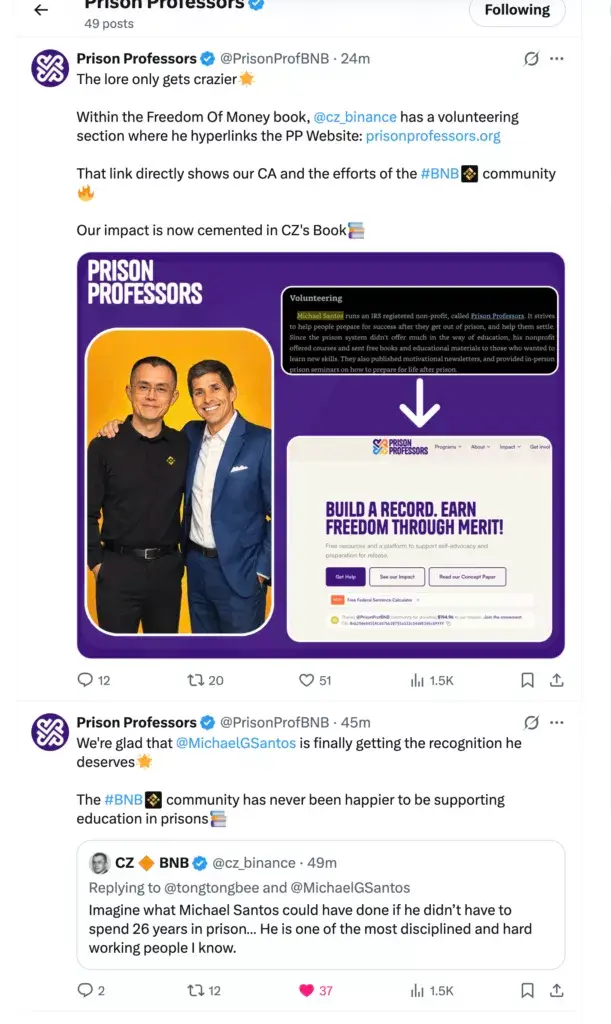
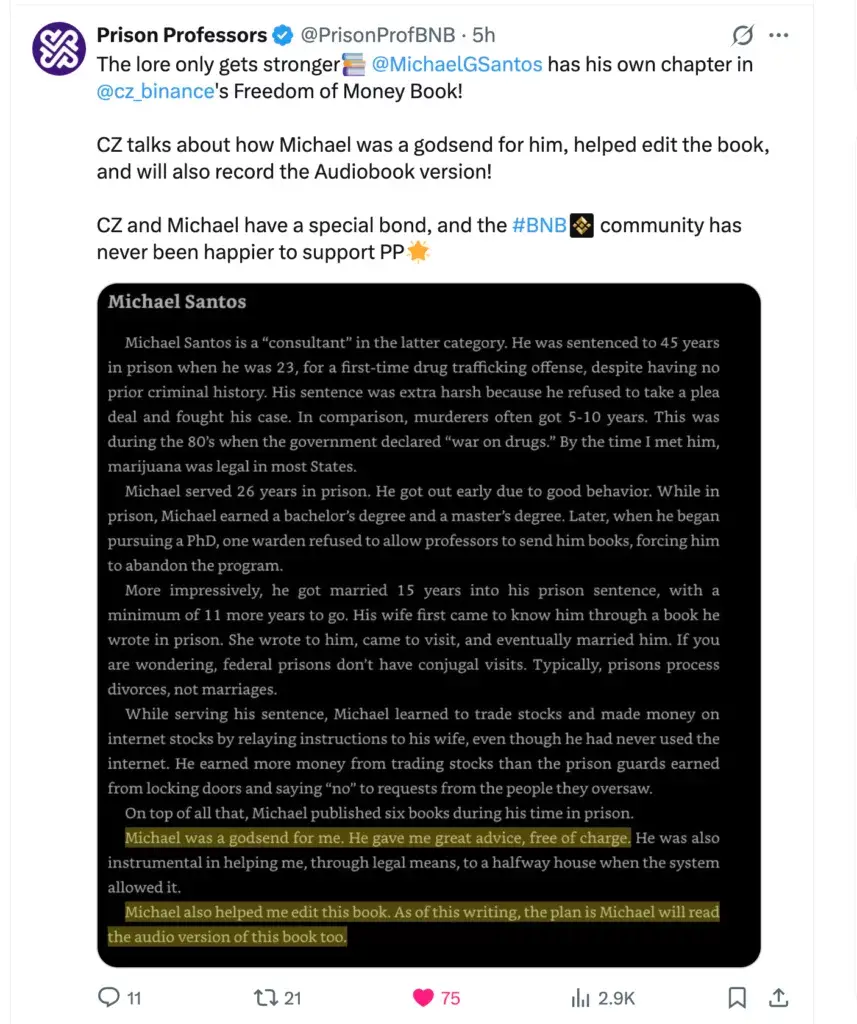
I read Freedom of Money because CZ has had an enormous impact on the world, and a direct impact on Prison Professors Charitable Corporation, an organization I support and believe in. He mentions Michael Santos throughout the book, calling him a “godsend.” Michael helped edit the manuscript during the four months CZ served his federal sentence. When the audiobook releases, Michael narrates it. CZ has publicly committed nearly $2 million to Prison Professors.
CZ and Michael come from completely different worlds. CZ grew up early in his life without running water, the nearest well about 300 meters away, his family showering a few times per season in the winter, his father away for long stretches. The book goes into great detail about how that life conditioned him to find gratitude and it set him up for the resilience he needed later in life.
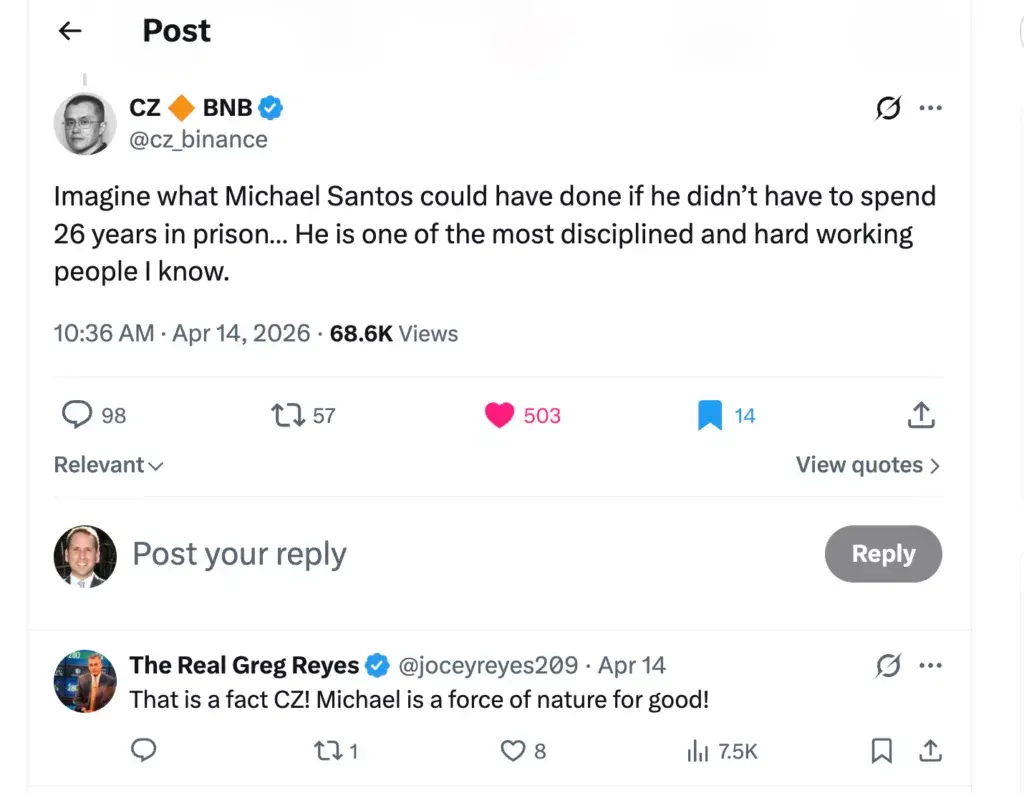
Michael received a 45-year sentence at 23 for a first-time drug offense during the war on drugs and served 26 years. Different eras, different countries, different circumstances. They share the same values: contribution, discipline, resilience, integrity. CZ said publicly on X that Michael is one of the most disciplined and hardworking people he knows. His $2 million commitment to Prison Professors is consistent with that.
I support Prison Professors because the work is specific: help people build a documented record they can use to earn higher levels of liberty. Here is a man who surrendered to Lompoc Federal Prison already working on a manuscript, who kept building under conditions designed to obstruct, and who walked out with an asset he could share with the world. Regardless of your environment you can make choices that enable you to build.
What Did CZ Actually Do Inside Federal Prison?
Before surrendering to federal custody, CZ had already begun the manuscript that became Freedom of Money. Once inside, he kept working on it. Michael writes that the prison system left him with a primitive terminal that shut off after 15 minutes and would not retain what he had written. CZ adjusted by writing on paper first, then going back to the terminal to enter what he could. Michael also writes that CZ sent him pages each day that later became part of the manuscript.
What Does This Mean for Someone in a Federal Case Right Now?
A lot of people in a federal case still live as if the rebuilding work can wait. After sentencing. After designation. After the lawyer says now. Then they look up and six months are gone. They have opinions, explanations, fear, anger, self-pity, hope. What they do not have is much on paper.
Michael’s first lesson fills in some details that belong in any serious discussion of this book. He writes that while CZ served his sentence, he stayed productive. He writes that CZ did not have access to much modern technology and found ways to use the resources available to him. This is relevant because rather than for perfect circumstances, CZ started. It is not about perfection, but using each moment wisely, always focus on the opportunities that exist. Indeed, in the book CZ writes something akin to, “there are always more opportunities in front of us, then behind us.”
That same first lesson also reaches back before prison. Michael includes the story of a friend telling CZ to stop spending so much time on golf and poker. CZ listened. Michael connects that decision to what came later, including Binance. I like that story because it shows the prison writing was not some burst of discipline that appeared only after sentencing. The pattern was already there. Cut what wastes time. Put the hours where they count.
I see the opposite pattern constantly. Defendants who had the same choice CZ had, the same choice Michael made at 23, and waste time. Not because they are bad people. Because the federal system is designed to wear people down. CZ writes about that directly. A counselor told him, smiling, that ICE had placed a detainer on him again, which meant he would not be eligible for the halfway house. The institutional culture blocked family visits, mail, and access to books. The system obstructs. Most people let it win. CZ did not.
Michael’s third lesson about lessons he learned from CZ, “Don’t Waste Time,” gives more of that prison detail. He writes that many people let prison become a lifestyle. Television. Games. Gossip. Routine. He says CZ walked in with a goal, stayed focused on the task, and by August 13, 2024, when Michael drove with CZ’s sister and friend to Lompoc to pick him up, the manuscript had been fully roughed out. The only chapters not fully developed inside were the ones describing the prosecution and imprisonment.
Michael left prison for a halfway house on August 13, 2012. Exactly 12 years before he drove to pick up CZ. I have spent enough time around Michael to know he did not mention that date by accident. It shows the power of building through decades and how his journey would continue to benefit people seeking guidance, including CZ, me and millions of other in prisons and jails who benefit.
That is one reason I think the book deserves attention from the people we serve.
I am not interested in telling a defendant, “go write a memoir.” That is not the point. The point is much narrower. A person can enter prison with a project underway and leave with something finished or close to finished. That is different from spending months talking about intentions and calling that preparation. CZ let the time serve him. If he can do it, why not you?
What Does CZ’s Book Reveal About How He Makes Decisions?
Michael’s second lesson in his X series adds a different side of the book. He titles it “Mission Before Money.” He starts with long-term value, then moves into CZ’s handling of CoinMarketCap. Binance had a business reason to solve the problem. People were leaving the platform to get information elsewhere. Binance tried building Binance Info. Users still preferred CoinMarketCap. Michael writes that CZ accepted the lesson, later acquired CoinMarketCap, kept it independent, and removed ads that hurt the user experience even though doing so turned a profitable business into what CZ described as a cash-burning one while the team rebuilt it.
That section belongs in a review because it shows how CZ makes decisions. He is not only writing about money. He is writing about stewardship, utility, trust, and the long horizon. Michael also pulls one sentence from the manuscript that I suspect a lot of readers will underline:
“Instead of chasing money, provide value.”
He follows that with another example from Binance’s early days, when the company made users whole on losses tied to projects it did not own and had no legal obligation to reimburse. Michael draws the lesson this way: do the right thing, not the easiest thing.
That makes the book broader than a prison story. The prison section shows progress despite restrictions. The CoinMarketCap section shows judgment when there were more options, more money, more room to maneuver. I found both useful.
In my criminal case, I made a different decision. I took a shortcut, told myself it was justified, and eventually I went to prison. CZ made a different decision when he had every reason to take the easier path.
Michael’s third lesson also adds a detail from before prison that fits. During the COVID era, while recovering from back surgery in Berlin, CZ mounted his phone so he could keep communicating with his team from a hospital bed. Different setting. Same refusal to sit around waiting for conditions to improve.
Why Should Someone in a Federal Case Read Michael’s Three Lessons?
People reading this because they are in trouble with the government do not need a lecture from me. They need examples they can learn from, someone they can identify with. Michael’s three lessons help with that because they pull real life examples and make them easy for readers like you and me to understand.
For example,
In Lesson 1, there is a detailed “asset building” plan. No delays or excuses.
In Lesson 2, there is a business decision that favored trust and user experience over short-term revenue.
In Lesson 3, there is the prison system doing what it does, and there is a man who kept working anyway.
We can learn from CZ because he is authentic and through his actions can tell he did the work. And now the world gets to benefit from the valuable lessons he shares. You should also visit Michael’s series on X and read all three posts themselves:
Lesson 1: Impact, Discipline, and Lessons I Learned from CZ
Lesson 2: Mission Before Money
What Does CZ Write About Time in the Appendix?
One more point from the book deserves mention. In the appendix, CZ writes that time is more limited than money. He writes that people should stop chasing money and provide value. He writes that success comes from doing a few important things well rather than scattering attention. Michael keeps returning to those same ideas in the series.
I work with enough defendants to know how easy it is to talk yourself into delay. You tell yourself you are thinking hard. You tell yourself you are preparing. You tell yourself you will get to it once the next legal event passes. Then there is very little to show for the time.
That is why this book held my attention.
Not because of the celebrity around CZ.
Because there is a manuscript.
Because there is a documented record written by someone whose second language is English.
Because there is a sequence anyone can follow.
That is what I took from Freedom of Money.
Freedom of Money is available now on Amazon. Michael Santos narrates the audiobook.