Table of Contents
A firsthand look at what happens when a defendant stops hiding, pleads guilty, and begins the federal cooperation process.
Note: The chapter below is reproduced exactly as I wrote it inside Taft Federal Prison Camp in 2008. The summaries, FAQs, and modern context appear after the chapter for clarity.
Table of Contents
- Delays and Missteps in Federal Cooperation
- Accepting Responsibility
- Top Misconceptions
- If You’re Facing a Federal Investigation or Prison…
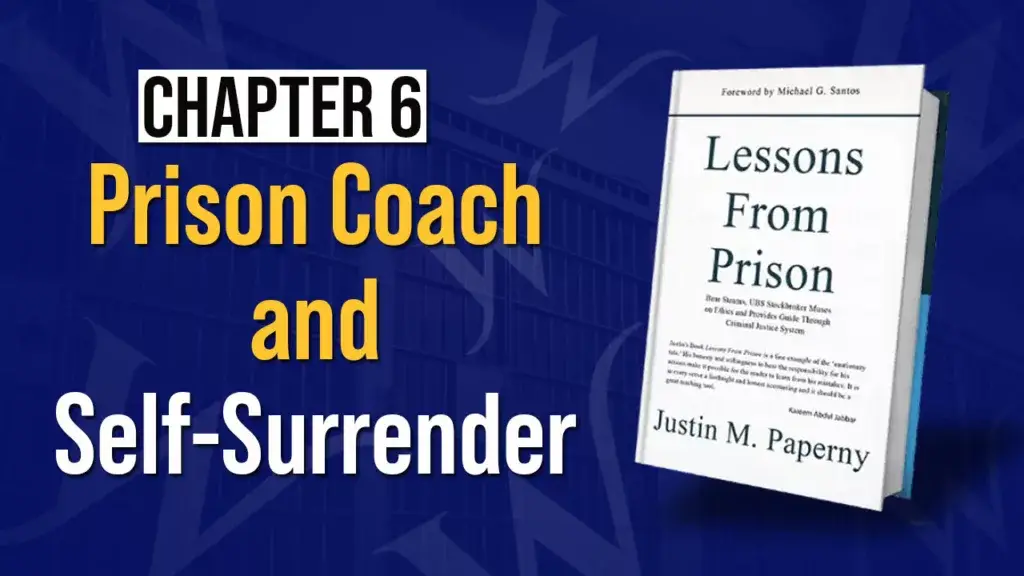
- Prison Coach Role Prior to Self-Surrender to Prison
Delays and Missteps in Federal Cooperation This chapter shows how I delayed telling the truth. I convinced myself I could manage the situation and that the government would focus elsewhere. That delay cost me two years, a lot of legal fees, and problems I created by not accepting responsibility sooner.
I didn’t understand federal cooperation early on. I saw it as weakness, or as turning on someone else. I didn’t see it for what it was. I didn’t understand it was part of the process. Prosecutors want clarity. I didn’t give it to them, and that cost me two years.
This chapter also shows the pressure that hits when you realize you’re the last one still telling the same story. Gilabert, Kyle, and UBS had already made their moves to protect themselves. I hadn’t. When I finally cooperated, it wasn’t a strategy. It was damage control.
If you’re in a federal case, this is what to avoid: denial, waiting, and hoping someone else gets blamed. That thinking only makes things worse. Cooperation isn’t about looking good. It’s about telling the truth before you run out of time. I waited too long.
Register for our Tuesday federal sentencing and prison webinar:Join Webinar
Also, grab a copy of our new book,14 Costly Errors Leading to Longer Sentences.
Accepting Responsibility
Finally, more than two years after UBS fired me, I had had enough. I began to correct the bad decisions I had been making. Refusing to continue the charade, I agreed to plead guilty to one count of conspiracy to commit wire fraud, mail fraud, and securities fraud. Those criminal charges exposed me to the possibility of five years in prison.
Had I understood the severity of my problems from the beginning, I could have taken proactive steps to avoid my two-year slide into the abyss. I was naive, oblivious to the treachery and self-preservation I would encounter from my colleagues. While I made the bad decision to dissemble and try to minimize culpability, Keith Gilabert had his own agenda. He was the principal behind the GLT Hedge Fund. Gilabert was also a duplicitous fraud. He wove sinuous stories into what became a preposterous effort to fool prosecutors into believing that my partner and I were part and parcel to every egregious act he committed.
Besides Keith Gilabert’s patently absurd efforts to deceive prosecutors, my partner and mentor, Kyle Smith surreptitiously schemed behind my back to protect himself while hanging me out as a scapegoat.
Although Kyle was the lead partner and commandeered 50 percent of the commissions generated by Gilabert’s GLT Hedge Fund, Smith slithered his way into an agreement that allowed him to return to his position with UBS and avoid criminal prosecution.
Meanwhile, during the two years that I struggled to regain my sanity, officers at UBS plotted to shield the global investment bank from liability. All of those forces machinated, together and independently, to protect themselves from the harshness of justice while simultaneously forcing my demise.
In the end, prosecutors developed a clearer understanding of all that transpired. They found Gilabert’s self-serving explanations implausible when they discovered his ongoing deceptions. As a consequence, they rescinded the cooperation agreement his lawyers had negotiated and charged Gilabert with new criminal conduct. Officials at UBS skated by with an agreement to pay more than $6 million to compensate for loses investors had suffered in the GLT Hedge Fund. Kyle Smith kept his bonuses and commissions, but forfeited his conscience.
Prosecutors wanted me to corroborate the evidence they had pieced together from all the snakes in the pit. In contemplating the dilemma of whether to assist government attorneys with the investigation, I sought counsel from my attorney.
“This cooperating,” I asked, “does this make me a rat?”
“Why do you ask? Have you been watching The Sopranos?”
“Well, you say that by cooperating I may serve time in prison. I’ve heard that those with the reputation of being rats serve more difficult sentences.”
“We can’t undo the past, Justin. Had you been the first to accept responsibility, and told the truth from the beginning, you could have been the one with the immunity agreement. You’re coming to the party two years late. It’s not too late, but it’s late. We can’t say for certain what kind of sentence you will serve, but if you’re truthful, you likely will serve your time in a minimum-security camp with nonviolent offenders.”
I had to make a decision, and I chose to cooperate. That was the decision I should have made from the start. After all, I was wrong. I had agreed to facilitate Gilabert’s swindle. When I came to learn that he was bringing in new money from unsuspecting investors to cover losses with other investors, I should have reported such illegal manipulations to my superior and to authorities. By the time I had become aware of the fraud, I was in too deep, trapped. Seduced by instant gratification, I seized opportunities as they presented themselves; I rationalized away my culpability.
While serving time in federal prison, I met many men who pleaded guilty to white-collar crimes. We walked around the track together, exercised together, and discussed the decisions we had made. Without exception, each white-collar offender with whom I spoke regretted that he didn’t know more about the options available.

I began writing with hopes of filling that void, and as a form of therapy while working through the sentence. As my attorney told me, the best cooperation agreements came to those who accepted full responsibility the soonest. Equally important to receiving the least onerous sanction, however, I found value in the catharsis that came with honesty. During those first two years that followed my abrupt termination as an executive at UBS, I was spinning a web of lies. Consequences came with that irresponsible approach.
I began by lying to my family, trying to convince them I had left my career voluntarily. I lied to my closest friend and to everyone with whom I came in contact. Perhaps worst of all, I lied to the attorneys whom I had paid a substantial sum to represent me. Then I felt I had no alternative but to mislead government attorneys with lies when I took questions from them. My thoughts were that I could control the damage and since government attorneys were not questioning me under oath, I was not compelled to answer truthfully. I was wrong.
My ignorance of the law was not a valid excuse for the new felonies I created by lying to federal law enforcement officers. Although I may not have been responding to questions under oath, and thus was not in danger of perjury charges, lying to law enforcement officers is a crime in and of itself. Such lies violate Title 18 of the United States Criminal Code, Statute 1001, exposing offenders to five years of imprisonment for each lie.
I didn’t learn that information until far later than necessary. Equally as bad as lying to federal attorneys were my efforts to conspire with others to lie. When government investigators wanted to question one of my friends about my actions, I coached him on what to say. Those efforts to manipulate the government’s case exposed me to additional criminal charges known as obstruction of justice.
We’ve all heard clichés of the Miranda warning. It requires law enforcement officers to recite that dreadful warning all Americans know. Those who hear the Miranda warning should know that anything they say to a law enforcement officer can and will be used against the individuals in a court of law. It’s serious. An individual does not have to talk with a government attorney or law enforcement officer. But if that person chooses to talk at all, he ought to tell the truth. That gem of truism escaped me until it was too late. In federal prison, I met many others whose lies magnified their problems.
Besides further exposure to criminal sanctions, living a web of lies had undeniable biological effects on me. For two years I couldn’t sleep without taking sleeping pills, which left me groggy the following day. I ate too much, smoked too much, felt irritable and paranoid. I played out every scenario in my mind except the one that made the most sense. The truth shall set you free.
My attorney was correct when he told me that I was late to the party. Had I accepted responsibility for the bad decisions I made at the outset, I would have assuaged my troubles with the criminal justice system. Likewise, however, I would have spared myself the anxiety and stress and expense that nearly ruined me as I was spinning that two-year web of lies. Many white-collar offenders I met in prison expressed the same sentiment.
Once I decided to come clean and cooperate, I felt a cathartic release, as if the truth about my criminally wrong indiscretions purged the anxieties that had been tormenting me for so long. Suddenly, those worries about what was going to happen didn’t plague me. By speaking honestly about my culpability in the offense, I felt as if I were taking the first steps to climb out of the hole I had been digging for myself.
During the year that followed my guilty plea, I had to tell and retell my story. I had to speak with FBI agents, U.S. attorneys, and attorneys from the Securities and Exchange Commission. I had neglected my duties as a financial professional. Decisions I had made enabled Gilabert to perpetuate his fraud with the GLT Fund, and as a consequence, I aided and abetted the loss of millions for unsuspecting investors. Those were criminal actions, and speaking honestly about them began the process of redemption, of healing.
As part of the legal settlement, UBS forked over the money to make all investors whole. In an effort to demonstrate remorse for the consequences of my actions, I liquidated my individual retirement account to contribute $100,000 to a restitution fund. That voluntary gesture of good faith brought me considerable benefit. Not only did it help clear my conscience, but it also persuaded my sentencing judge that I was sincere.
I didn’t know anything about living in confinement. More than anything else, I think that living with the unknown was the worst. At least the 18-month sentence brought some finality. I knew the worst, and I knew my release would come at least six months sooner than the terms for which government prosecutors had been asking.
Top Misconceptions
Misconception: Federal cooperation is only for people seeking special deals.Correction: It’s a standard part of federal cases and often the only path to leniency.
Misconception: Cooperating means blaming others.Correction: Cooperation means telling the truth about your own conduct first.
Misconception: Waiting gives you leverage.Correction: Waiting destroys leverage. Early honesty is what prosecutors value.
Misconception: Cooperation eliminates all punishment.Correction: It doesn’t. It helps reduce exposure, but it does not erase misconduct.
If You’re Facing a Federal Investigation or Prison…
- Pay attention to how denial delayed everything in this chapter.
- Notice how cooperation only helped once the truth was complete.
- Timing matters; waiting limits your options.
- Prosecutors don’t guess—they compare statements.
- The sooner you accept responsibility, the better your outcomes tend to be.
FAQ What is federal cooperation in a white-collar case? It means working with federal investigators by giving truthful information about your conduct and others involved.
Why didn’t I cooperate earlier?
I was scared and convinced myself I could avoid consequences. That denial kept me stuck.
How did delaying cooperation hurt me?
I lost any chance at early leniency and created new problems through lies and avoidance.
Does cooperating make someone a “rat”?
No. That’s street mythology. In federal cases, cooperation is a structured process that prosecutors use to understand the full picture.
What happens when multiple people are involved in a case?
Those who accept responsibility earliest usually receive the best agreements. Latecomers lose leverage.
Did cooperation reduce my sentence?
It didn’t erase the past, but it helped establish honesty and remorse, which mattered at sentencing.
How should a defendant think about federal cooperation?
Not as betrayal, but as acknowledging the truth and minimizing long-term damage.
Why does timing matter so much?
Prosecutors reward early candor. Once others have cooperated, your information is less valuable.
Written by
Justin Paperny
Founder White Collar Advice