
Table of Contents
If you or someone you love is facing federal prison time, the sentence the judge hands down is rarely the time actually served. Understanding this gap—and knowing what credits you qualify for—can mean the difference between years and months.
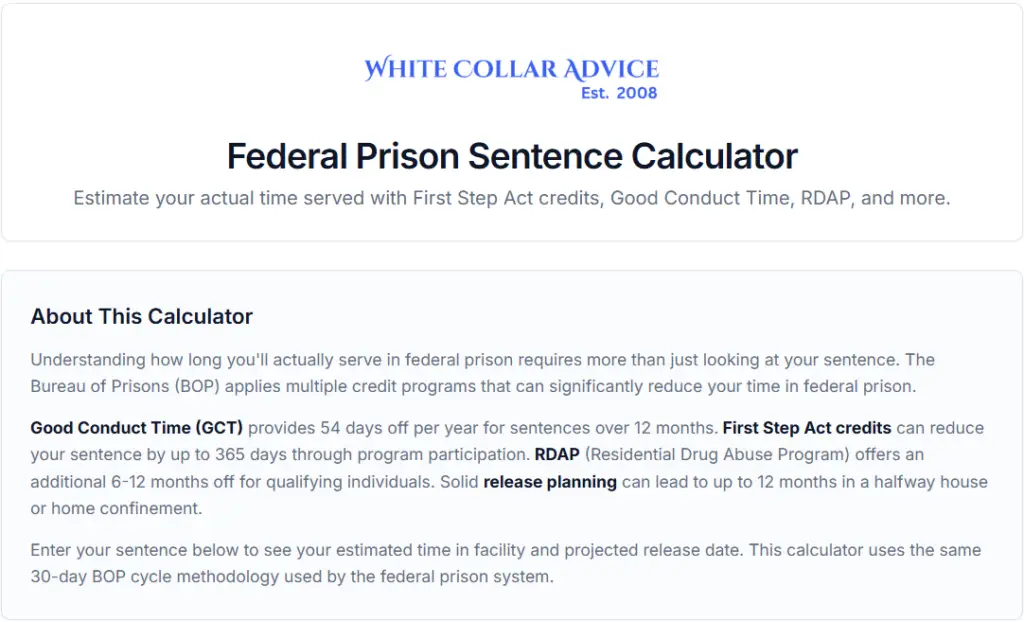
Our team built a federal prison sentence calculator to help people get a realistic picture of what’s ahead. Not the number on paper. The actual time in a facility.
Use the Federal Prison Sentence Calculator →
Got your estimate? Schedule a call to discuss your options.
Federal good time credit chart
Federal inmates serving sentences longer than one year earn 54 days of good conduct time per year served. This means most people serve approximately 85% of their sentence before release.
SentenceGood time creditActual time served (approx.)12 months54 days~10 months18 months81 days~15 months24 months108 days~20 months30 months135 days~26 months36 months162 days~31 months48 months216 days~41 months60 months270 days~51 months84 months378 days~72 months120 months540 days~102 months180 months810 days~153 months240 months1,080 days~204 months
These are estimates. Actual release depends on disciplinary record, First Step Act credits, and RDAP completion.
Why Your Federal Sentence Isn’t What You Think
When a judge says “60 months,” most people hear five years. But federal prison doesn’t work that way.
The Bureau of Prisons (BOP) applies several credit programs that reduce time served. These include Good Conduct Time, First Step Act credits, and for qualifying individuals, RDAP (the Residential Drug Abuse Program).
Our federal prison sentence calculator accounts for all of these. It takes your sentence length, applies the BOP’s formulas, and shows you an estimated release date—not a guess, but a calculation based on how the system actually works.
How Good Conduct Time Reduces Your Sentence
Good Conduct Time (GCT) is the most straightforward credit. If your sentence is longer than 12 months, you earn 54 days off per year served. That’s roughly 15% of your sentence.
Here’s the catch: you can lose GCT. Disciplinary infractions—fights, contraband, failing drug tests—can strip away those credits. The BOP giveth, and the BOP taketh away.
When you use a federal prison sentence calculator, it assumes you’ll maintain a strong record. If you don’t, your actual release date moves back.
First Step Act Calculator: How FSA Credits Reduce Your Sentence
The First Step Act (FSA), passed in 2018, created a new way to earn time off your sentence. By participating in programs—educational classes, vocational training, drug treatment, cognitive behavioral therapy—you earn credits that reduce your time.
The timing of that rate increase depends on your sentence length:
Sentences 18 months or less: Team meetings every 3 months, so you hit 15 days/month after 3 monthsSentences over 18 months: Team meetings every 6 months, so you hit 15 days/month after 6 monthsFSA credits are capped at 365 days (12 months) of sentence reduction. Any credits beyond that cap can be applied toward additional community custody time.
Our federal prison sentence calculator factors in your sentence length and estimates FSA credit accumulation over time.
RDAP: The Biggest Reduction Most People Don’t Know About
The Residential Drug Abuse Program is a 9-month intensive treatment program. It’s not easy. It requires daily participation, group therapy, and genuine engagement.
But if you complete it successfully, you can earn 6 to 12 months off your sentence—on top of GCT and FSA credits.
To qualify for RDAP, you need:
- A sentence of at least 24 months
- A documented substance abuse history (verified by a medical professional or court records)
- No disqualifying offenses (certain violent crimes and immigration detainers make you ineligible)
When you run your numbers through a federal prison sentence calculator with RDAP selected, you’ll see how dramatically it changes your projected release date.
Community Placement: The Final Stretch
The last portion of a federal sentence can often be served outside the prison walls. This is called community placement—either in a Residential Reentry Center (halfway house) or on home confinement.
You may be eligible for up to 12 months of community placement. The exact amount depends on your offense, behavior, and whether you have an approved release plan with housing, employment, and support systems in place.
Solid release planning can lead to up to 12 months in a halfway house or home confinement. A federal prison sentence calculator shows this as “time in community” separate from “time in facility.”
What a Federal Prison Sentence Calculator Actually Does
Let me be specific about what this tool calculates:
- Total sentence in months (including any days, converted to BOP’s 30-day month format)
- Good Conduct Time (54 days per year for sentences over 12 months)
- First Step Act credits (based on sentence length and program participation rates)
- RDAP reduction (6-12 months for qualifying individuals)
- Estimated community placement (up to 12 months based on eligibility)
- Projected release date (based on your surrender date)
The federal prison sentence calculator we created uses the same 30-day BOP cycle methodology as the federal prison system.
Real Numbers: A Practical Example
Say you receive a 60-month sentence and surrender on March 1, 2025.
Without any credits, you’d serve until March 2030.
With Good Conduct Time: approximately 51 months (release around June 2029).
Add First Step Act credits (maxed at 365 days): approximately 39 months (release around June 2028).
Add RDAP (12 months for a sentence this length): approximately 27 months (release around June 2027).
With community placement: you might transfer to a halfway house around June 2026, with full release in mid-2027.
That’s the difference between five years in a facility and roughly 15 months—if you qualify for everything and build the right record, you can defend.
A federal prison sentence calculator shows you these numbers instantly.
Why This Is Important Before You Surrender
Most people facing federal prison focus on the sentencing hearing. That makes sense; it’s the moment that’s easiest to fixate on.
But the work happens after sentencing. The months before surrender are your opportunity to:
- Understand which credits you qualify for
- Document your substance abuse history (for RDAP eligibility)
- Start building your release plan
- Learn how the facility operates
- Prepare mentally for what’s ahead
Using a federal prison sentence calculator before you surrender gives you clarity. You stop guessing and start planning.
Try the Calculator
I built this tool because too many people go into federal prison without understanding how the system actually works. The sentence on paper and the time served are two different numbers.
Use the Federal Prison Sentence Calculator →
Run the calculation twice: once assuming RDAP participation, once without. This shows you the potential value of RDAP eligibility and helps you decide whether to prioritize documenting your substance abuse history in the pre-sentence report.
If you want help preparing for what’s ahead, schedule a consultation.
Thank you,
Justin Paperny
Article 1 of 31 | Series: Federal Sentencing & the Sentence Calculator
“Not only was I granted a sentence reduction by the court — the judge specifically recognized the work I had done and documented — I also was able to show my case manager and camp administrator that I was worthy of the full benefits that Second Chance and First Step Acts offered.”
— Tracii Hutsona, sentenced to 51 months, served significantly less through deliberate record-building
Tracii’s federal sentencing calculator would have shown 51 months. It would have applied good conduct time, maybe First Step Act credits, and produced a release date. What no calculator could have predicted — and what no calculator can capture — is what Tracii did with that number.
She built a record. She documented everything. She taught classes, filed for a sentence reduction, and ultimately received an 11-month reduction from the court, a full year in a residential reentry center, and ongoing FSA credits — all without completing RDAP, which wasn’t available due to staff shortages at her facility.
That is what our federal sentencing calculator is designed to help you understand: not just what the math says, but what’s actually possible when you show up and do the work.
What Building a Record Actually Looks Like
Through White Collar Advice, we help clients build this record from the moment they engage with us — long before they surrender to a facility. The process involves four elements.
First, a written release plan. Not a vague statement of intentions, but a specific, documented plan for who you will be at every stage of your sentence — what you will study, what programs you will complete, how you will serve others, what you will produce. Tracii posted hers publicly on a blog. Her case manager suggested she share it with other inmates. It became a teaching tool.
Second, consistent documentation. Journals, blog posts, book reports, class completion records. Every certificate matters. Every letter of support matters. Every class you teach or mentoring session you offer should be documented. This evidence base is what you present when you apply for sentence reduction, early community placement, or expanded home confinement.
Third, engagement with the unit team. Your case manager is not your adversary. Tracii’s case manager was “receptive” from the first meeting because Tracii came prepared. Most people do not come prepared. The ones who do stand out immediately.
Fourth, ongoing connection with people who understand the system. Tracii connected with people who had navigated the same sentence length — and their guidance helped her understand what was actually possible. We facilitate those connections because we know how helpful the specific information can be.
Frequently Asked Questions
How do you calculate a federal prison release date?
Start with the full sentence length, subtract 54 days of good conduct time per year served, then factor in any First Step Act earned time credits and RDAP reductions if eligible. Our calculator does this math for you based on your sentence length, conviction type, and program eligibility.
How much of a federal sentence do you actually serve?
Most federal prisoners serve approximately 85% of their sentence. There is no parole in the federal system, but good conduct time credit of 54 days per year reduces the total. First Step Act credits and RDAP completion can reduce it further.
What is federal good conduct time?
Federal inmates earn 54 days of good conduct time per year served, meaning they serve roughly 85% of their sentence. This credit is not automatic — it can be lost through disciplinary infractions. It applies only to sentences longer than one year.
What are First Step Act (FSA) time credits?
The First Step Act allows eligible federal inmates to earn 10 to 15 days of time credits for every 30 days of qualifying programming, depending on risk level. Not everyone qualifies — certain offenses, particularly violent crimes and some sex offenses, have restrictions. The BOP makes the final eligibility determination.
How does RDAP reduce a federal sentence?
Completion of the 500-hour Residential Drug Abuse Program can reduce a federal sentence by up to 12 months for eligible non-violent offenders. Eligibility depends on having a documented substance abuse history and meeting BOP criteria. The 12-month reduction is the maximum, not a guarantee. If you don’t qualify for RDAP, good conduct time and FSA credits still apply.
Can I lose my earned credits?
Yes. Both good conduct time and First Step Act credits can be revoked for disciplinary infractions. Maintaining a clean record is essential to keeping your projected release date on track.
Is the BOP release date accurate?
The BOP projected release date on the inmate locator reflects good conduct time but may not account for pending First Step Act credits, RDAP reductions, or recent disciplinary actions. It’s a baseline estimate that can change.
How old will I be when I get out of prison?
Use our calculator’s date-of-birth feature to see your projected age at release. Enter your birth date alongside your sentence details and the calculator will show both your release date and your age at that time.
How long is 60 months in federal prison?
A 60-month (5-year) federal sentence typically results in approximately 51 months served after good conduct time, or roughly 4 years and 3 months. First Step Act credits could reduce this further depending on eligibility.
How long is 84 months in federal prison?
An 84-month (7-year) federal sentence means approximately 72 months of actual time served after good conduct time, or roughly 6 years. Additional reductions are possible through FSA credits and RDAP.
How long is 27 months in federal prison?
A 27-month federal sentence results in approximately 23 months served after good conduct time credit, or just under 2 years. With First Step Act credits and halfway house time, eligible prisoners see additional reductions.
How long is 18 months in federal prison?
An 18-month federal sentence means approximately 15 months of actual time served after good conduct time credit. With First Step Act credits and halfway house time, eligible prisoners see additional reductions.
How many months is a year in federal prison?
A full year in federal prison is 12 months, but with good conduct time credit (54 days per year), you serve approximately 10.2 months of actual time per year of sentence.
Can I get a sentence reduction after I’m already in federal prison?
Yes. Under 18 U.S.C. § 3582(c), courts can modify a sentence after it is imposed under specific circumstances. Tracii Hutsona received an 11-month sentence reduction after one year of documented work, teaching, and mentoring — all of which she had built into a formal release plan and presented to both her case manager and the court. The key is documentation and consistency from day one.
How accurate is a federal sentencing calculator?
The credit calculations are based directly on federal statutes and BOP policy, so the math itself is accurate. However, the final release date depends significantly on factors no calculator can fully model — your conduct record, program participation, sentence reduction petitions, and how your case manager and unit team assess your eligibility for expanded community placement. The calculator gives you a realistic range, not a fixed date.
How do I become a candidate for the maximum early release and community placement benefits?
Build a documented record from the first day you can. Write a release plan before you surrender and share it with your case manager on arrival. Participate in every approved program available to you. Document your progress — journals, blog posts, class completions, letters of support. Apply for a sentence reduction if you qualify. The BOP and the courts respond to evidence. Your record is your evidence.
About the author! Justin Paperny (hey, I’m writing about myself in the third person!) is an ethics and compliance speaker and founder of White Collar Advice, a national crisis management firm that prepares individuals and companies for government investigations, sentencing, and prison. He is the author of Lessons From Prison, Ethics in Motion, and the upcoming After the Fall. His work has been featured on Dr. Phil, Netflix, CNN, CNBC, Fox News, The Washington Post, and The New York Times.
Written by
Justin Paperny
Founder White Collar Advice