Table of Contents
Table of Contents
- Prison Staff Hierarchy Explained
- The Bureaucratic Structure
- How the Prison Staff Hierarchy Fits Within the Federal Government
- The Regional Structure Of Prison Staff Hierarchy
- Local Management: Wardens
- Executive Assistant
- Associate Wardens
- Department Heads
- Unit Team
- Case Managers
- Counselors
Administrative Remedy Process: A Realistic Look Inside Prison Staff Hierarchy Explained This chapter breaks down how the Prison Staff Hierarchy functions in federal institutions and how each role affects daily life. From wardens to counselors, each staff group influences decisions related to housing, programs, discipline, and progress reports. Understanding this structure allows a person to direct questions to the right level instead of wasting time or creating avoidable conflict.
Understanding the Prison Staff Hierarchy is a practical necessity for anyone entering a federal facility. Federal prisons operate through a layered bureaucracy that resembles a rigid organizational chart more than anything seen in the private sector. Knowing who does what, and why, helps you move through the system with fewer surprises.
RoleReports ToWhat They ControlBOP DirectorAttorney GeneralEntire federal prison system — policy, budgets, all institutionsRegional DirectorBOP DirectorAll institutions within one of six geographic regionsWardenRegional DirectorSingle facility — operations, staffing, policy enforcementExecutive AssistantWardenWarden support, media issuesAssociate WardenWardenMajor departments — programs, industries, operations, custodyDepartment HeadAssociate WardenDaily operations within a department (education, health, food, facilities)Unit ManagerDepartment HeadOversees unit team — housing unit operationsCase ManagerUnit ManagerClassification, custody level, release dates, transfers, FSA creditsCounselorUnit ManagerVisiting lists, room assignments, work details, disciplinary committee
The Bureaucratic Structure Federal prison operates within a strict administrative framework. Program statements set policy at the national level, and local institutions follow their own written policies. Staff members refer to one another formally, creating an environment that often feels out of step with the outside world. The formality can seem theatrical, but it determines the culture.
How the Prison Staff Hierarchy Fits Within the Federal Government
The Bureau of Prisons functions within the Executive Branch. For context, we have three branches of government:
• Legislative Branch, where Congress creates laws• Judicial Branch, where judges interpret the law• Executive Branch, where agencies carry out the law
The President leads the Executive Branch and appoints the Attorney General. On the Attorney General’s recommendation, the Director of the Bureau of Prisons is appointed. That director oversees the federal prison system.
According to the Bureau of Prisons, the system includes more than one hundred institutions and tens of thousands of employees responsible for a population approaching two hundred thousand people. A system of that size depends on uniform rules. People in custody often feel processed by the system rather than viewed as individuals.
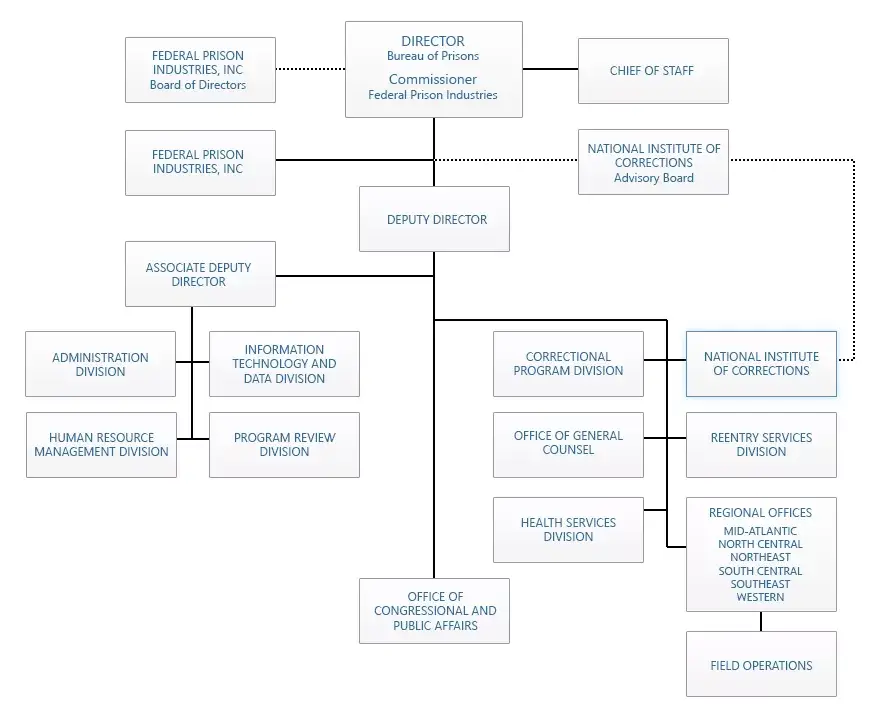
The Regional Structure Of Prison Staff Hierarchy The BOP divides the country into six regions:
• Mid-Atlantic Region• North Central Region• Northeast Region• South Central Region• Southeast Region• Western Region
Each region is led by a Regional Director who oversees institutional operations within that geographic area. These executives represent the top levels of the BOP’s leadership. Prisoners rarely interact with them. When senior leaders visit, local staff usually direct the movement and conversations so the executives see only selected areas and interactions.
Local Management: Wardens
Every institution has a warden who serves as the facility’s chief administrator. We have served time in institutions of every security level, and wardens differ widely in how they manage.
Some wardens walk the compound and speak with incarcerated people directly. Noon meals are often when they make themselves available. This is referred to as “standing mainline,” and prisoners can raise concerns during these brief interactions.
Many federal institutions sit inside complexes containing several prisons with different security levels. Each facility has its own warden, and the entire complex is supervised by a complex warden. The Federal Prison Complex in Florence, Colorado, for example, includes multiple high-security and lower-security facilities under one umbrella.
Executive Assistant
Each warden has an Executive Assistant. This person accompanies the warden and often listens to conversations between the warden and prisoners. Executive Assistants have limited interaction with the incarcerated population other than when media-related issues arise.
Associate Wardens
Wardens rely on several Associate Wardens who oversee specific departments. Common positions include:
• Associate Warden of Programs• Associate Warden of Industries and Education• Associate Warden of Operations• Associate Warden of Transportation• Associate Warden of Custody
They may appear at mainline as well, although they typically direct inquiries back down the chain of command.
Department Heads
A federal prison resembles a self-contained town. Each department is run by a department head. Examples include:
• Unit Managers• Supervisor of Education• Supervisor of Health Services• Captain• Supervisor of Food Services• Supervisor of Facilities
These staff members oversee daily operations within their departments. When a complaint arises, prisoners are expected to address it first with the staff member directly involved before elevating it through the chain of command. Unresolved issues can eventually be raised through the administrative remedy process.
Unit Team
The Unit Team is the group most people in prison encounter regularly. The Unit Management System assigns each prisoner to a housing unit, and staff members on that team oversee daily matters related to case management and living arrangements.
A Unit Manager oversees the team. Case Managers and Counselors handle most direct contact. Program Statements specify that Education Advisors and Unit Psychologists are also part of the team, but we have rarely seen them involved in regular unit operations.
Case Managers
Case Managers oversee each prisoner’s classification scoring, custody level, release date calculations, transfer requests, and periodic progress reports. Under the First Step Act, Case Managers document program completions and help determine earned time credits.
Counselors
Despite the title, Counselors focus on administrative responsibilities. They handle visiting lists, living space assignments, work details, compliance with the Financial Responsibility Program, sanitation matters, mailouts, and disciplinary committee participation.
Team Meetings
Prisoners with more than twenty-four months remaining meet with the team twice a year. Those closer to release meet more frequently. These meetings involve a short review of work evaluations, disciplinary history, program completions, and financial responsibility compliance.
New prisoners often expect guidance during these meetings. They leave disappointed. Team meetings offer little direction, and the focus tends to be basic compliance. Although policies state that Unit Managers should coordinate individualized programming, real support rarely matches the policy description.
People who want to make progress usually have to find their own opportunities. Staff members often favor routines, and anything outside that pattern can draw pushback. That preference for sameness is a big part of the culture inside.
If you want to understand how staff roles affect your experience, join our weekly webinar.
Thank You,
Justin Papernyis an ethics and compliance speaker and founder of White Collar Advice, a national crisis management firm that prepares individuals and companies for government investigations, sentencing, and prison. He is the author ofLessons From Prison,Ethics in Motion, and the upcomingAfter the Fall. His work has been featured onDr. Phil, Netflix, CNN, CNBC, Fox News,The Washington Post, andThe New York Times.
Who sits at the top of the Prison Staff Hierarchy?
The Director of the Bureau of Prisons leads the system under the Executive Branch, with wardens running individual institutions.
Will I interact with a Regional Director?
Almost never. Regional Directors work far above daily operations.
What does a warden actually do?
A warden oversees all operations in the facility, delegates responsibilities, and enforces policy.
How often do wardens speak with prisoners?
Some walk the compound regularly, while others remain office-focused. Interaction varies widely.
What is the Unit Team responsible for?
They handle case management, housing assignments, and administrative matters for each prisoner.
What’s the difference between a Case Manager and a Counselor?
Case Managers oversee classification and release-related issues; Counselors handle administrative and housing matters.
Do Team Meetings offer guidance on improving my status?
Team Meetings are usually brief and procedural with little individualized guidance.
How do I handle complaints about staff?
Begin with the staff member directly involved, then move up through the chain of command if needed.
Who oversees work details?
Counselors typically manage work detail assignments.
How do Associate Wardens fit into the hierarchy?
They oversee major departments and report to the warden.
Written by
Justin Paperny
Founder White Collar Advice