
https://traffic.libsyn.com/whitecollaradvice/5-1-25_webinar_.m4a
Last week, my daughter Alyssa asked me to watchAmerica’s Got Talentwith her.
I told her:
She wore me down. We watched it together.
And before I go further, because I’ve been to federal prison, I think I’ve earned the right to tell a few prison jokes.
But this email isn’t about humor. It’s about something much harder:
Trying.
And why most people avoid it.
A few days ago, I got a call from an executive in his 30s. Southern California guy. Educated. Supported. Recently home from prison.
He was stuck.
Not because he lacked opportunity or resources, he had plenty.
He was stuck because he kept replaying what he lost: title, reputation, identity. Every sentence began with “I used to…”
When I asked what he was doing now, he said:
That’s not unique. I hear it often.
He wasn’t failing because he couldn’t act; he was failing because he wouldn’t.
Trying, for him, didn’t mean building something big. It meant walking into a Rotary Club and offering to speak. Showing up at areentry nonprofitand asking how he could help.
But he wouldn’t.
Trying made him feel exposed. And exposure felt worse than standing still.
That brings me back toAmerica’s Got Talent.
That night, Alyssa and I watched a man named Richard take the stage.He was 55. A janitor. He’d spent 23 years quietly cleaning public schools.
No spotlight. No connections. No reason to expect applause.
But he stood up and sang, and something shifted. You could feel it. The crowd, the judges, the country… they didn’t just hear him. They saw him.
He won the competition.
He walked away with $1 million.
But more importantly, he showed what can happen when you finally stop asking for permission to try.
Let’s be honest:
Most people won’t try.’
Because trying risks failure. It invites judgment. It forces you to show your hand.
But I’ll ask you the question Richard answered that night:
Why not try?
Why not take a step even when your past is complicated?
Why not swing even when the odds aren’t in your favor?
History is full of people who had every reason to give up and didn’t:
- Nelson Mandela spent 27 years in prison, then led a nation.
- Abraham Lincoln lost more elections than he won.
- Viktor Frankl endured a concentration camp and helped the world find meaning in suffering.
- Epictetus, born a slave, became one of the great teachers of Stoicism.
- Malcolm X rebuilt his identity in a prison library and became a global voice.
- Michael Santos served 45 years, yet created a record so powerful that it now educates more than a million people in jails and prisons every year.
They all had reasons not to try.
They tried anyway.
But let’s be clear about something else:
Trying doesn’t come without criticism.
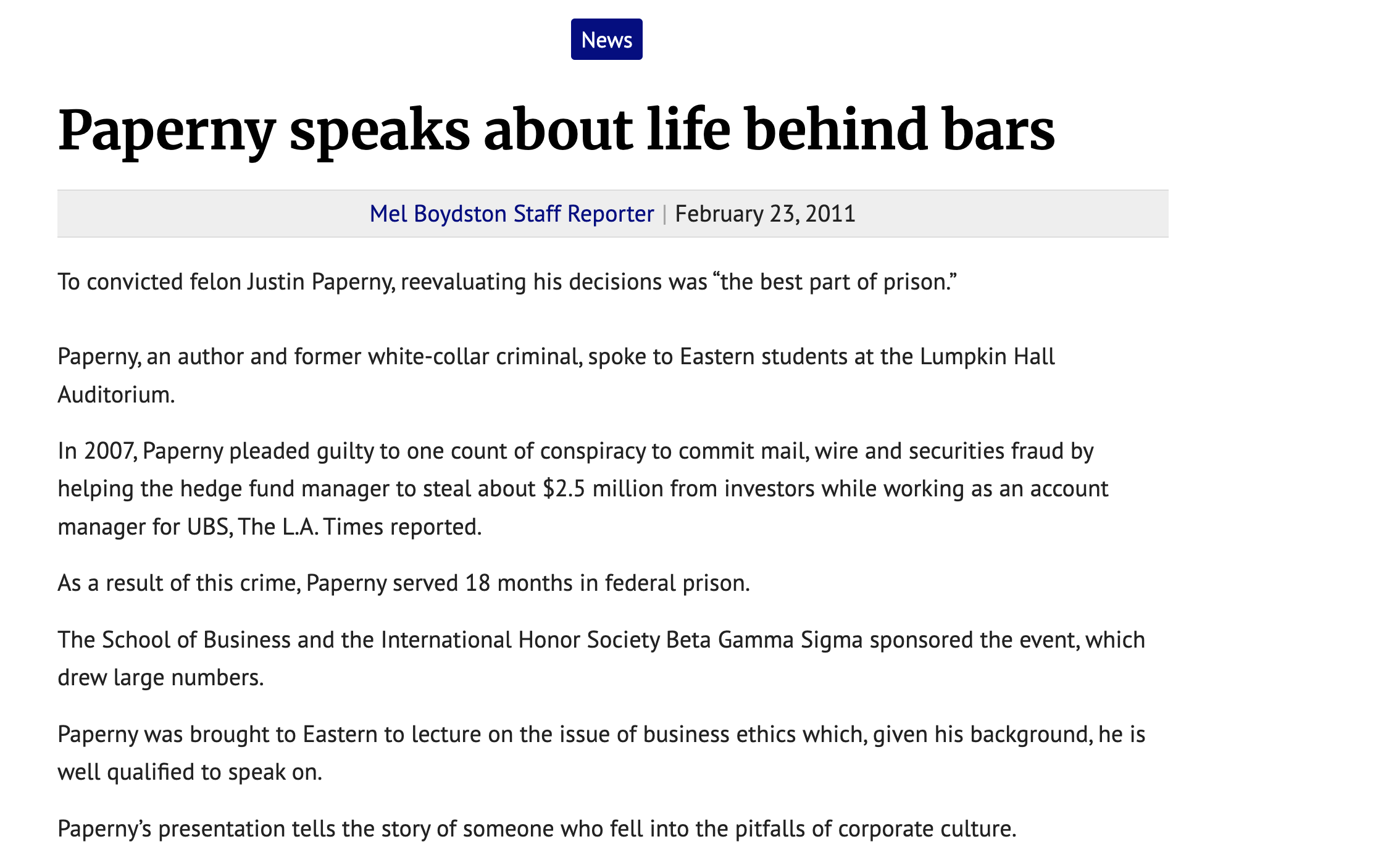
In February 2011, I was invited to speak at a university in Illinois.
Word got out. A professor circulated an email that made its way to me:
Afterward, I had a conversation with someone I admire.Kareem Abdul-Jabbar, who’s been a mentor and friend for years.
I asked him how he handles judgment, especially when it’s personal, when it’s not about your work, butyou.
His answer was simple. The kind of clarity Michael Santos used to challenge me with in prison:
That was it.
Any basketball fan knows the criticism Kareem faced. Some of it brutal, some of it unfair. That story has been told in countless documentaries.
In retrospect, does he have regrets? Yes. Do I? Yes.
But trying, learning, improving and enduring regret is better than surrendering to the voice that says:
That’s an ad hominem attack.
It’s when someone doesn’t engage with your ideas or your work, but goes after you instead. Your label. Your past. Your identity.
They’re not arguing.
They’re trying to create a diversion by focusing on the person’s background.
They don’t want to have the conversation.
They want to disqualify you from the start.
Sometimes it’s:“He’s a felon.”
Other times (and this is something I’ve heard more than 100 times since my release from prison in 2009) it’s:
“Well, of course Justin bounced back. He’s Jewish. Jews are good with money. He’s connected.”
It’s lazy. But it’s powerful because it hits where you can’t argue.
And if you’re not careful, you’ll do their work for them. You’ll silence yourself.
You’ll start to believe:
That’s the trap.
It’s how you stay stuck for years, thinking you’re being practical, when in reality, you’ve just absorbed someone else’s judgment as truth.
And the only way out is action.
Quiet, unglamorous, imperfect action.
Trying isn’t about making a scene. It’s about refusing to disappear.
Here’s a snippet from a staff reporter about that speech I did:
Carl Jung put it this way:
So if you’ve been mocked, ignored, dismissed—know this:
You’re probably doing something worth noticing.
You’re not spectating.
You’re not waiting for permission.
You’re not coasting on what used to be.
You’re moving.
That’s where everything begins.
Justin Paperny
Written by
Justin Paperny
Founder White Collar Advice