Federal Prison Processing from arrival, intake, property handling, searches, paperwork, and final transfer to camp housing.
Note: The chapter below is reproduced exactly as I wrote it inside Taft Federal rison Camp in 2008. The FAQs, and modern context appear after the chapter for clarity.
Table of Contents
Federal Prison Processing Inside Receiving and Discharge
I reported to Taft Federal Prison Camp through self-surrender and went through federal prison processing inside the Receiving and Discharge building. The process included arrival timing, custody intake, property decisions, handcuffing, identification, paperwork, strip search, clothing issuance, fingerprinting, and final transport to the camp. Processing lasted approximately four hours from surrender to completion.
I arrived before noon to avoid late-day shift changes that could result in segregation during processing. Officers assigned a registration number, conducted intake procedures, required completion of medical and psychological forms, and issued prison clothing and identification. The sequence followed a controlled movement through locked areas, searches, documentation, and administrative steps.
Register for our Tuesday federal sentencing and prison webinar: Join Webinar
Also, grab a copy of our new book, 14 Costly Errors Leading to Longer Sentences.
Processed into Prison
On the morning of my self-surrender, I called Walt from my mother’s house. I wanted to express appreciation for the help he gave my mother, and to thank him for the insight he had given me. That guidance truly made me feel as if I could handle the prison experience, and it helped me move forward from a position of strength. With that purpose, I could ease my mother’s worries on our final morning together before my imprisonment.
I was not scheduled to surrender to the prison until two in the afternoon. From my conversations with Walt, I learned that reporting to prison earlier would lessen the possibility for complications. Prisons schedule a shift change in the late afternoon, and if I arrived too late, the possibility increased that officers would lock me in segregation for processing the following morning. Wanting to avoid the discomfort of segregation, I made arrangements to arrive well before noon.
My brother, Todd, met me at my mother’s house, and together the three of us drove north on I-5 towards Bakersfield. We turned right off the highway and into the prison complex at Taft around ten. I steeled myself as my mother wiped away tears. We embraced and said our farewells outside, but Todd walked me in to the lobby of the administration building to ensure all would go well. When we saw an officer in uniform, I informed him that I was reporting to self-surrender, and I extended my hand to shake in greeting.
“No offense,” the officer gave me a stern look, “but we don’t shake hands with inmates.”
When the officer refused my friendly gesture of a handshake, I looked at my brother. I knew my life had changed, at least for a while. I would have to embrace the reality that in surrendering my freedom, I simultaneously had to surrender some expectations of common decency.
As my brother walked away, the admitting officers asked for my name and registration number. I gave them my name, yet not knowing my registration number, I drew a blank. Understanding that I was new to the system, the officers asked for my birth date. When I answered, they responded by telling me that my registration number was 44499-112.
“Memorize that number,” the officer told me. “You’re going to need it.”
I was then taken into custody. For the first time since my ordeal began, I felt the cold steel of handcuffs to my wrists. With my hands locked behind my back, I carried my bag of personal belongings as the officers escorted me through a series of steel gates and locked doors. By pushing buttons and signaling into surveillance cameras, officers in a remote control center would open and unlock the passageways that would lead me deeper into the prison.
We arrived at a processing center known as the R&D building or Receiving and Discharge. Once inside the locked center, the officers unlocked my handcuffs. They looked at the bag I was carrying.
“What goodies have you got there?” They looked at me with unrestrained contempt, as if I were a grown man carrying a bag for candy handouts on Halloween.
“These are my running shoes, toiletries and a few books. They’re my personal items.”
“You can’t bring them in with you. Would you like to send the package home at your own expense, or do you want to donate them to the institution?”
“But I called here before. The officer who spoke to me said I could bring these items with me.”
“Well, you can’t. Do you want to send the items home at your own expense, or would you rather donate them to the institution?”
Feeling as if I had just been artfully robbed, I agreed to donate my belongings to the institution. I didn’t know the real meaning behind donating my property to the institution, though I suspected I was likely donating my $200 running shoes and other belongings to some other cause, like the correctional officers wellness foundation. Either way, I had time to serve. I didn’t want to create any waves, so I agreed to forfeit my belongings for the good of the cause.
Those who expect to self-surrender to prison ought to take that personal experience under advisement. I’d like to say it was unique to me, but while I served my 12 months, I made a point of interviewing and interacting with other prisoners. Some of those men had considerably more experience of living in prison than me, and by listening to their stories, I learned a great deal.
One lesson I learned was that, like I did, many white-collar offenders who self-surrendered called the prison before they reported. They wanted to inquire on what they could bring. Somehow, they all seemed to be advised that they would be allowed to carry some personal items in with them. When surrendering, however, after their family members had driven away, they were given the option of either donating the items or sending home the package.
The anecdotal lesson suggests that when a man self-surrenders to prison, he should not bring anything that he doesn’t absolutely need. If he needs medication, he should bring the medicine in sealed containers with a letter from a physician. A health services representative of the prison will make a determination as to whether to allow the medication. Medications for heart ailments, diabetes or other biological issues will stand a better chance of allowance than sleeping pills.
Other items I’ve heard prisoners can carry inside include religious medals and wedding rings, provided the jewelry’s monetary valuation does not exceed $100. Prisoners may bring currency or a U.S postal money order, as well, and administrators will post the funds to a debit account the inmate may access for commissary purchases. From what I’d been told, however, nothing else gets in.
After taking my belongings, the officers handed me a stack of forms. They led me to a cell of concrete and steel and locked me inside with a tiny, flexible pen.
“Fill out the forms,” the officer told me. “Answer every question. Someone will come by to see you soon.”
That was it, I thought. I was in prison. My friend, Walt, had prepared me with descriptions of what being locked in a cell would feel like. Those descriptions helped my anxiety. I knew the processing would take several hours, so I wasn’t as antsy as I could have been. When I spoke with other white-collar offenders who self-surrendered, they said that they didn’t know anything. They thought they may have had to serve the entire sentence in the locked room. I felt grateful that I at least had some forewarning of what to expect.
The forms were quite basic, inquiring about my medical needs and my psychological state of mind. The dense pages seemed to go on without end, requiring me to respond to hundreds of questions. After more than 30 minutes of reading the fine print, I finished. Then I waited. Alone. Locked in a concrete bunker with nothing but thoughts to accompany me.
Okay. I reasoned it was time to get started. I squatted on the concrete floor, kicked my legs back and began my pushup routine. I weighed more than 200 pounds coming in to the prison, and I was determined to embrace an exercise regimen that would ensure I left in better physical shape. I began in those first hours of my confinement. As I waited for the next round of admissions procedures, I was able to knock out six sets of pushups, with between ten and twelve reps each.
“Paperny!” An officer at the door called my name.
“Yes sir!”
“What’s your number?”
“Pardon me?”
“Your number. Give me your number.”
“Oh, I’m sorry. I’ve just come in. I don’t remember.”
“Date of birth?”
When I told the officer my birth date, it was as if I had given the open sesame command. He unlocked the steel door.
“Come with me,” the officer said.
He led me through a maze of corridors and took me inside another room.
“I need you to strip naked. Throw all your clothes in the basket. I’ll be back.” The officer then walked out from the shell of a room. Feeling peculiar and somewhat violated, I took off my clothes.
I stood in that room, stark naked, for perhaps 15 minutes before the officer returned. He had a mouthful of chewing tobacco and he used a plastic Big Gulp cup from 7-Eleven as a spittoon. I didn’t detect any emphasis on bedside manner as the correctional officer seemed to check me out. He was fully outfitted in a gray officer’s uniform, with pant legs tucked into black jackboots. A black leather belt cinched around his prodigious belly, and the belt had numerous loops for all sorts of pens, handcuffs, clubs, and other artifacts that distinguish the profession of corrections. He wore a bright badge proudly on his chest.
“First time.” He said it more as a statement than a question as he looked me up and down.
I felt as if I were a horse he was evaluating to purchase. By the look of contempt on his face, I didn’t feel as if I was measuring up. Did he want to look at my teeth?
“Yes sir,” I was deferential to his clear authority. “I’ve never been incarcerated before.”
“Virgin, eh?”
“Excuse me?”
“Ah crap,” the officer said. “It ain’t nothing.”
I didn’t know what to do as he stood looking at me naked. It seemed to me as if an inordinate amount of time was passing. Finally, he picked up a white clipboard and clicked one of the many pens that he pulled from a loop in his belt.
“Let’s get this rodeo started,” he said. “Any tattoos?”
“No, sir. None.”
The officer checked his clipboard. “Lift your arms.”
I reached up with my palms forward as if surrendering.
“Lift your testicles,” he told me.
I lowered my arms and complied with his request.
“Turn around,” he said.
I gave the officer my back side.
“Bend over.”
I bent at the waist as if I were trying to touch the floor without bending my knees.
“Spread ‘em’.”
I opened my legs wider.
“Not your legs,” the officer barked, “your cheeks.”
I felt as if he were purposely trying to humiliate me. Satisfied with what he saw, the officer told me to squat and cough.
“What?”
“You heard me. Squat and cough!”
After I forced a cough, the officer ordered me to lift my feet off the ground. Not understanding, I leaned to my right and lifted my left leg as if I were a sumo wrestler.
The officer laughed at me.
“Not like that. Let me see the soles of your feet.”
The entire inspection ordeal felt humiliating. Apparently, I passed, however, as the officer threw me an orange jumpsuit and told me to dress. He then led me back to the cell where I had left my paperwork. The officer told me I could pay to mail home the personal clothes I had left behind, or I could donate them to the institution.
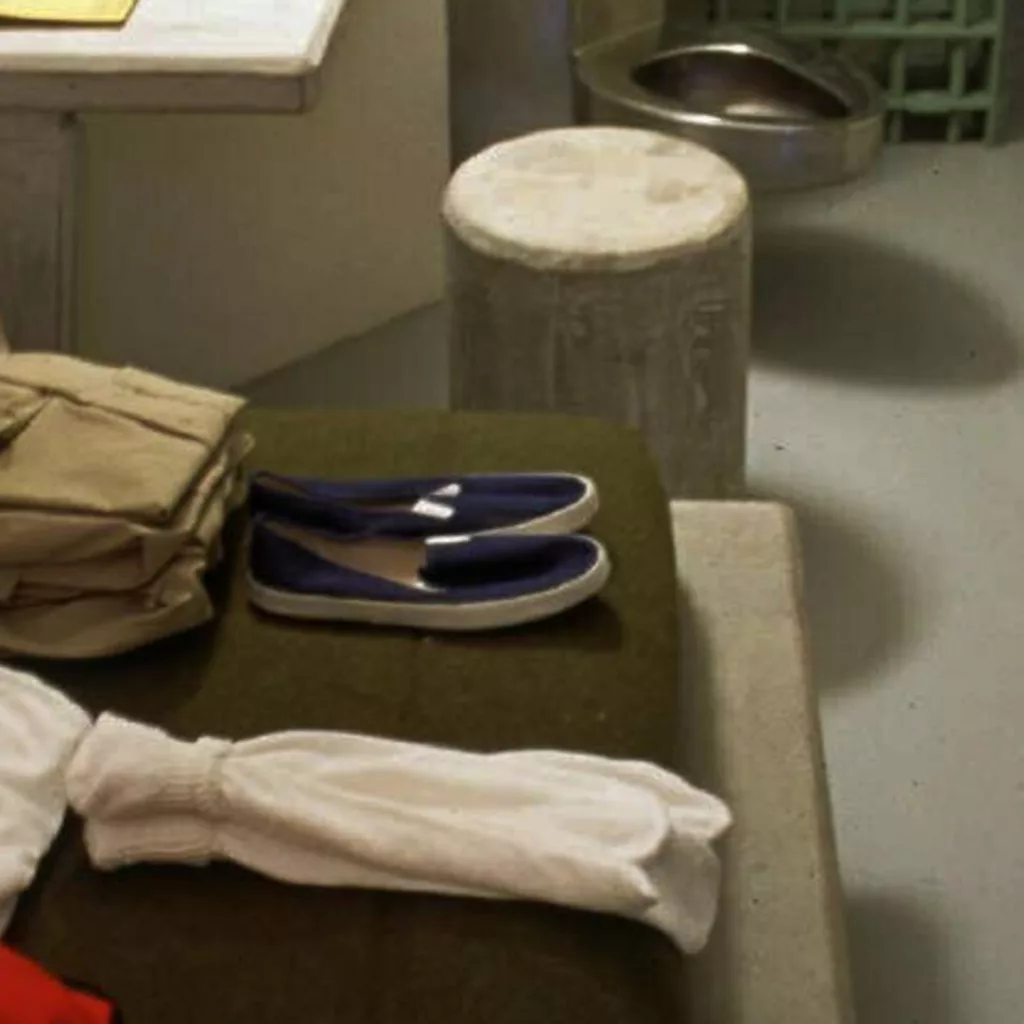
Finally, about four hours after I had self-surrendered, an officer handed me a pair of khaki, elastic-band pants and a white T-shirt. He issued me a pair of blue slip-on shoes and told me to change. This time no one stood over me watching. Once dressed, the officer brought me to a station for a photograph and fingerprinting. He then issued me an identification card and a handbook that listed the rules and regulations of the prison camp. That concluded my processing, the officer told me. He was ready to drive me over to the camp.
Top Misconceptions
- Self-surrender allows prisoners to keep personal belongings
- Intake processing is brief and immediate
- Identification is assigned before arrival
- Strip searches do not occur at camp facilities
- Processing occurs inside housing units
If You’re Facing a Federal Investigation or Prison…
- Where federal prison processing begins after self-surrender
- How arrival time affects intake sequence and housing placement
- When registration numbers are assigned and reused
- Where personal property is taken, mailed, or donated
- How Receiving and Discharge procedures are ordered
- Where paperwork, searches, and clothing issuance occur
- How long intake lasts before transfer to camp housing
FAQ
How long does federal prison processing usually take after self-surrender?
Processing lasted approximately four hours from initial custody to issuance of clothing, fingerprinting, identification, and transfer to the camp.
Where does federal prison processing occur after surrender?
Processing took place inside the Receiving and Discharge (R&D) building, a secured intake facility separate from camp housing.
What information is required during federal prison processing?
Officers requested name, date of birth, assigned registration number, medical history, and responses to intake forms.
What happens to personal property brought to prison during self-surrender?
Property was taken and the inmate was required to choose between mailing it home at personal expense or donating it to the institution.
Are strip searches part of federal prison processing?
Yes. The intake included a full strip search conducted by correctional staff before issuing prison clothing.
When is prison clothing issued during processing?
Temporary clothing was issued after intake searches, followed by standard camp clothing near the end of processing.
What identification is issued during federal prison processing?
An identification card was issued after fingerprinting and photograph completion.
When does transfer to the prison camp occur?
Transfer to the camp occurred immediately after completion of intake, fingerprinting, and issuance of clothing and ID.