While visiting my dad last fall—he was recovering from surgery—I got this text:
“Interviewing people who can get me out of prison the fastest. You’re on the list. What can you do on 24 months?”
I get it. When you’re facing prison, you want clarity. You want someone to tell you how long you’ll really serve. You want a shortcut through the uncertainty.
I wanted that too.
But here’s what I’ve learned about how to prepare for federal prison: the question you’re asking matters more than the answer you’re looking for.
And most people are asking the wrong question.
The Text That Reminded Me of Coach Gillespie
That text from the finance executive took me back to my junior year of high school.
Mike Gillespie—legendary USC baseball coach—was sitting in my living room. I was a recruit. Nervous. Eager. Trying to figure out my future.
I asked him: “If I sign with USC, how many at bats will I get as a freshman?”
“How Many At Bats Will I Get?”
He did not mince words. Part of the reason freshmen often left practice in tears. Including me.
“Justin, that is the wrong question. Frankly, a stupid question.”
He leaned forward.
“Will you outwork other recruits? What time did you wake up today? How many swings off the tee? The answer lies in your work ethic. I will not make up an answer. You will get a chance to play. That is all I can promise.”
I never forgot that.
Gillespie wasn’t being cruel. He was being honest. He was telling me that outcomes aren’t guaranteed—but the work that leads to outcomes is entirely within my control.
Twenty-five years later, I found myself giving the same speech to a finance executive going to federal prison.
The Finance Executive Who Wanted a Guarantee
What Can You Do on 24 Months?
I thought about Coach Gillespie while texting this executive back.
“What did you do today that proves you’re a candidate to go home early? How does your case manager perceive you? Your judge? I googled your case—your judge called you a ‘lifelong grifter.’ What are you doing to change that narrative? Give me those answers.”
“Nah, I’m good,” he said. “Some guy told me I’d only do a few months.“
Some guy. No plan. No work. Just a promise from someone who wouldn’t be there when things went sideways.
“I wish you well,” I replied. “I hope you enjoy working for the Colonel. The fryer gets super hot, I hear.”
“What do you mean?”
Working for the Colonel
“Bud, you have kids. A wife. You owe restitution. And you’re looking for a guarantee. I guarantee we will be authentic and honest. As Michael says, we will never ask you to do what we have not done and documented. But you’re looking for a shortcut. You want the buzzwords that get you home without doing the work. You won’t get them from me.”
I’ve seen what happens to people who don’t learn how to prepare for federal prison properly.
I met a physician at the Hollywood halfway house. Educated. Successful. Respected. He was working the fryer at KFC.
Not by choice. Because it was the only job they’d approve.
He did the bare minimum inside. Television. Card games. Complaining. His case manager had nothing to work with. So she didn’t.
That’s who I was thinking about when I mentioned the Colonel.
(Internal link placeholder: anchor text “why some people end up at KFC after prison”)
How to Prepare for Federal Prison the Right Way
I continued with the finance executive:
“You may get an F and serve every day of your sentence. Or you can engineer an outcome that leads to an A or B. And yes—you may do the work to engineer an A and still get a C. That’s life.
But while you create, your family is inspired by your work ethic. Your judge—who called you a grifter—may appreciate your updates from prison. Maybe your case manager throws your plan in the trash. But maybe it compels your case manager at the halfway house to approve your job instead of sending you to work for the Colonel.
I don’t know. I’m not psychic, though that would be cool.”
Creating Assets That Do Not Exist
What I do know is this: nothing happens until you start creating assets that do not exist.
That’s what I paid Michael Santos to help me do in 2008. I was inside Taft Federal Prison Camp, wasting my days exercising six hours and reading without purpose. Michael had been inside 22 years. He taught me that federal prison preparation isn’t about knowing what to pack—it’s about building a record that stakeholders can see.
A release plan. Book reports. Journal entries. Documentation of what you’re learning and who you’re becoming.
You may be able to do it on your own. Cool—use our free stuff. I could not. I needed help. Had a budget and a willingness to learn, even though it wouldn’t advance my release date since there was no First Step Act back then.
I was more concerned about life after prison. As you should be.
Engineering Your Outcome
And guess what?
That engineering Michael and I worked on in 2008? It worked.
The finance executive texted me. I did not solicit him. The work I did inside prison—the assets I created—led to this business, this platform, this opportunity to help others learn how to prepare for federal prison.
I asked him: “What outcome are you engineering? Start there and things improve.”
“You take crypto?” he asked.
“Yes.”
The 10 Questions That Determine Your Federal Prison Preparation
That conversation is why I built our quiz.
Ten questions. Two minutes. The same questions I wish someone had asked me before I surrendered to Taft.
Questions like:
- Have you written your personal narrative?
- Do you have a release plan on paper?
- Do you understand why some people skip the halfway house and go straight to home confinement?
- Do you know why some people get their job approved after prison—and others end up at KFC?
- Have you formed a reading list?
- Do you understand the quadrant theory—which decisions are high-risk/low-reward vs. low-risk/high-reward?
- Does your family know how to send you money?
- Have you created a profile on Prison Professors to document your journey?
Most people can’t answer these questions. That’s the gap.
The quiz shows you where the gaps are. Then you can start closing them.
What Outcome Are You Engineering?
Going to federal prison is hard. I’m not pretending otherwise.
But the question isn’t how long you’ll serve. Nobody can answer that—not honestly.
The question is: what are you doing today to prove you’re a candidate for early release? How does your case manager perceive you? Your judge? Your probation officer?
What outcome are you engineering
Coach Gillespie didn’t promise me at bats. He promised me a chance to play—if I did the work.
Michael Santos didn’t promise me early release. He taught me how to prepare for federal prison in a way that would serve me for the rest of my life.
The finance executive wanted a guarantee. I couldn’t give him one. Nobody can.
But I can show you what to build. I can show you the questions that matter. I can show you how people like Tracii Hutson turned 51 months into 17—not by hoping, but by engineering.
Start with the quiz. See where the gaps are.
Justin
About the Author
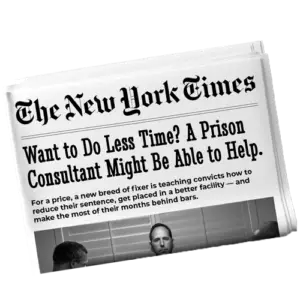
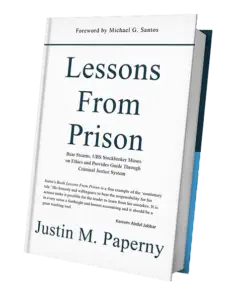
Justin Paperny (hey, I’m writing about myself in the third person!) is an ethics and compliance speaker and founder of White Collar Advice, a national crisis management firm that prepares individuals and companies for government investigations, sentencing, and prison. He is the author of Lessons From Prison, Ethics in Motion, and the upcoming After the Fall. His work has been featured on Dr. Phil, Netflix, CNN, CNBC, Fox News, The Washington Post, and The New York Times.
FAQs
How do I prepare for federal prison if I’ve never been inside before?
Start by understanding what your case manager and probation officer will look at—your probation report, victim impact statement, and the record you build. Create a written release plan, document your progress, and focus on what you can control before and during your sentence.
What is the biggest mistake people make when going to federal prison?
Asking the wrong question. Most people ask “how long will I serve?” instead of “what am I doing today to prove I’m a candidate for early release?” The first question has no reliable answer. The second is entirely within your control.
Can I really reduce my federal prison sentence?
It depends. The First Step Act created opportunities for earned time credits and resentencing. But you need evidence—documentation, a release plan, proof you’ve been working. Tracii Hutsona turned 51 months into 17 by building a record her judge could see.
What should I do before I surrender to federal prison?
Write your personal narrative. Create a release plan. Establish a point of contact. Understand early release possibilities. Build a reading list with purpose. Document everything—this becomes evidence for your case manager, probation officer, and potentially your judge.
How does federal prison preparation affect my halfway house placement?
Your case manager at the halfway house reviews your record from prison. If you’ve documented your progress, built a plan, and shown growth, you’re more likely to get your job approved. If you did the bare minimum, you may end up working at KFC.
What is the “quadrant theory” for federal prison preparation?
It’s a framework for evaluating decisions: high-risk/low-reward vs. low-risk/high-reward. Using a contraband phone is high-risk/low-reward. Building a documented release plan is low-risk/high-reward. Every decision inside should run through this filter.
How do I prepare for federal prison if I don’t have money for a mitigation consultant?
Use free resources. Create a profile on Prison Professors. Document your journey. Write book reports. Build your release plan. The work is what matters—not whether you paid someone to help you do it
What questions should I be asking about how to prepare for federal prison?
What did I do today to prove I’m a candidate for early release? What does my case manager see when they look at my file? What am I building that didn’t exist before? These questions lead to outcomes. “How long will I serve?” does not.
Key Takeaways
- Stop asking how long you’ll serve—start asking what you’re building today.
- How to prepare for federal prison comes down to creating assets that do not exist: release plans, documentation, evidence of growth.
- Your case manager, probation officer, and judge form opinions based on your file—make sure there’s more in it than the government’s version of you.
- The difference between KFC and a real job after prison is the record you build inside.
- Engineer your outcome: you may do the work for an A and get a C, but your family will see your effort—and so will stakeholders.