I was texting with my mom this morning, confirming a visit to Los Angeles, when she reminded me: next week marks 18 years since I surrendered to federal prison.
April 28, 2008. My parents drove me to Taft Federal Prison Camp. Before I got out of the car, I made them a promise.
Preparing for Federal Prison: The Promise That Carried Me Through
I know I had it easier than most. I say that often and I mean it. I was 33 years old. Not married. No children. And I found a mentor inside almost immediately, which changed everything. I do not want to minimize what other people face when they go in.
But none of that made the first months easy.
I became a runner at Taft. That was my coping mechanism. I would run at a fast pace and then stop, staring out at the agriculture surrounding the camp, and just stand there. Scared. Frustrated. Asking myself the same questions on a loop: what am I going to do when I get out? How will I sustain myself? What happens next?
I had no answers. So I would run again.
After the runs I would go back to my cubicle, sit on a backless swivel stool, and stare out the same window and ask the same questions. I was critical of people who watched television all day or played dominoes and spades. But I was not doing anything more useful. I was just doing my version of the same thing. Running, staring, obsessing, getting nowhere.
Wondering is good. It is hopeful. But wondering without a plan just keeps you in the struggle longer.
October 12, 2008 – Federal Prison Mindset
Michael Santos changed that.
On October 12, 2008, we wrote the first blog together. I did not know what would come from it. I put it in the mail slot with the chain and the lock, dropped it in, and told my mom: put it on the internet.
We produced something every single day after that.
The feedback in the beginning was not kind. Your sentence is too short. You are a tourist. Nobody cares. You have not been inside long enough to offer anything. There was truth in some of that. I was not pretending otherwise. But I kept writing.
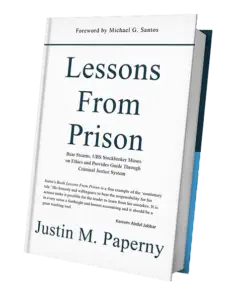
When I came home and started cold-walking into law offices with copies of Lessons From Prison, one lawyer told me he was going to call security or my probation officer. I kept going. When I started knocking on professors’ office doors during office hours, uninvited, not a student, not expected, telling them I had just been released from prison and thought I could provide something to their class: most looked at me like I was out of my mind. Some of them called back.
That led to hundreds of speaking events. I spoke to nine classes in a single day at Cal State Dominguez Hills once. A student in the front row was asleep. I wanted to hand him a napkin.
Every embarrassing moment. Every door closed in my face. Every room where people looked at me like something was wrong with me. I went back to the same thought every time.
The promise I made to my parents.
The Federal Prison Mindset a Promise Creates
When my parents stopped the car at Taft Federal Prison Camp on April 28, 2008, I turned to them before I got out and said this:
Mom, Dad. I am not going to encumber your retirement. You worked an entire lifetime. You gave Todd and me every opportunity. I squandered some of them. I am not going to be the reason your retirement falls apart.
I am going to find a way to pay back the $535,000 in restitution. I have no idea how. But I am going to find a way to sustain myself.
That took ten years on the restitution. The sustaining myself part happened faster than I expected, because of the record I started building on October 12, 2008.
My probation officer, Isaiah Muro told me: because of what you built in federal prison, I am going to let you work with felons. I am going to let you travel the country to speak. That was not a given. That was a direct result of a documented record that began in federal prison with Michael Santos’s help.
What the Promise Actually Did
The promise did not make the work easier. It made the work non-negotiable.
When I was writing and people hated it, the promise made it so I kept writing.
When I was getting thrown out of offices, the promise made it so I kept knocking on doors.
When the students were falling asleep, the promise made it so I kept speaking.
I was not doing the work because I expected a specific return. I was doing it because I had made a commitment to two people who had never stopped believing in me.
I hear from people in our our weekly webinars: I will do this work if it gets me home early. I will build this record if it results in a shorter sentence. And I understand why people think that way. But it is also the exact thinking that leads to stopping. Because if you only do the work when you believe it is going to produce the outcome you expect, you will stop the moment someone tells you it is not working or that what you built is not enough.
The work has to come from somewhere else. A promise you made to someone. A commitment to not let this thing define the rest of your life. Something that holds when the case manager is skeptical and the process is slow and you are not sure anything you are doing matters.
For me it was two people in a car at Taft Federal Prison Camp on a Monday morning in April 2008.
The Question I Am Asking You
If you are going to prison, or if someone you love is going, I want to ask you something directly.
What promise are you making?
Not to your attorney. Not to the judge. Not in a letter that gets filed and forgotten. A real promise to a real person who you love.
Justin Paperny
Frequently Asked Questions About Preparing for Federal Prison
What is the most important thing to do before going to federal prison?
Make a decision about who you are going to be while you are there. That sounds abstract but it is not. The people who use their time well in federal prison almost always have something specific driving them: a person they do not want to let down, a commitment they made before they went in, a problem they are determined to solve when they get out. The people who struggle are usually waiting for the system to tell them what to do next. The system does not do that. You have to bring your own reason.
Does what you do in federal prison actually affect your outcome?
Yes. Your programming participation, your disciplinary record, your relationship with your case manager, and the release plan you build inside all factor into how much halfway house time you receive and how your probation officer works with you when you come home. My probation officer, Isaiah Muro, approved me to work with felons and travel the country speaking on ethics directly because of the record I had built starting October 12, 2008.
What did Michael Santos do in federal prison that made a difference?
He documented everything. Every day for 26 consecutive years he built a record of who he was, what he was learning, what he was contributing, and where he was going. He did not do that to advance his release date. He did it because it was who he chose to be. That framework, the Straight-A Guide, is now implemented in every federal Bureau of Prisons facility and is the foundation of everything taught at White Collar Advice and Prison Professors.
How do you stay motivated in federal prison when nothing seems to be working?
The people I have seen sustain their commitment through the hardest stretches of a federal sentence were not motivated by outcomes. They were committed to a person or a promise. The commitment did not depend on whether the case manager noticed, whether the halfway house placement came through, or whether anyone was paying attention. It was non-negotiable. If you build your motivation around results you cannot control, you will stop when those results are slow or absent. Build it around something that does not move.
What is a release plan and when should you start building one?
A release plan is a documented record of who you are, what you have learned, what you intend to do, and how you plan to hold yourself accountable. It is not a document you write once before sentencing. It is a living record that grows every day. My release plan is approximately 7,000 pages after 17 years. The best time to start building it is today, regardless of where you are in the process.