Someone in our community got a year and a day sentence. He’s home in 83 days.
His case manager loved his Straight-A Guide profile. Loved that he was documenting his journey through prison. Was inspired by his work. Rewarded him.
I tell that story every week because it is real, it is recent, and it is repeatable.
But here is the other story I tell just as often: a mother called me crying hysterically because someone stole $15,000 from her to write a compassionate release letter that ChatGPT produced in seven seconds. There was no record behind it. No documented journey. No evidence of change. Just words on a page that a case manager read and threw away.
That is the difference. Not hope. A plan. Not a letter. A record.
What Case Managers Actually Do With Your Federal Prison Release Plan
Some case managers are going to love what you build. Some are going to say, I didn’t ask for this, get out of my office.
You do not build the record for the case manager.
You build it for your family. You build it with dignity. You build it because you never know who is going to read it. Some of you want compassionate release. Some of you want an earlier release date. Some of you are serving 16 to 32 years in a state system and a parole board is going to decide your release date.
Every one of those outcomes requires the same thing: a record that is documented, timestamped, and real.
Mathew Boyer knows this. Many of you know him as the bookmaker in the Shohei Ohtani case. He spoke on our client call this morning. His mitigation work with Prison Professors led to a shorter sentence, earlier release from prison, and more liberty immediately in the halfway house. He is now in home confinement.
The whole thing was engineered. But it required him to look years into the future and do work that would not pay off for 18 months or more.
Too many people ask, how will this help me right now? They are not willing to do work that helps them in two years or ten years.
I have been home from federal prison for 17 years. Work I did at Taft still brings in business today. Someone found me last month because they were reading my prison blog from 2008. A website I do not even maintain anymore.
You never know who is going to read it.
Under-Promise and Over-Deliver on Your Prison Profile
Someone on the call this morning asked how much they should write in their release plan.
Say you are going to write twice a week. Then write four days. Say you are going to do two book reports a month. Then do four.
Because here is what happens if you promise four days and do two: a case manager looks at your profile, sees you said one thing and did another, and says exactly what they expect from a convicted criminal.
Here he goes again.
Embrace that perspective. It is real. Case managers are cynical. They should be. You broke the law. The only way to change their perception is not through promises. It is through a record that shows, over a sustained period of time, that you did what you said you would do.
That is accountability. Not the word. EVIDENCE
Michael Santos Is Walking Into Your Federal Prison
Michael Santos, my partner and mentor, served 26 consecutive years in federal prison. He is now part of the national resource team for the Federal Bureau of Prisons. He visits prisons across the country. He presents profiles of people who are doing the work. He writes lesson plans for case managers in English and Spanish. Staff in the Bureau of Prisons have access to those plans. They print them out and give them to prisoners.
Case managers are being trained on prisonprofessors.org and using it as a barometer to determine who is a candidate for earlier release.
If you know that, and you are not building a profile, what are you doing?
When I share a release plan with a case manager, I encourage the messaging to be authentic: I decided to read this plan after learning about a nonprofit featured by the Bureau of Prisons. I found Michael Santos on the BOP website. I reached out and created a profile because I wanted to build a record that shows why I am a candidate to earn my way home.
That is honest. That is documentable. That works.
CZ Built a Record From Federal Prison With English as His Second Language
The founder of Binance, CZ, recently received a pardon from President Trump. He served a four-month federal prison sentence. He was ineligible for the First Step Act. He was facing deportation. English is his second language.
And every 15 minutes he had access to a prison terminal, he was writing his manuscript. Sometimes it got deleted. He started again. He sent it home. Michael helped him edit it. He built his way through prison and shared it with his family.
His book is called Freedom of Money.
If CZ can do it in a low-security prison knowing it would not advance his release date one day, I am asking all of you to do the same.
No television. No boredom. No overdoing the bocce ball and the pickleball, or at least do it in dosages you can sustain.
The end is coming. You are coming home from prison. There is too much struggle on the other side for people who use the experience as a waste.
Get it done.
What Your Federal Prison Schedule Should Look Like
I knew my schedule cold at Taft. Up at 4. Coffee. Quiet room with Michael at 5. Chow hall at 6. Upstairs at 6:30. Read and write until 8. Exercise until 10. Standing count at 10:30. Job in the kitchen from 11 to 1. Shower. Writing until 5. In bed at 7.
The gambling, the drugs, the wasted evenings. All of that happens when the day is behind you and you have nothing pulling you forward. I wanted to be in bed at 7 like an 85-year-old man. It is easier to be in bed at 7 when you got up at 4 and used the day.
Michael Santos uses this analogy in the Straight-A Guide: are you a drifter or a driver?
The drifter: the prison is not nice, the case manager is mean, the water is cold, the food is bad. The drifter waits. The drifter blames.
The driver knows the end is coming and builds toward it every day.
Write your schedule down. Share it. Hold yourself to it.
The 15 Principles of People Who Get It Done
I was reading CZ’s book at 3 in the morning and asked myself: what are the rules and principles of White Collar Advice?
I wrote them out.
They decide faster. They answer people. They wake up early. They do what they said they would do. They take care of their health. They move their body. They listen closely. They keep good people around them. They learn from people ahead of them. They look for ways to be useful. They adjust when circumstances change. They stay out of petty drama. They do not trash other people. They follow up. They live by a schedule.
I fail at some of them. Writing them down is the first step toward holding yourself accountable.
Write your own.
What You Can Do This Week
Create something you can defend.
Not a character reference letter someone else wrote about how great you are. Something in your own words that documents what you learned, what you read, what you are building, and why you are a candidate for the outcome you want.
Start with a page. Start with a napkin. Start today.
Go to prisonprofessors.org and create a free profile. Email roman@prisonprofessors.org with questions. Our free courses on the probation report and RDAP are on our site. It takes about seven hours to go through both. Only 20% of the people I give them to actually complete them.
Be in the 20%.
The free Tuesday webinar runs every week at 11am Pacific at whitecollaradvice.com. Bring your questions.
And if you are not going to do the work, I understand. It is hard. I did not want to do it either. I got a longer sentence because I did not start sooner.
You have the chance I wasted. Start now.
Frequently Asked Questions About Federal Prison Release Plans
What is a federal prison release plan?
A federal prison release plan is a documented record you build before and during your sentence that shows your case manager, probation officer, and judge who you are, what you learned, where you are going, and how you are part of the solution. It is not a letter. It is a sustained, timestamped body of work that proves change through action, not words.
Do case managers actually read prison profiles on Prison Professors?
Some do, some don’t. You do not build the record for the case manager. Case managers at dozens of facilities are now being trained on prisonprofessors.org and using profiles as a barometer for earlier release recommendations. Michael Santos visits prisons across the country and presents profiles of people doing the work directly to wardens and staff.
Can a federal prison release plan help with compassionate release?
Yes, but only if there is a real record behind it. A letter produced by ChatGPT in seven seconds will not move a case manager. The legal standard for compassionate release is extraordinary and compelling. You have to prove it with documented, timestamped work built over months or years, not a form letter submitted the week you apply.
How much should I write in my federal prison release plan?
Under-promise and over-deliver. Say you will write twice a week, then write four days. Say two book reports a month, then do four. If a case manager checks your profile and sees you promised more than you delivered, they will use it as confirmation that you are exactly who they thought you were.
When should I start building a federal prison record?
The day you are charged, not the day before sentencing. Justin Paperny waited three and a half years after the FBI showed up before he started building a record. He got a longer sentence because of it. The earlier you start, the more you have to show a judge, probation officer, or case manager when it matters.
What is prisonprofessors.org and how does it help with sentencing?
Prison Professors is a nonprofit operating in every federal Bureau of Prisons facility. It helps people document their journey through prison, develop values and skills, and build a profile they can share with judges, case managers, and probation officers. Creating a profile is free. Michael Santos, who founded it after serving 26 consecutive years, visits prisons and presents profiles to staff.
Does building a prison record guarantee an earlier release date?
No. Nothing guarantees an outcome. Michael Santos built a documented record for 26 consecutive years and none of it advanced his release date one day. He did it anyway. CZ did it knowing it would not advance his release. The people who do the work without a guarantee tend to get more of what they want than those who wait for certainty before starting.
About the Author
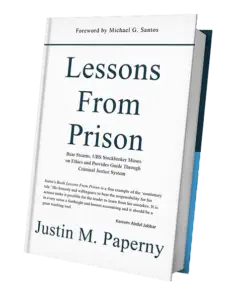
Justin Paperny and Michael Santos founded White Collar Advice in federal prison in 2008. One idea drove it: document everything. Judges don’t believe words. They believe records.
Everything here is free. The blog, the courses, the Tuesday webinar at 11am Pacific. That’s not a marketing strategy. It’s the model. Those who see the value and want a team to engineer the plan hire us. We never promise outcomes. We let the record speak.
The work is rooted in 26 consecutive years Michael Santos served in federal prison. Everything we teach flows from his framework. You cannot fake that. No competitor has it.
We never ask you to do what we have not done and documented. We are not prison consultants. We are engineers who help people build records that overcome the government’s one-sided version of events.