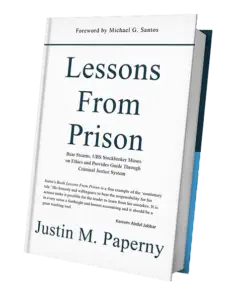
14 Costly Errors That Lead to Longer Prison Sentences – How Defendants Lose the War for Leniency — And the Strategies to Win It
By Justin Paperny and Tayana Franco
Featuring interviews by Michael Santos with Judges Stephen Bough and Mark Bennett
Table of Contents
Guide to Structure
How to Read This Book
Author’s Preface
Introduction
Part I — The Foundations of Failure
Error 1 Mistaking Silence for Strategy (Guided by the Polarity Strategy)
Error 2 Building a Case Around Excuses, Not Change (Guided by the Counterbalance Strategy)
Error 3 Ignoring the Ecosystem of Stakeholders (Guided by the Envelopment Strategy)
Error 4 Waiting Until Sentencing to Show Remorse (Guided by the Blitzkrieg Strategy)
Interlude I: What Judges Really See
Part II — Understanding Influence and Perception
Error 5 Failing to Understand What the Judge Values (Guided by the Intelligence Strategy)
Error 6 Ignoring Social Proof Opportunities (Guided by the Flanking Strategy)
Error 7 Treating Sentencing as a One-Day Event (Guided by the Chain-Reaction Strategy)
Error 8 Weak or Vague Calls-to-Action (Guided by the Decisive-Point Strategy)
Interlude II The Power of the PSR
Part III — Discipline, Framing, and Personal Responsibility
Error 9 Believing Cooperation Alone Keeps You Out of Prison (Guided by the Double-Edged Sword Strategy)
Error 10 Believing Paying the Money Back Keeps You Out of Prison (Guided by the Economy-of-Force Strategy)
Error 11 Misaligning the Message with the Moment (Guided by the Guerrilla War-of-the-Mind Strategy)
Error 12 Going to Sentencing Without a Detailed Plan (Guided by the Command-and-Control Strategy)
Interlude III The Rare Apology
Part IV — Timing, Adaptability, and Redemption
Error 13 Starting Too Late (Guided by the Death-Ground Strategy)
Error 14 Failing to Adjust When the Data Speaks (Guided by the Counterattack Strategy)
Interlude IV The Record That Speaks After You
Appendices and Closing Sections
Appendix A The Mitigation Checklist
Appendix B Case Snapshots
Appendix C How Families and Friends Can Help
Author’s Note
Final Words
Guide to Structure
This book started because Tayana and I got tired of watching people lose years they didn’t have to lose. We have seen it hundreds of times now… smart people, good people, who just didn’t understand how to respond when the government came after them.
For clarity, we don’t play lawyer. What we focus on are the things that influence how government bureaucrats see you: your actions, your tone, the record you build… day after day.
💡Your record decides how long you’re away from your family!
There are fourteen mistakes in this book. Every one of them came from actual cases. Nothing made-up, make-believe. These are patterns we’ve watched repeat in courtrooms all over the country. And truth be told… the sentencing mistakes are the same going back to when I started attending sentencing hearings in 2009, after my release from prison. To date, I have attended more than 1,500 hearings; same mistakes now and then.
For each mistake, we’ve added the counter-move or sentencing mitigation strategy that fixes it. We borrowed a few ideas from Robert Greene’s 33 Strategies of War–not the language, just the logic and the way it’s structured. Greene wrote about generals; we’re talking about defendants. Same idea: know what’s coming, don’t panic, respond fast.
💡That’s all the structure you need: read the error, understand why it happens, and see how people corrected it.
How to Read This Sentencing Mitigation Book
This is that ONE thing you don’t want to rush. This is your life. Do it right, once.
💡Read and digest ONE mistake at a time.
I mean it! Slow down, take your time. If you speak with Tayana or me… we will quiz you!
After each section there are questions. They’re not homework and you’re not required to answer them. But you should… since we are trying to engineer the best possible outcome.
You can’t do it by reading alone–you must get engaged, answer them honestly and start building a record that influences cynical government bureaucrats.
If you’re reading this for someone you care about, don’t cushion it. They don’t need comfort right now; they need clarity, honesty: a truth teller!!!
If you’re an attorney, this helps your client show the judge who they really are: not who the government wrote about in the indictment or sensationalized press release.
💡Judges pay attention to people who do the work over time.
They pay attention to timing. They notice when someone owns it early instead of scrambling at the end. This book is about helping you build assets over time to help you engineer the outcome you want: the shortest sentence possible (you will also feel great along the way knowing you are doing all you can to respond to this difficult situation).
Quick Note From JP
When I went to federal prison, I thought my sentencing was about the crime. It wasn’t. It was about how the judge, the prosecutor, and the probation officer perceived me.
That part crushed me because I’d built a career on controlling perception. I thought my background and education would protect me. They didn’t. I left the work to my lawyer, stayed quiet, and, as described in chapter one of After the Fall, walked into court blind, foolish, stupid.
💡In and after prison I kept meeting people who made the same mistake.
They thought silence meant strength or that paying the money back or cooperating would be enough to keep them out of prison. It never is. Judges see everything in patterns, and silence looks like denial.
Tayana sees those patterns earlier than I do. She’s usually the first call—the person someone talks to right after getting the knock on the door or the target letter. She hears it all: the panic, the anger, the bargaining. By the time they reach me, most of that’s settled. She’s the one who gets the raw version.
That’s why she’s part of this. Her conversations show where people freeze. My work starts once they move. This book comes from both sides of that phone line.
Quick Note From Tayana
Here’s the real deal… most people call me first when the system lands on them. Similar to when we call up customer service, I hear the frustration, the panic, the fear, the anger, you name it. Some are ready to act, some are frozen, thinking their good friend, lawyer or silence will save them.
Spoiler: it won’t.
And my commitment? To meet you exactly where you are. No judgment. No fluff. Just an honest conversation.
Here’s the part that always makes people laugh, even when things feel terrifying: I ask, “Who are you, really? Who raised you? What made you the way you think?” Because if you don’t tell your story, a judge only hears your silence… and your lawyers. Meanwhile, the prosecutors are painting the worst possible version of you… like a horror movie directed by your worst nightmare. It’s kind of like asking your crazy ex to describe you… not exactly accurate, right?
So what I do is help people get proactive:
Start showing the real you.
Build credibility.
💡Build the story that compels the government to take the totality of your life into consideration.
My heart goes out to people and their families that are going through this journey because I get it… the moment you start moving, creating, and documenting, everything changes. That’s the difference between being seen as a “monster” and being seen as a person who owns their life and wants to be part of the solution, as Judge Bough told Michael Santos in this video.
Introduction on Sentencing Mitigation
Federal sentencing feels like you’re standing still while everyone else moves around you… the prosecutor talking, the lawyer shuffling papers, the leathery wood smell, the stiff officers in every corner, the judge looking down at your central file that now defines your life.
💡You can’t control most of it, but you can control what version of yourself walks into that room.
Every chapter in here shows a common way people lose time they didn’t have to lose. Sometimes it’s silence (hey, that was me!). Sometimes it’s blaming. Sometimes it’s giving the wrong message. Sometimes it’s waiting too long to show they care. All of it adds up to the same thing: the judge seeing a person who didn’t prepare properly.
The result?
More time eating in the prison chow hall, or dining room, as some preferred to call it.
You’ll also hear directly from two judges, Stephen Bough and Mark Bennett. Michael Santos interviewed them, and their words explain what really moves a sentence down or up. Pay attention to those parts… they’re not opinions; they’re the view from the bench.
If you’re scared or frustrated right now, that’s normal. I was too. So is everyone Tayana and I talk to.
💡What matters is what you do next; your task, if you choose to accept it, is to build a record that proves you are different from the government’s one sided version of events. (I may repeat that phrase again as I write this book; let’s do it now–their version is one-sided and the onus is on you, no one else, to prove them wrong, to build your way out of this mess. Judge Boulware told me at a legal conference in San Diego the order of mitigation follows: defendant, lawyer, friends and family. Most people he said, “get the order wrong.”
I urge you to read this book slowly. Think, be deliberate. Fix one thing at a time.
Trying to repair it all at once leads nowhere. It is too overwhelming. After reading, pick one thing, one, then implement. I was going to write, rinse and repeat, but I truly hate that phrase. I mean I really hate it. It is nearly as bad as my children saying “6,7” everyday. I have no idea what that means and I am too lazy to google it.
Let’s keep going.
Part I — The Foundations of Failure
Error 1: Mistaking Silence for Strategy
(Guided by the Polarity Strategy: Pick a side and commit. Split messages destroy credibility.)
When you’re under investigation, silence feels safe. Everyone tells you not to talk. Your lawyer says, “Don’t make it worse.” Friends say, “Keep your head down.” And sure, there’s a time for that. But at sentencing, silence kills you.
Here’s what I mean:
The judge isn’t guessing who you are. They’re reading a record. That record is mostly written by other people: the government, probation, victims. If your voice isn’t in there, your version doesn’t exist.
Judge Bough told Michael Santos:
“You’re creating your own evidence—for good or bad. The PSR puts a human face on the individual. If I don’t see responsibility there, I assume it doesn’t exist.”
Judge Bennett said almost the same thing:
“So often, defense lawyers just go with the government’s offense-conduct statement. They don’t spend enough time with their client to contest it or tell the defendant’s point of view.”
So yeah… silence doesn’t protect you. It replaces you and it sure replaced me! Never forget, I interviewed Paul Bertrand, the FBI agent who arrested me. He said had I responded differently I would have avoided prison.
Case Example A – The Doctor Who Stayed Quiet
A New York doctor was looking at 47–54 months for health-care fraud. When probation called, he gave one-word answers. The report called him “minimizing.” The judge quoted that word out loud and hit him with 54 months—the top of the range. Let me repeat for the record: “minimizing”. That’s the result of spending seven minutes preparing for a probation interview.
Case Example B – The Doctor Who Spoke Up
Same kind of case, same district. This doctor rewrote his statement months before sentencing. He cut out excuses, paid $640,000 in restitution, and said it wasn’t about avoiding time—it was about making things right. The judge believed him and gave 24 months with one year supervision. One year. Yes, I wrote it again on purpose, as the result was that impressive.
Lesson
💡If you don’t prepare and tell your story, someone else will, and you won’t like their version.
Judge’s Lens: Silence leaves the government’s story unchallenged. Participation creates evidence of your own character.
Reflection
Why are you still hiding behind your lawyer?
If the judge only had your words, would they know who you are, what you learned, where you are doing?
What’s one thing you can create today that proves you are more than bad decisions from your past?
Error 2: Building a Case Around Excuses, Not Change
(Guided by the Counterbalance Strategy)
People think judges want to hear explanations. They don’t.
“I did not have bad intentions.”
“I was under pressure.”
“I trusted the wrong person.”
Those lines make judges tune out faster than anything else. Some Judges, like Judge Blumenfeld in Los Angeles, get irate!
Judge Bough said it this way:
“If your kid throws a baseball through the window and says, ‘I’m sorry,’ that’s one thing. But if they’re busy cleaning it up and not blaming Bobby next door, that’s real remorse.”
And Judge Bennett added:
““Good allocution takes responsibility, talks about the impact on victims, and includes a solid plan of rehabilitation — what they think they can get out of prison programs and what they intend to do when they get out.”
Here’s what they’re saying: stop talking about why you did it and start showing what you’re doing about it. That’s why you hand a release plan to a Judge at sentencing, along with your personal case study (or personal narrative as I used to call it).
Case Example A – The Broker Who Argued
A Boston securities broker faced 37–46 months. He used his PSR interview to argue about the unfair DOJ press release. Probation wrote, “Defendant downplayed seriousness and shifted blame.” The judge read that line in court and gave him the high end—46 months.
Case Example B – The Accountant Who Changed His Tone
A Dallas CPA in the same range volunteered early, said he used the DOJ press release as a learning lesson for his children and made sure his case study was authentic—no defensiveness, no excuses. He added a short plan about mentoring others after release. The judge went below the guidelines—24 months—and recommended FPC Montgomery. He did the drug program (RDAP) and he was released in 9 months and two weeks.
Lesson
💡You can’t argue your way into leniency. You can only show it.
Judge’s Lens: Apologies mean nothing until they show up as work to repair the damage.
Reflection
What lines in your statement still sound defensive?
Do you spend more time explaining or repairing?
What’s one action that would speak louder than another paragraph?
Error 3: Ignoring the Ecosystem of Stakeholders
(Guided by the Envelopment Strategy: Surround every decision-maker with the same consistent message.)
Most people think sentencing is about convincing one person—the judge. It’s not.
You’re also being judged by the probation officer who writes your report. The prosecutor who’ll argue against you. Even the case manager later at the Bureau of Prisons. All of them are part of your life. They talk to each other, compare notes, and by the time you walk into court, the impression’s already built.
Judge Bough put it like this:
“The guidelines are a grid. The 3553 factors are where I put the human face on the defendant.”
Judge Bennett said:
“I find well-done psychological records and reports and medical history and reports are very helpful… depending upon who the psychiatrist or psychologist is and how much experience they have.”
If you tell a different story to every stakeholder, you look dishonest. Be consisted with probation, psychiatrist or psychologist, lawyer: everyone.
Case Example A – The Executive Who Ignored the Flanks
A Boston executive facing 41–51 months for securities fraud had a lawyer who produced a five page sentencing memorandum and didn’t create any objections or clarifications to the probation report. The defendant, I know because he hired us after sentencing, was in his own words, “totally checked out, completely.” At sentencing Judge Gorton said, “He doesn’t get it.” The judge gave him 48 months, a $50,000 fine and would have taken him into custody, “if not for his two young kids.”
Case Example B – The Entrepreneur Who Enveloped
A Seattle tech founder charged with wire fraud (let’s call it what it was, a Ponzi Scheme) wrote a personal letter to probation explaining his plans to pay back the $1.2 million through selling of assets, including his primary residence. His character letters to the judge spoke to his character, not wasted space like, “there is no need to send him to prison.” His lawyer’s memo for the prosecutor acknowledged all the victims and made clear severe consequences should follow. The judge said, “Consistency and a record I think I can rely on. Time will tell,” and gave him 24 months—half the range.
Lesson
💡Everyone reading about you should see the same person.
Judge’s Lens: Every stakeholder reads you differently. Your job is to make sure they all see the same person.
Reflection
Would your probation report and your memo describe the same person?
Do your character letters speak to your character?
Where are you sending mixed signals without realizing it?
Error 4: Waiting Until Sentencing to Show Remorse
(Guided by the Blitzkrieg Strategy: Move fast and overwhelm with evidence before anyone defines you.)
This one hurts to watch because it happens all the time.
People wait until the week of sentencing to write an apology or make a donation or start volunteering. They think, “Better late than never.” Judges see it and think, “”These last minute efforts are totally contrived.”
Judge Bough said:
“I can count on one hand the number of times I’ve been genuinely moved by an apology.”
Judge Bennett added:
“When I ask if they want to speak, and they look at their lawyer like it’s the first time they’ve thought about it—that conversation should happen long before sentencing.”
Case Example A – The Last-Minute Speech
An LA (he was from the 818, like me) financial advisor wrote his statement the night before court. It started with, “I take full responsibility but…” The judge stopped listening after the “but” and gave him 37 months—the high end. Generally, “buts” or “howevers” should be totally removed from your vernacular, presuming you want a shorter sentence.
Case Example B – The Early Starter
A Los Angeles attorney pled guilty to bank fraud (this was a fascinating case as he dipped into the trust fund to get compensated from a client who stiffed him). Right after, he started volunteering at Prison Professors Charitable Corporation. He time stamped his hours, got letters, and sent updates to probation. His lawyer filed the memo a week early with everything attached. The PSR described “genuine and proactive rehabilitation.” The judge gave him the low end—21 months—and gave him five months to surrender to Lompoc Federal Prison Camp.
Lesson
💡Remorse has a timestamp. The earlier it starts, the more real it looks.
Judge’s Lens: Last-minute remorse looks like strategy. Start early or it doesn’t count.
Reflection
When did you start showing remorse?
Can you prove it with dates, not words?
If sentencing were tomorrow, what would your record say about timing?
Interlude I – What Judges Really See
Judges don’t sentence people; they sentence what they can verify.
Judge Bough:
“You’ve already pled guilty. You had ninety days. You could have reached out and had restorative justice all on your own. You don’t need me to do it.”
Judge Bennett:
“When defendants finally speak, too many talk about how the crime affected their family, not their victims. That can move a judge the wrong way.”
Both of them are talking about the same thing—effort. Not talk. Not emotion. Effort.
They read for patterns. Early action. Consistency. Something that looks like self-awareness, with a total focus on the people harmed.
If your remorse or change only shows up when you need something, it doesn’t count.
Judge’s Lens: Remorse isn’t about you; it’s about the people you hurt and when you start showing it.
Part II — Understanding Influence and Perception
Error 5: Failing to Understand What the Judge Values
(Guided by the Intelligence Strategy: Learn the terrain—know your judge, your prosecutor, your audience.)
People keep asking, “What do judges want?” as if there’s a single answer. There isn’t. Every judge has a pattern—some care about restitution, some about deterrence, some about family impact. But most defendants never bother to find out which one they’re standing in front of nor do they consider the Judges values.
Judge Bough told Michael Santos:
“Know your judge. Talk to your lawyer. Figure out their background and what they value.”
Judge Bennett:
“I don’t generalize. I look at the life of the individual in context.”
In our Pre-Suasion webinar we emphasized that the people we’re most likely to be persuaded by are those we identify with—those we perceive to share our values. It’s human nature. We respond best when we feel connected. That’s why your judge’s background and their values matter.
So ask yourself:
What does your judge value?
Discipline? Education? Public service? Accountability?
If you’ve identified those values—have you mirrored them? Have you shown your work ethic, how you are making things right? Have you written, taught, served, or contributed in any way that echoes what your judge spent a career building?
If not, why would they identify with you?
Case Example A – The Copy-Paste Memo
A Chicago investment adviser copied another defendant’s narrative he found nearly word for word. Different case, different judge, same boilerplate. But this judge knew (this is their job after all) this defendant wasn’t authentic, something was missing. Further, this narrative he stole missed the part this Judge cared most about. Thirty-seven months, took him into custody. Top of the range sentence.
Case Example B – The Homework Memo
A Denver business owner spent a weekend reading five sentencing decisions from his judge. Every one of them mentioned teaching, mentoring, and education. He wrote a long letter around those themes, showing how started speaking to business students (he spoke with me at the USC Marshall School of Business) and he planned to continue teaching ethics classes inside. The judge called it “thoughtful” and gave him a year and a day at FPC Florence. He was home in four months.
Lesson
💡If you don’t know what moves your judge, you’re guessing. And guessing costs months.
Judge’s Lens: Judge Bennett explained that judges read thousands of cases and notice patterns. He said most defendants never study what has moved judges in prior cases — a missed opportunity to prepare better.
Reflection
Have you looked at what your judge has done before?
Does your statement sound personal or copied?
If someone read it out loud, would they believe you wrote it?
Error 6: Ignoring Social Proof Opportunities
(Guided by the Flanking Strategy: Come at the problem from an angle no one expects—authentic voices, real, strategic assets.)
The truth is most letters miss the mark, tell a Judge what to do and fail to focus on the only thing the Judge wants to learn more about: the defendant’s character.
Judge Bough:
“I’ve had 67. In one case, that’s too many. 67 character references are too many. I don’t need the whole community, whether it’s a white collar crime or someone who’s been selling drugs. … Five is probably as many as you can really come up with. If all you’re going to say is, this guy’s a really good guy and he screwed up and please go light on him. I don’t need 50 of those. A couple of those are okay, but I’m looking for somebody genuine, somebody that really knows that criminal defendant, somebody that really knows how they’ve progressed through life and how they’ve progressed since being arrested.”
Judge Bennett:
“So I’d much rather have a letter from a street sweeper or a janitor that has known the individual for, you know, maybe more than ten years or maybe most of their life than a letter from a state senator or a United States senator that’s clearly writing it as a favor to the family and may or may not even know the individual.”
Letters only work when they sound real. Cut-and-paste praise makes you look stupid, resulting in a longer prison term.
Case Example A – The Mass Email
A Florida developer sent out a template to everyone he knew. Fifty-two letters came back with the same opening line. Probation wrote that they “appeared coordinated.” The judge barely glanced at them and gave 50 months at FPC Miami.
Case Example B – The Flanking Set
A Texas CPA (great guy by the way and a two handicap golfer who crushed me on the course!) facing tax evasion charges chose six people—clients, a neighbor, a pastor, Michael Santos and two employees. Each letter told a specific story about how he’d improved the life of someone: with specifics, rather than “he is a great guy who loves to help people.” The judge called them “credible and consistent” and sentenced him to 12 months home confinement.
Lesson
💡Pick voices that show your effort from different angles. A handful of honest letters beats a stack of empty ones.
Judge’s Lens: Judges care less about who you know and more about who actually knows you.
Reflection
Who can speak to what you’ve actually done?
Do their letters sound like them or like you wrote them?
If you were the judge, which one would you believe?
Error 7: Treating Sentencing as a One-Day Event
(Guided by the Chain-Reaction Strategy: Small moves done early create momentum that’s hard to stop.)
Most people treat sentencing like a deadline. It’s not. It’s a timeline. Every meeting, every submission, every conversation builds or breaks momentum.
Judge Bough:
“This is the most important day in a defendant’s life. And I understand that. I’ve got to keep cases moving and can’t give everybody every day, the whole day. And so finding that balance and me understanding that it’s the most important day in that defendant’s life and that defendant understanding, I’ve got two other guys that feel the same way that we’re going to hear today and mutually respecting each other and the limits on that is important.”
Judge Bennett:
“Allocution can have a huge impact. Not in every case, but across the board allocution was a significant factor, hardly ever raising a sentence, but a significant portion of the time moderating a sentence. Maybe it doesn’t result in a below guideline sentence, but it results in a judge who is thinking about sentencing in the middle of the guidelines to go to the bottom of the guidelines.”He meant that your paperwork, the record you build does the talking. If you wait until the last minute, it shows.”
Case Example A – The Scramble
A Virginia contractor wrote a last minute letter that focused on how his own life had fallen apart since his arrest. Then he gathered 10 boilerplate letters before sentencing that focused on how much his kids would miss him and that it made more sense for him to be in the community working to pay restitution, rather than prison. His Judge called the letters “calculated.” At sentencing his probation officer summed up his actions as “recent and reactive.” The judge gave him 15 months and just 10 days to surrender to prison, making it likely he would have to surrender to the United States Marshalls instead of going directly to a camp. If there was one guy in 2020, during Covid, who should have avoided prison it was this guy.
Case Example B – The Chain Builder
A New Jersey dentist began his plan right after his plea. Weekly volunteer logs, ethics training, new compliance program (okay, we wrote it; it was really good!) monthly restitution payments, regular updates to his probation officer, his lawyer. He never once mentioned the $1.2 million he paid back. By sentencing, the pattern was clear. The judge said, “This shows habit, measurable progress” and gave home confinement. He also kept his dental license!.
Lesson
💡Start early. Consistency tells the story for you.
Judge’s Lens: If I can’t see your progress across time, I assume it doesn’t exist. — Judge Bennett
Reflection
When did you start documenting your progress?
Is there a record of it, or just memories?
What’s one small thing you can start tracking today?
Error 8: Weak or Vague Calls-to-Action With The Wrong Message
(Guided by the Decisive-Point Strategy: Focus everything on one clear argument that actually matters.)
When judges review the sentencing mitigation assets you create (case study, release plan, volunteer work, etc.) they should know exactly what you stand for. Most don’t. They see pages of random arguments—health, family, charity—all piled together with no focus or discipline.
Judge Bough:
“The allocution is an opportunity for somebody to say, I’ve recognized what I’ve done is wrong. And here’s how I’m going to try to make amends to my victims and how I’m going to try to make amends in the future and change my life path. And so if you don’t do that, then you’re missing out on a piece of advocacy that is essential to the case.”
Judge Bennett:
“I had a sentencing just last week where I came very close to increasing the sentence based on the allocution. All he did was complain about the fact that his family was upset at him and he had no empathy at all for any of the victims of the crime. It was all about him and his family, and I found that offensive.”
Case Example A – The Laundry List
A Houston banker submitted a 80-page memo that covered every possible reason for leniency. The problem was the words did not match his actions over the 22 months he lived as a defendant. The judge called his statement “boilerplate” and gave him 33 months at FPC Texerkana.
Case Example B – The Focused Ask
A Denver small-business owner picked one theme—besides remorse, of course, his new business that proved he could earn a living, and pay taxes, as a law-abiding citizen. Every word, every action reinforced that. The judge said, “Focused and sincere,” and gave 10 months at FPC Sheridan.
Lesson
💡You can’t persuade someone to believe everything. Pick one point and prove it.
Judge’s Lens: Your sentencing day matters, but it’s your long-term preparation that really determines the outcome.
Reflection
What are you actually asking for?
Does your memo say it clearly?
If the judge had ten seconds to summarize your request, could they?
Interlude II – The Power of the PSR
The Presentence Report sets the tone for everything—sentence length, federal prison placement, bunk, job, early release opportunities (Residential Drug Abuse Program) and more.
As Ron Burgandy, “it is sort of a big deal.”
Judge Bennett:
“I would be super impressed in reading a pre-sentence report if I knew that the defendant had thought about that (written the personal narrative) even at the time the pre-sentence report was being prepared, rather than waiting until the night before sentencing to come up with it. So that would be astoundingly impressive to me to have a defendant that thoughtful and a defense lawyer that thoughtful, that they would include that information in the pre-sentence report and the pre-sentence report.”
Judge Bough:
“If there’s things in the PSR that the lawyer can cite to and that the defendant can cite to and talk about, you’re creating your own evidence at that point, for good or for bad. You’re telling your PSR writer in the probation office, here’s everything you need to know about me and how I got here. That is good advocacy.”
The PSR is your chance to show that human face. Write a section in your own voice. Attach evidence of everything you’ve done to become part of the solution, as Judge Bough told Michael. Check every detail for accuracy and be authentic, vulnerable; you’re the star of this show. Do not outsource work only you can do.
Judge Bennett (yes, I am saying it again, in case you skipped over it) told Michael he’d be “astoundingly impressed” to see a defendant include a personal narrative in their PSR. He never has. That means you still can.
Practical Steps
Read your draft PSR like you’re the judge
Fix errors right away.
Add context that explains —not excuses—how you got here and what you’re doing to make it right.
Get your narrative to your probation officer and ask them to insert the letter in the completed report.
Judges and probation officers identify with people who have done the work over a sustained period of time.
Judge’s Lens: A real plan shows accountability. Self-pity shows you still don’t get it.
Part III — Discipline, Framing, and Personal Responsibility
Error 9: Believing Cooperation Alone Keeps You Out of Prison
(Guided by the Double-Edged Sword Strategy: Anything can help or hurt you depending on how you use it.)
People think that because they helped the government, the judge will keep them out of prison. It doesn’t always work that way.
Cooperation matters, sure. But it doesn’t erase what happened. It only tells part of the story. If the rest of your life looks empty—no plan, no reflection, no documented progress—cooperation just feels transactional.
Judge Bough:
“I think when you look at that, if you’re a federal judge and you’re sentencing somebody, you want to know that somebody’s genuinely remorseful for what they’ve done.”
“And so coming in and being genuinely remorseful and not just saying I’m sorry to everybody in the courtroom, but knowing who the victims are and trying to heal that regardless of my sentence and just truly self-evaluate themselves and figure out how they got in this spot and start making conscious efforts to improve.”
Judge Bennett:
“Allocution can have a huge impact. … For example, I had a sentencing just last week where I came very close to increasing the sentence based on the allocution because the offender … had no empathy at all for any of the victims of the crime. It was all about him and his family. Good allocution takes responsibility, talks about the impact it has on the victims, and, especially, and this is pretty rare, indicates a solid plan of rehabilitation.”
These quotes are relevant because they focus on what Judges want to see: focus on victims, remorse, your plans moving forward: not just your damn cooperation.
Case Example A – The Partial Cooperator
A Florida businessman helped prosecutors with another fraud case. He got credit, but his PSR said “limited personal reflection or understanding of his offense.” The judge still gave him 27 months at FPC Miami.
Case Example B – The Full Cooperator
A New York trader testified, then started teaching finance classes inside his community. He repaid victims and wrote publicly about what he learned. The judge called it “comprehensive rehabilitation” and sentenced him to time served plus supervision.
Lesson
💡Cooperation is one piece, not the whole picture. It can’t replace your own work.
Judge’s Lens: Helping the government doesn’t replace helping yourself. Cooperation earns credit; character earns trust.
Reflection
Have you done anything that wasn’t part of your deal?
Would your file look good if the prosecutor said nothing about your help?
How are you showing who you are outside of cooperation?
Error 10: Believing Paying the Money Back Keeps You Out of Prison
(Guided by the Economy-of-Force Strategy: Put your energy where it counts—don’t waste motion on noise.)
Writing a check doesn’t fix the problem by itself. Some people do it early and mean it. Others do it right before sentencing and call it “restitution.” Judges can tell which is which.
Judge Bough:
“Paying restitution is important, but only when it’s paired with genuine accountability. If you break the window, you fix it. You don’t blame it on Bobby. You go in and fix it. And if it costs more money than you got in your pocket to fix it, then you volunteer to mow the lawn or feed the dog or whatever you’ve got to do to make this right.”
Judge Bennett:
“Absolutely. That’s much more impressive than saying in the allocution, ‘I hope when I get out to start making restitution payments.’ You’ve started making restitution payments and you probably don’t have a lot of money. If you’ve hired a defense lawyer, they have most of your remaining funds. I’m being facetious there, but no, the fact that you’ve been willing, even if it’s a small amount, if that’s all you can afford … I’d be impressed by it if I thought it was sincere.”
Money without sincerity just looks like strategy.
Case Example A – The Last-Minute Payment
A New Jersey banker wired $2.1 million three weeks before sentencing and made it the centerpiece of his personal narrative and sentencing statement. The judge called it “calculated” and gave him 51 months at FCP Otisville.
Case Example B – The Repair Work
A Phoenix dentist started paying restitution months before sentencing. He also volunteered at a local college, speaking about ethics. The judge said it showed “repair, not manipulation,” and gave him 12 months at FPC Tucson.
Lesson
💡Restitution means more when it’s part of a bigger pattern—time, effort, follow-through.
Judge’s Lens: Restitution matters, but paying to look good is different from paying to make things right.
Reflection
Have you shown effort beyond writing a check?
Do your actions prove sincerity or fear?
If someone read your timeline, would it look steady or last-minute?
Error 11: Misaligning the Message with the Moment
(Guided by the Guerrilla War-of-the-Mind Strategy: Adapt to the setting, change tone fast, stay unpredictable.)
Every stage of the process has a different tone. The PSR interview isn’t the sentencing hearing, and the sentencing hearing isn’t the allocution. People mix them up all the time.
Judge Bennett:
“Every case is different. I don’t generalize. I look at the facts of every case, every case is different, and make a judgment. So it’s very important to put the life of the individual in context, because that can often explain—it doesn’t justify—but it does explain and in my judgment often mitigates what the punishment should be.”
Judge Bough:
“Different judges, different reactions—know your judge. And in knowing your judge, knowing their background, talking to your lawyer about it … I can come in and if I’m genuine and I really have tried to figure out what I did and how I got here, and the things I can do to address that, I vary down.”
If you sound defensive during the PSR, you lose credibility later. If you sound rehearsed during allocution, you lose authenticity.
Case Example A – The Wrong Tone
A Los Angeles contractor used his allocution to argue about legal issues. The judge called it “a closing argument disguised as an apology” and added three months.
Case Example B – The Adjuster
A Miami CPA changed tone with each step—direct with probation, factual in his memo, personal at sentencing. The judge said he was “balanced and mature” and sentenced him to a year and a day at FPC Pensacola.
Lesson
Different stages need different voices. Know where you are in the process and act like it.
Judge’s Lens: Each phase of sentencing has a tone. When a defendant mixes them, the message collapses.
Reflection
Does your tone match the setting?
Have you practiced what to say—or are you planning to wing it?
If the judge asked you a question mid-hearing, could you answer calmly?
Error 12: Going to Sentencing Without a Detailed Plan
(Guided by the Command-and-Control Strategy: Take charge of your plan—no one else will run it for you.)
Judges see hundreds of people a year. Most show up without any plan for what comes next. No program list, no work plan, no structure. That makes it easy to give a heavier sentence.
Judge Bough:
“I vary down when I can truly understand a defendant’s situation and see how they’ve planned to change their path.”
Judge Bennett:
“Good allocution takes responsibility, talks about the impact on victims, and includes a solid plan of rehabilitation—what they think they can get out of prison programs and what they intend to do when they get out.”
Case Example A – The Drift
A Denver lawyer convicted of money laundering walked into sentencing with practically nothing on paper. No schedule, no goals. He got a guideline sentence of 33 months. After asking for more halfway house time his case manager told him “you have no plan and no record to justify going home earlier, leave my office.”
Case Example B – The Planner
A Philadelphia consultant convicted of tax fraud filed a plan with his memo—RDAP, HVAC certification, job letters. The judge called it “a model of readiness” and gave him 10 months at FPC Schuylkill. He went home after 91 days at the camp, straight to home confinement.
Lesson
💡If you don’t show the judge what you’ll do, they’ll assume you’ll do nothing.
Judge’s Lens: A plan proves intention. Without one, you look like someone still waiting to be told what to do.
Reflection
What’s your plan after sentencing?
Does it fit your skills and history?
Would it convince someone you’re serious about change?
Interlude III – The Rare Apology
Judges hear apologies all day. Most sound the same.
Judge Bough:
“I can count on one hand the number of times I’ve been genuinely moved by somebody’s apology. They really recognized it, and not just a check mark of the box. I’m supposed to say, I’m sorry … but a true introspection and thinking about how they got there, I think is pretty valuable.”
Judge Bennett:
“When defendants finally speak, too many talk about how the crime affected their family, not their victims. That can move a judge the wrong way.”
An apology works only when it’s personal, specific, and backed by documented behavior.
Case Example – The Prepared Apology
A Houston software founder spent months writing and rewriting his statement. He shared drafts with his lawyer and mentor, practiced reading it out loud, and spoke directly to his victims. He finished by describing the concrete steps he’d take to repay them. The judge called it “authentic and practical” and went below the guideline range.
Lesson
💡Words matter less than evidence. Show what you’ve done, then speak from that place.
Judge’s Lens: Preparation shows sincerity. When I read a thoughtful apology supported by action, I believe the words. — Judge Bennett
Reflection
Have you written your statement yet?
Does it mention victims or just you?
If someone heard it, would they feel something real—or a script?
Part IV — Timing, Adaptability, and What Happens After
Error 13: Starting Too Late
(Guided by the Death-Ground Strategy: Act like there’s no escape route. That’s when people finally move.)
This one’s simple: most people wait too long. They wait for the plea. Then they wait for sentencing. Then they wait for the lawyer to tell them what to do next. By then, the story’s already written.
Judge Bough:
“I need to know ahead of time what I’m dealing with.”
He meant: if your preparation shows up at the last minute, it doesn’t matter how good it is. The judge has already decided who you are.
Judge Bennett told Michael Santos that judges read PSRs more than once. The earlier your work shows up, the more times it gets seen. When it’s late, it looks like panic.
Case Example A – The Last-Minute Video
A Virginia consultant sent in a video a day before sentencing. Probation had already turned in the report. His lawyer already turned in the sentencing memorandum, which did not include a personal narrative from the defendant. The judge hated the video saying, “This looks like someone trying to buy their way out of prison” and gave him 27 months at FPC Petersburg.
Case Example B – The Early Starter
A California engineer started the day after his plea. New job, therapy for AA and gambling, volunteer records—everything dated. The PSR memorialized his progress. The judge gave him a sentence 10 months below the low end of the sentencing guidelines.
Lesson
💡There’s no benefit to waiting. Every day you hesitate is a day that could’ve been on record.
Judge’s Lens: Preparation done early looks sincere. Preparation done under deadline looks strategic. — Judge Bennett
Reflection
When did you actually start working on your case, not just worrying about it?
Would your paperwork prove that?
If someone looked at your timeline, would they see fact or fiction?
Error 14: Failing to Adjust When the Data Speaks
(Guided by the Counterattack Strategy: When you get new information, adjust fast and turn it to your advantage.)
People think consistency means never changing their story. It doesn’t. Real consistency is staying truthful while learning from what’s in front of you.
Judge Bough:
“The lawyer can help put it together, but it has to keep coming back — it has to be genuine. But most of the time I really don’t need to hear from the defense lawyer. This is about the defendant. And if you believe what I’m saying about the inhumanity of the sentencing guidelines and the humanity of 3553, the best person to tell that story is the defendant.”
Judge Bennett:
“Every case is different. I don’t generalize. I look at the facts of every case, every case is different, and make a judgment. So it’s very important to put the life of the individual in context, because that can often explain — it doesn’t justify — but it does explain and in my judgment often mitigates what the punishment should be.”
You have to listen. If probation flags “minimizing,” fix it. If your lawyer says a line sounds defensive, cut it. That’s not weakness—it’s awareness.
Case Example A – The Stubborn One
A New York contractor refused to edit a paragraph in his statement that blamed auditors. The judge said it was “tone-deaf to the harm caused” and added four months.
Case Example B – The Adapter
A Georgia business owner rewrote his statement three times based on feedback. The final version focused on his employees and customers, not himself. The judge said it showed “unusual self-awareness” and gave him probation plus six months home confinement.
Lesson
💡You’re not there to prove you’re right. You’re there to prove you’ve learned.
Judge’s Lens: When I see a defendant take feedback and revise, I see growth. When he repeats mistakes, I see ego. — Judge Bough
Reflection
Have you made the same argument more than once?
Who gave you feedback that you ignored?
If you had to rewrite your story today, what would change?
Interlude IV – The Record That Speaks After You
When you walk out of the courtroom, your file keeps growing. That’s what people forget.
Judge Bennett:
“The number one thing for me is their prison record. What have they done? Do they have a clean discipline record or close to a clean discipline record? And what steps are they taking to become a better person? What courses are they taking? What classes are they taking? Are they helping other inmates? What are they doing with their time?”
Judge Bough:
“If somebody is in federal prison, they’ve had no violations. That tells me they’ll have no violations when they get out, which is what I want. My fairy-tale view of the world is that the sentence in the Bureau of Prisons is supposed to be the punishment aspect of it, and that supervised release is where we hopefully give people some skills and support and some monitoring to make sure they generally follow the rules of society.”
💡Every class, every job, every program becomes data. Your case manager writes notes in your central file. Those notes decide things later—placements, transfers, early release. A clean record helps. A record that shows contribution helps more.
Judge’s Lens: Your record keeps helping or hurting you long after sentencing.
Appendix A — The Sentencing Mitigation Checklist
Before Sentencing
- Write your own statement—plain, specific, honest.
- Review your PSR with your lawyer line by line.
- Collect five specific letters that show examples of how you helped someone.
- Start restitution and community service now, not later.
- Keep proof of every class, counseling session, or volunteer log.
During Sentencing
- Speak directly to the judge, not through your lawyer.
- Refer to what you’ve already done, not what you hope to do.
- Hand in your reentry plan with contact info and documentation.
After Sentencing
- Keep a binder of your prison work—certificates, notes, program records.
- Send updates to your family or advocates; they may help you later.
- Keep showing progress. Judges remember the names that show up again.
Appendix B — Case Snapshots
The Cost of Silence
A defendant refused to participate in his PSR interview. The report said “limited insight.” The judge added 18 months.
The Value of Consistency
Another man started volunteering after his plea. Six months later, the PSR documented it. The judge cut a year.
The Late Apology
A woman wrote her apology the night before sentencing. The judge said, “If I’d seen this months ago, it might’ve changed things.”
The Complete Plan
A man filed a detailed reentry plan with letters from employers. Judge Bough called it “a plan that looks real.” He got the minimum.
The Post-Sentence Record
A defendant asked for early termination of supervision. Judge Bennett reviewed his file—perfect conduct, steady work, clean programs—and granted it a year early.
Appendix C — How Families and Friends Can Help
When someone’s facing sentencing, the people around them matter more than they realize. Here’s what helps.
- Keep Them Accountable
Ask what they’re doing, not how they’re feeling. It’s fine to care; just make sure the conversation doesn’t stay emotional forever. - Write Real Letters
Skip the adjectives. Tell stories. Describe something you saw. Judges can feel the difference. - Organize Everything
Help keep records—emails, volunteer logs, receipts. The cleaner the file, the stronger the message. - Don’t Overpromise
Don’t say “we’ll get through this.” Say “we’ll work through it.” There’s a difference. - Think Past Sentencing
Help plan for the first day inside and the first day out. Housing, job contacts, family support. Judges notice who has a plan waiting.
Support isn’t about saying it’ll be okay. It’s about showing the person they’re not alone in the work.
Author’s Note
When I walked into Taft Camp in 2008, I thought the worst part would be the time. It wasn’t. It was learning to accept I could not change the past. I had to let go of what I could not control.
I wrote this book with Tayana because she sees what I didn’t. She’s usually the first person people talk to—the one who hears the panic, the questions, the long silence before someone says, “I can’t believe this is happening.”
I meet them later, when they’re ready to embrace the work.
This book came from both places—her calls and my time inside, our years helping others do better than we did. The judges you’ve read about, the people we’ve met, the mistakes we’ve watched repeat—they’re all part of this.
It’s not complicated. You either take control of what you can, or someone else will define you.
Final Words
Judges support people who do the work. Everyone else blends together and is so easily forgotten. Start now. Be consistent. Enjoy the process.
Frequently Asked Questions
What is sentencing mitigation?
Sentencing mitigation is the work a defendant does to help the court see the full person, not just the offense conduct. It usually includes preparation, accountability, documentation, timing, and a stronger record.
Why do people get longer prison sentences than they expected?
Because they often misunderstand what sentencing turns on. They stay quiet, prepare late, ignore the presentence report, and assume remorse will be obvious without proof.
How important is the presentence report?
It is one of the most important documents in the case. It shapes how probation, the judge, and later the Bureau of Prisons understand the defendant.
Do character letters still matter?
Yes, but only when they are specific and credible. Generic letters full of praise usually do very little.
Does cooperation keep someone out of prison?
Not by itself. Cooperation can help, but it does not replace remorse, planning, discipline, or a persuasive record.
Does paying restitution guarantee leniency?
No. Restitution matters, but judges usually care how and when it happened, and whether it fits a broader pattern of accountability.
When should sentencing mitigation begin?
As early as possible. Delay is one of the easiest ways to lose credibility and increase the risk of longer prison sentences.
What is the biggest mistake defendants make before sentencing?
Many mistake silence for strategy. They let others define them instead of building a record in their own voice.