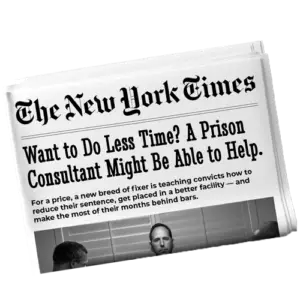
A headline. Los Angeles Times. My co-defendant had agreed to plead guilty and was cooperating in an ongoing federal probe. He had named an unindicted co-conspirator.
That was me: terrific!
I called my lawyer. He told me that for the past year, while I had been selling real estate and playing golf, Agent Bertrand and the assistant U.S. attorney had been building the case. My co-defendant had been talking. I was the unnamed co-conspirator.
That is what a proffer vs offer in federal court actually looks like from the receiving end. My co-defendant sat across from federal prosecutors, gave them everything he had, and walked out with a deal. I got a phone call telling me to plead guilty to a conspiracy count carrying up to 60 months.
That was a bad day. What made it worse was understanding what I had done to create it.
What Cooperation Means
Paul Bertrand spent 12 years investigating financial fraud for the FBI in Los Angeles. He explained to our community how cooperation works and why co-defendants become the government’s most powerful witnesses.
Most people cannot commit a federal crime alone. Someone else is usually involved. The best witness the government can put on the stand about your involvement is someone who was standing right next to you.
That is your business partner. Your CFO. Your co-founder. The person who processed the transactions, signed the documents, or was on the calls.
When that person decides to cooperate, they sit down with the prosecutor and the agents and they tell the whole story. Not just their part. Everybody’s part. What was said, what was agreed to, who knew what and when.
Paul said cooperation is powerful precisely because the cooperating witness was there. They do not have to reconstruct events from documents. They lived them.
Robert Greene on Information and Power
Robert Greene spent years studying how power works across history. His conclusion: information is the primary currency. The person who controls what others know, and when they know it, holds the advantage.
He wrote in The 48 Laws of Power: “Keep others in suspended terror: cultivate an air of unpredictability.”
That is what the government does to defendants. They know what your co-defendant said. You do not. They know what documents they subpoenaed. You do not know exactly which ones or what they show. They know whether there are other witnesses. You are operating in the dark.
The only rational response to that asymmetry is to stop making decisions based on hope and start making them based on what you can control, influence.
I did the opposite. I assumed the investigation would stall. I assumed my co-defendant would be the only one held accountable. I assumed the distance between what I did and what could be proved was bigger than it was.
None of those assumptions were correct. And I was the last to know.
What My Co-Defendant’s Cooperation Cost Me
When I lied to Paul Bertrand at my house, I committed obstruction. I did not think of it that way at the time. I thought I was protecting myself.
What I did was close the door on cooperation and put myself on a path to prison.
Paul went back to my former employer UBS after I lied to him. He spent the next year building the case from documents, witnesses, and everything I had told him that he then proved was false. By the time my co-defendant went to the U.S. attorney’s office and named me, I had nothing left to offer.
My co-defendant had four children. He made a pragmatic decision early. He told the truth about everything, including his own conduct. He got cooperation credit. I did not.
The government argued at my sentencing that I was actually less culpable than my co-defendant in the underlying conduct. Paul confirmed this. I was less involved. But my co-defendant cooperated and I did not, which is why he ended up in a better position than me despite being more involved.
Less culpable. Worse outcome. Because I wasted a year and then lied.
What is a Proffer Is Why It Is A Big Deal!
A proffer is a meeting at the U.S. Attorney’s office. You sit across from the prosecutor and the agents with your lawyer present. You answer questions about what happened. The government agrees, in most cases, not to use your statements directly against you if cooperation breaks down.
Paul was at my proffer. He took detailed notes. I saw those notes years later and was surprised by how badly I performed even when I thought I was being open. A lot of deflecting. A lot of framing. Not a lot of owning.
The proffer is not a casual conversation. The agents know the case, all the details. They have the timeline, the documents. They have what your co-defendant already said. They are not asking questions to learn what happened. They are asking to see whether you will be honest about what they already know. I would say they know 99% of the questions they ask you.
If you go around the elephant in the middle of the room, they notice. Paul said it plainly: that omission is treated like it was on purpose.
The proffer is also where you find out what cooperation actually looks like for your specific case. What the government wants. How long it could take. What you are agreeing to. Your lawyer needs to negotiate the proffer agreement carefully. What happens to your statements if cooperation falls apart matters.
Does Cooperation Keep You Out of Prison?
Almost never.
Paul said in his entire FBI career he saw one cooperating defendant avoid prison entirely. One case. That person cooperated on multiple investigations for approximately five years before being sentenced to probation.
Everyone else who cooperated got shorter sentences. Meaningful reductions in some cases. But they still went to prison.
This is important because defendants who hear “my co-defendant is cooperating” sometimes respond by assuming that if they also cooperate, they will stay home. That is almost never how it works.
Cooperation narrows the gap between what the government asks for and what the judge imposes. It does not eliminate the sentence.
What to Do if Your Co-Defendant Is Already Talking
First, do not call your co-defendant. Do not text. Do not reach out through anyone else. Your lawyer will tell you this. Listen.
Second, understand that the window to cooperate may still be open, but it is probably narrowing. The government values cooperation most when it gives them something they do not already have. If your co-defendant has already described everything you both did, your information may have less value.
Have a direct conversation with your lawyer about what cooperation would actually look like in your case. What would you be offering? What would they be asking? How long would it take? What is the realistic range of outcomes?
Get honest answers. Not what you want to hear.
Third, regardless of whether you cooperate, start building the record that exists outside of cooperation. Paul said something in our webinar that most defendants never act on: even defendants who did not cooperate and had no opportunity to cooperate got meaningful results at sentencing because of what they built in the time between indictment and sentencing.
Working helped me. Paying taxes. Getting letters from people I had actually helped, not people my wife emailed a template to. Volunteering in ways that could be measured and verified. Judge Wilson commented on every letter I submitted.
What the Government Is Not Telling You
The government is not going to call you and explain their case. They are not going to tell you how strong the evidence is or what your co-defendant said in specific terms. They are going to let you operate in the dark for as long as possible.
Greene’s point about information holds here. The side with better information makes better decisions. You are not going to get the government’s information. What you can do is stop making decisions based on assumptions you cannot verify.
Assumption: my co-defendant will not say much. Paul Bertrand spent a year disproving everything I told him. My co-defendant talked for months.
Assumption: this will probably go away. Federal cases that reach the indictment stage almost never go away.
Assumption: cooperation will keep me home. Almost never.
The defendants who get the best outcomes are the ones who stop assuming and start building. The record you create between now and sentencing is the only counter-narrative to what your co-defendant is telling the government right now.
What To Do This Week
Talk to your lawyer about the cooperation question directly.
Start building the record regardless of what you decide about cooperation. Journal. Pay something toward restitution if there are financial victims. Get into treatment if it is part of your story. Document everything with dates.
Take the free probation report course before your PSR interview: Probation Report Course
Join the free weekly webinar every Tuesday at 11am Pacific / 2pm Eastern: Register Here
If you want to talk through your situation directly, schedule a call. The earlier, the more there is to work with: Schedule a Consultation
Frequently Asked Questions
My co-defendant is cooperating. Does that mean I will be charged?
Not automatically, but it increases the likelihood significantly. A cooperating co-defendant gives the government a witness who was present for the conduct and can describe your involvement in detail. Talk to your lawyer immediately about where you stand.
What is a proffer in a federal case?
A proffer is a meeting at the U.S. Attorney’s office where you answer questions about the case with your lawyer present. The government typically agrees not to use your statements directly against you if cooperation falls through. It is how you begin the cooperation process and how the government evaluates what you can offer.
Is cooperation different from a proffer?
A proffer is part of the cooperation process, usually the beginning. Full cooperation means continuing to provide information, potentially testifying at trial, and working with the government over a longer period. A proffer can lead to a cooperation agreement or can end without one.
What is a 5K1.1 motion?
A motion filed by the prosecutor asking the judge to sentence below the guidelines based on the defendant’s substantial assistance to the government. It is only available when the prosecutor files it. The judge does not have to grant it, but most do.
Can I still get a good outcome if my co-defendant cooperated and I did not?
Yes. Paul Bertrand said defendants who did not cooperate still got meaningful results at sentencing because of what they built in the time leading up to it. The record matters regardless of cooperation status.
If I cooperate, will I avoid prison?
Rarely. Paul Bertrand said in his entire FBI career he saw one cooperator avoid prison entirely. Cooperation can reduce a sentence significantly. It almost never eliminates it.
Should I contact my co-defendant to find out what they said?
No. Do not contact them directly or indirectly. Talk to your lawyer.