Table of Contents
“Never wrestle with a pig. You both get dirty, and the pig likes it.” — George Bernard Shaw
Should I hire a lawyer right away? What good lawyers ask before you sign anything
The Moment
“Don’t sign anything today.”
“I’m not signing. I’m defending my name.”
“Those aren’t the same thing. Sit down. Tell me what you think you’re buying for $30,000.”
“Finding out who wrote it.”
“And then what? If we identify him and he fights back — where do we sue? What state? What’s the timeline if he contests it? What’s the worst-case number, not the best case?”
“I don’t know.”
“Then you’re not deciding. You’re reacting. Let’s figure out what you’re actually deciding before you write a check.”
On April 4, 2017, I did the opposite. I did not ask whether I should hire a lawyer right away. I just did.
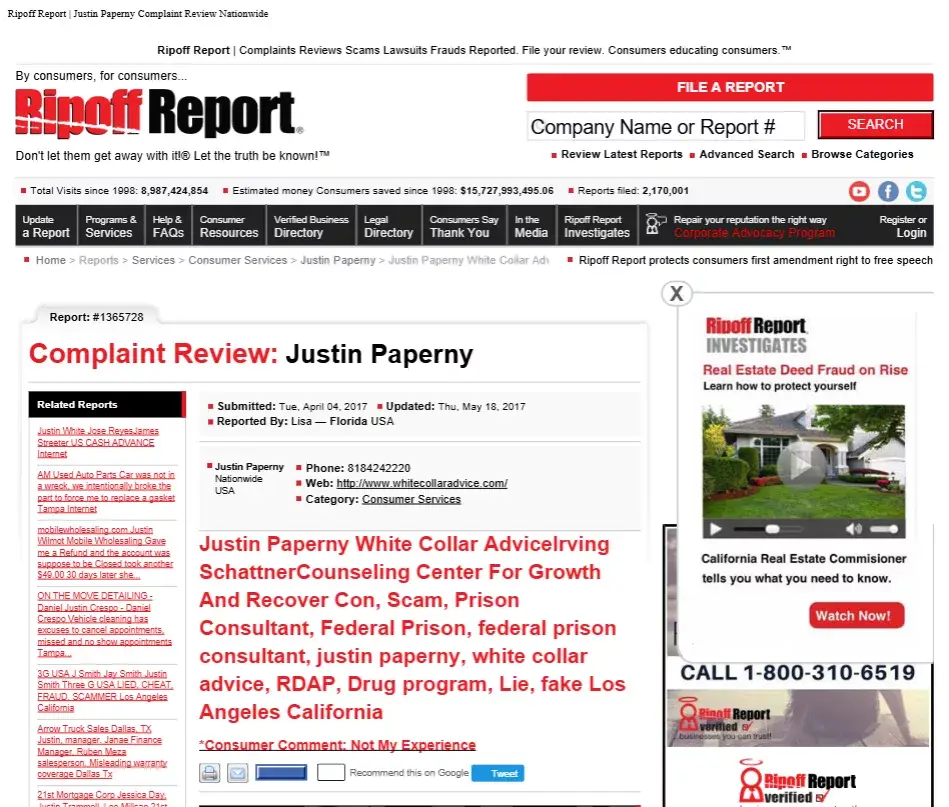
A Google alert landed in my inbox. Someone named “Lisa” — reporting from Florida — had filed Ripoff Report No. 1365728 about me. The headline called me a con and a scam. It said I charged families in crisis, took their money, and delivered nothing. It said people at a federal camp in Texas were warning each other about me. It called me the “White Collar Predator.”
I read it once. I knew immediately it was false. I also knew, with near certainty, who wrote it. The details were too precise, too targeted, too constructed. This was not an unhappy client. This was a competitor who knew exactly what would hurt me.
Nobody said “don’t sign anything today.” I signed two contracts before I picked my daughter up from pre-school.
What I did not know yet — and what took me two years and more than $100,000 to learn — is that the report had almost no power on its own. I gave it power. I handed it power the moment I picked up the phone.
This chapter is not about me. It is about the conversation I never had — and the one you need to have before you make the same decision I made. You will face a version of this. Maybe not a Ripoff Report. Maybe a lawsuit from a partner you trusted. A public accusation. A deal that blew up and someone is already calling an attorney. The circumstances will differ. The pressure will feel identical: act now, hire now, respond now.
What good lawyers do differently — the ones who actually protect you — is slow you down before any of that. Not to run up fees. Because they have watched enough clients make the decision I made, in the first hour, from the worst possible mental state, to know that urgency is almost always the enemy of judgment.
The Mistake People Make
Within one hour of seeing that report, my phone started ringing. Reputation management companies. One after another, same script: your search results will be destroyed, clients will find this before they find you, this will follow you forever, you need to act now. They were not calling by coincidence. They monitor these platforms. They set alerts for new filings. They call in the first hour specifically because that is the most profitable hour — the person on the other end is frightened and not yet thinking clearly.
I did what most people do when something feels like a threat: I mobilized. I acted. I never stopped to ask whether I should hire a lawyer right away or whether 24 hours of patience might change what I was walking into. I told myself action and judgment were the same thing.
They are not.
Think about the last time you made a significant decision while afraid. Not a small one — a big one. A lawsuit you almost filed. A confrontation that finally exploded. A partnership dissolving badly, lawyers already circling. In almost every case, the decision made in the first 24 hours costs more than any decision made in the following 30 days. Fear does not compress your options. It compresses your ability to see them. It makes the threat feel larger than it is and your leverage smaller. It tells you delay is danger.
Often, delay is wisdom.
Sometimes the right move is to ignore the attack entirely. Some reports, some accusations, some online hits — if you respond, you amplify. You create the Barbara Streisand effect: the thing that 40 people saw becomes the thing 4,000 people see because you drew attention to it. Sometimes the right move is to sue. Sometimes the right move is to address it openly and let your record do the work. The mistake is not choosing wrong. The mistake is choosing in the first hour, before you know which of those options actually applies to your situation.
The Cost
Here is what I did not understand when the attorneys told me the cost to identify the author would be $20,000 to $30,000. I heard the number. I did not ask what it meant.
What it meant: $27,000 in subpoenas to Google and Ripoff Report just to get a name. Google cooperated. Ripoff Report, based in Arizona, refused. So we filed a separate legal action in Arizona to compel them. New state. New attorneys. New timeline.
Once we had the name — Daniel John Wise, a prison consultant in Spokane Valley, Washington — we had to sue him in Washington state, where he lived. Another attorney. Another jurisdiction. Another retainer check I wrote without fully absorbing what it meant.
Wise did not fold when served. He claimed he had been hacked. He claimed a competitor had forced him to write the report. Every new fabrication required another response. I remember opening an invoice from the Washington firm one morning, the third one in two months, and sitting with it for a full minute before I could make myself look at the number. I attended court appearances virtually, from my desk in California, while attorneys billed by the hour in rooms I would never see.
I remember the moment it became clear the Arizona action was not going to resolve quickly. I was between client calls. I had maybe 20 minutes. My attorney was explaining why Ripoff Report’s resistance required an additional motion and I just sat there thinking: this is not ending. I had imagined a process with a finish line. What I had was a process with more process behind it.
Two years. More than $100,000. And then the turn I did not expect.
When I finally began mentioning the report openly — in conversations with prospects, in coaching sessions — I braced every time. The response was not what I had spent two years dreading. One prospective client said, “I saw that. I knew in three seconds it wasn’t true.” Another had Googled me before our first call, found it, and hired me anyway because everything else he found told a different story. A third had never seen it at all.
I had spent $100,000 and two years protecting a reputation from an attack my reputation had already survived on its own.
What I Did / What I Learned
Here is the part harder to admit than the money: I went quiet.
I have built my entire career on transparency. I counsel people facing federal prosecution to lead with honesty, to get ahead of the narrative, to trust that the truth told plainly is more durable than any strategy designed to contain it. When this happened to me, I did none of that. I managed it in the dark. Lawyers, suppression campaigns, strategy calls — all of it kept away from my audience, my clients, the world I had spent years building trust inside.
Two mentors told me, in different words, the same thing: this is part of building something. You are probably not as good as your best review and not as bad as your worst one. Move on. I searched Tony Robbins and found dozens of these reports. I searched other leaders I respected — same pattern. Anonymous attacks are a tax on visibility. The higher you build, the more certain people feel entitled to take a swing. My mentors were right. I heard them. I filed the lawsuit anyway.
What I wish I had done: talked about it the week it happened. Not defensively — not in the way that makes you sound like someone who got caught — but plainly. I had been on television. I had spoken to audiences across the country for years. I had hundreds of clients with documented outcomes. I had a record. A person with a record does not need to hide from a lie. They can simply point to the record and let it answer.
That said — and I want to be honest about this — going public is not always right either. Context matters. If the attack is obscure, talking about it can be the thing that makes it visible. The question is not “should I go public?” The question is “what does this specific situation actually call for?” That is the question I never slowed down enough to ask.
I also wish I had asked the attorney I hired one question before I signed: “What are the questions I should be asking that I haven’t asked yet?” That is the most underused question in any professional engagement. A good lawyer, given an honest client and that question, will tell you things you did not know to ask. The fee you pay for that conversation is the cheapest money you will spend.
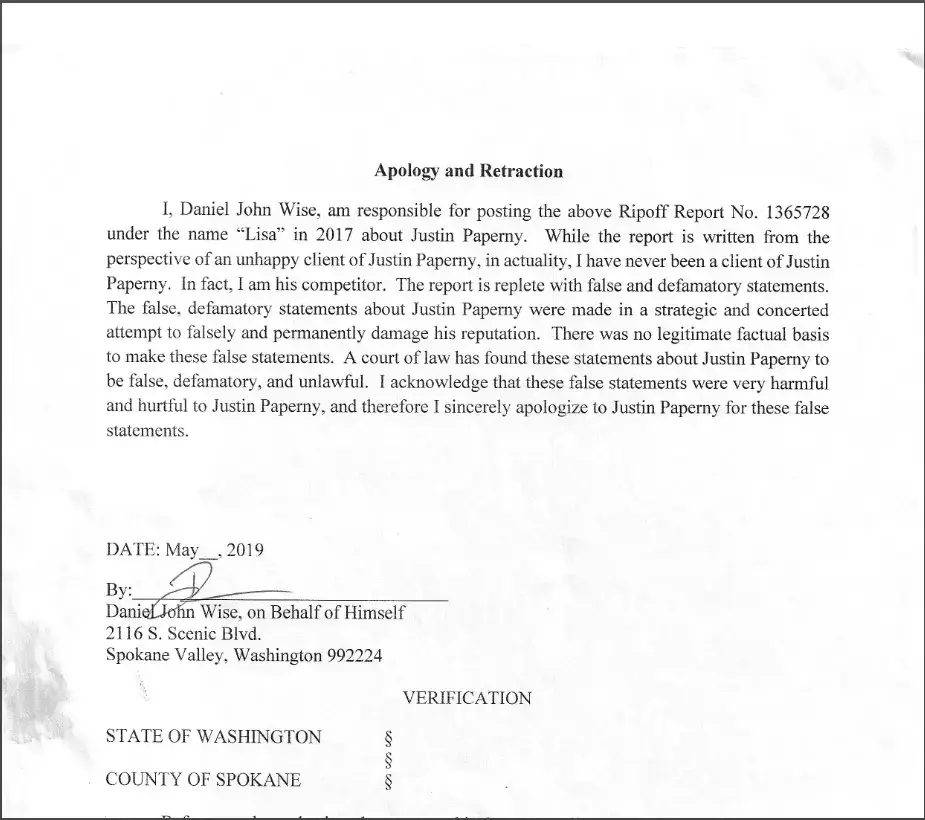
Daniel John Wise signed that document in May 2019, before a notary in Spokane County. He admitted he posted Ripoff Report No. 1365728 under the name “Lisa.” He admitted he had never been a client of mine — he was a competitor. He admitted the report was a deliberate, strategic attempt to falsely and permanently damage my reputation. He admitted there was no factual basis for any of it. A court of law found the statements false, defamatory, and unlawful.
I won.
Winning meant I had a signed document. A notarized confession in a file in my office. It did not give me back the two years. It did not refund the $100,000. It did not return the mental bandwidth I spent on a man in Spokane Valley while I was supposed to be building.
Winning, in this case, cost more than losing quietly would have.
What to Do Next
What good lawyers do differently is make sure you have the right conversation before you are committed to a path. They distinguish between what you have the legal right to do and what is actually in your interest to do. Those are not the same thing. The gap between them is where most legal fees are spent and most regrets are born. Here is how to close that gap before you write a check.
1. Should I hire a lawyer right away? Give yourself 24 hours first.
Not a week. Twenty-four hours. The firms that called me within an hour had set alerts for new reports. That is their business model: reach people at their most frightened. The first hour is the worst possible time to make a five-figure decision. Let the initial surge pass. The threat will still be there in two days. You will think more clearly about it.
2. Make the lawyer say the full number out loud.
Not the first number. The last number. Not the cost to identify the author. The cost if he fights, if he appeals, if it crosses two states. Make them say the timeline out loud too — not best case, worst case. Write it down in front of them. The answer to “what am I looking at if this goes the distance” should be part of your decision, not a surprise you encounter eighteen months in.
3. Ask: what questions should I be asking that I haven’t asked?
This is the most underused question in any high-stakes engagement — legal, financial, medical. A good lawyer will answer it honestly. If they cannot, or if the answer is vague, that tells you something important about who you are working with.
4. Call two people who will not simply validate your anger.
Not people who will confirm that yes, this is outrageous, you should fight. Those calls feel good and produce bad decisions. Call people who have built something, been through something like this, and will ask you hard questions. Ask them directly: would you file suit? What would you do instead? What am I not seeing right now?
If you need a vetted attorney before you make that call, schedule a call.
5. Search your own name the way a stranger would.
Open a browser you have never used. Search your name. Look at the first page as someone who has never heard of you and is deciding whether to trust you. If the attack is buried under years of legitimate work, your actual exposure may be far smaller than fear is telling you. Know the real landscape before you decide how to respond to it.
6. Keep building. Do not let the fight become your full-time job.
A good lawyer will tell you: I’ll handle the case. You keep building your record. The most durable response to any attack on your reputation is more reputation. I kept building during those two years — talks, articles, client work. It is the reason the report did almost no damage. The case was the lawyer’s job. Building was mine. Don’t confuse the two.
The Turn
The confession is signed. The report is gone. The man who wrote it admitted, in a legal document before a notary, that he made all of it up in a deliberate attempt to destroy something I had spent years building.
What I think about, reading that document now, is not the victory. I think about the two years. The invoices I didn’t want to open. The court dates blocked on my calendar. The mental space consumed by a competitor in Spokane Valley while clients in front of me deserved my full attention. I think about what I could have built with $100,000 and two years of redirected energy.
The report was an attempt to take something from me.
What I took from myself was more.
The first hour is where people lose years.
That is what good lawyers protect you from.
FAQs
Should I hire a lawyer right away when someone attacks my reputation online?
Give yourself 24 hours before hiring anyone. Search your own name the way a stranger would to understand your actual exposure. Call people who will ask hard questions, not validate your anger. Then — and only then — have a full conversation with a lawyer about what you have the legal right to do versus what is actually in your interest to do. Those are not the same thing.
Should I sue over a false online review or defamatory post?
Not automatically. Sometimes suing amplifies an attack that would have faded on its own — the Streisand effect. The thing 40 people saw becomes the thing 4,000 people see because you drew attention to it. A good lawyer helps you evaluate whether legal action serves your interests or the attacker’s. That conversation should happen before you sign anything.
How much does a defamation lawsuit cost?
More than you expect, and the number you hear first is rarely the number you pay last. In Justin Paperny’s case, identifying the author of a false report cost $27,000 in subpoenas alone. When the case crossed state lines — California to Arizona to Washington — new attorneys and new retainers followed. Total cost over two years: more than $100,000. Always ask for the worst-case number, not the best case, before you commit.
What is the Streisand effect and how does it apply to defamation cases?
The Streisand effect occurs when attempting to suppress information causes it to spread further than it would have on its own. Barbara Streisand’s lawsuit over aerial photos of her home resulted in 420,000 views of an image that had been downloaded six times before the suit. In defamation cases, legal action can draw attention to attacks that most people would never have seen. A good lawyer evaluates this risk before advising you to file.
What questions should I ask a lawyer before filing a defamation lawsuit?
Ask what the full cost looks like if the defendant fights back — not best case, worst case. Ask what happens if the case crosses state lines. Ask what the realistic timeline is. Ask whether legal action serves your interests or risks amplifying the attack. And ask the most underused question in any legal engagement: “What questions should I be asking that I haven’t asked yet?”
Where can I find a vetted attorney for a defamation or civil case?
TopWCA.com profiles five vetted criminal and civil attorneys in each of the 94 federal judicial districts. Bankruptcy, trust, and divorce attorneys are coming soon. If you are unsure where to start or want guidance before your first consultation, reach out directly — we help people find the right lawyer every day.
Written by
Justin Paperny
Founder White Collar Advice