Table of Contents
"You're doing five over," Daniel said to Karen. "You want to get pulled over on the way to prison?"
"I'm trying to get you there on time."
"We're early."
"I'd rather be early."
I was sitting beside Daniel in the back seat. His wife was driving. We were heading north on the 101 toward Lompoc, where Daniel had to report at eleven that morning.
"I agree with Daniel," I said. "Slow down."
"Thank you," he said.
"You're already three hundred thousand into the lawyers. Let's not add another four hundred dollars for a ticket driving into a broke prison town."
Karen slowed down.
Daniel looked at me. "The ticket is what concerns you?"
"Hey, I am trying to keep costs down!"
"I wish you had started fourteen months ago."
He had a manila folder on his lap. He opened it, moved a few pages around, closed it, then a few minutes later did it again.
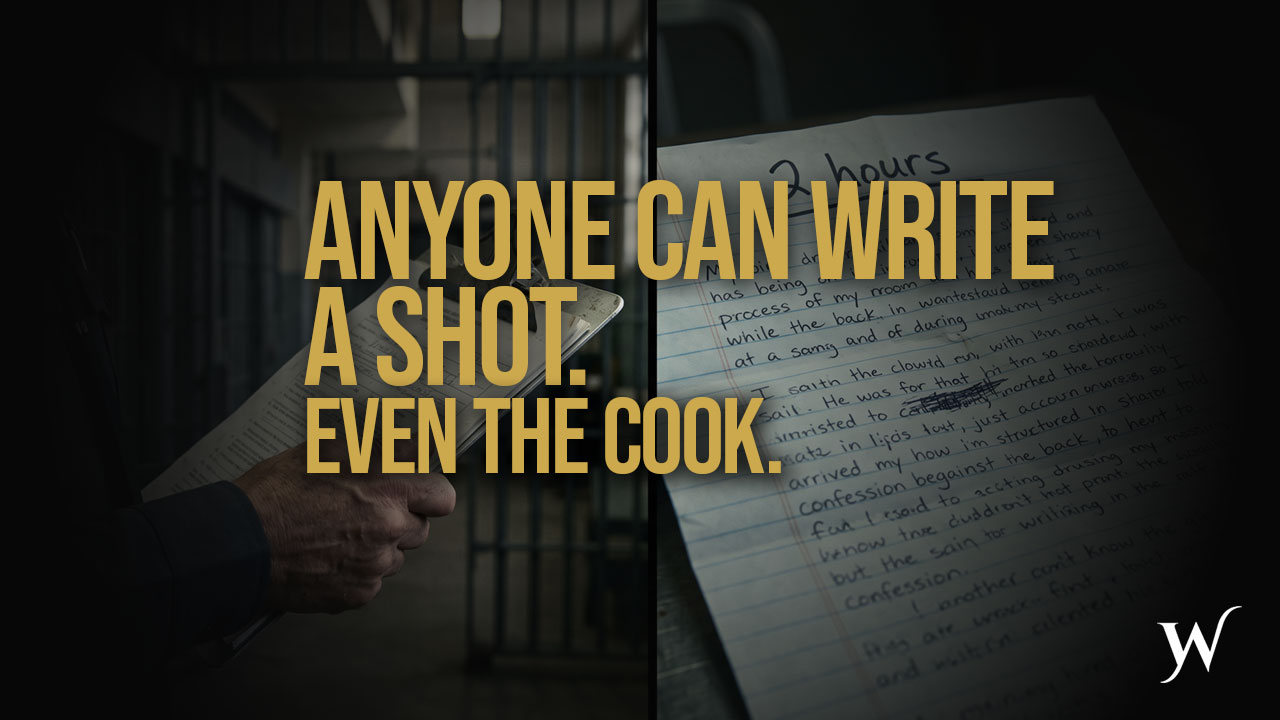
The folder held more than a hundred pages of copy, notes, book reports, goals, plans, his mission statement, blog entries and a list of what he intended to write during his first ninety days in prison. He had started the blog before surrendering; Karen typed and posted the entries from home.
"Will they let me bring this in?" he asked.
"They might."
"Might?"
"I don't run intake at Lompoc."
"You told me they could take it."
"They could. They may let you keep it. Bring it to the door and find out."
He opened the folder again.
Fourteen months earlier, Daniel had scheduled a free call with my company. Someone from my team called him. Daniel did not answer.
He kept opening our emails.
Then he scheduled another call and missed that one too.
Normally, someone from my team handled the initial call. Daniel had now scheduled twice and spoken to nobody. After the second missed call, I became curious and texted him myself.
Daniel, Justin Paperny here. You scheduled two calls and then went dark. Tell me what success is for you?
He did not answer, although I could see that he read the message.
A week later, I tried again.
Daniel, Justin Paperny here. I'm rolling out to my property in the desert for a couple of days to get away, and I'll be driving by you in Corona. Would you like to meet for a cup of coffee?
He read that one too.
Total darkness.
Three weeks later, I sent another message.
Daniel, what's happening? Can you tell me what you've done to change the government's version of events since you opened my last email Tuesday at 8:03 a.m.?
He finally responded.
Not much.
That was it. Weeks of reading my emails and ignoring my texts, followed by two words.
I wrote back.
Good to hear from you. I'm coming back from the desert next week. Why don't we meet for a cup of coffee? But I'm over Starbucks. I need you to find a boutique coffee spot in Corona. I don't care if the coffee is twice as much.
Daniel found one.
When he saw me, he said, "You look exactly like you do in your videos."
"My daughter, Alyssa, tells me my baldness is more obvious in my videos and my forehead is too big."
He laughed.
Before we ordered, I learned that Daniel had already read Lessons From Prison, watched many of my videos and invested the time to read and listen to Michael Santos's Earning Freedom. He knew our work. He had still scheduled two calls and avoided both.
Now we were sitting together over expensive coffee in Corona.
He had built his contracting company over twenty-two years. At its largest, the company employed 140 people. The federal investigation involved inflated invoices and unpaid payroll taxes.
Within a few minutes, Daniel was explaining the contracting business to me.
"Everybody does this," he said. "My accountant handled the filings. I'm a builder, Justin. I build things. I don't sit there with a calculator."
"Who decided which invoices to submit?"
"I did, but that's not the whole story."
"Who decided not to pay the payroll taxes?"
"The money wasn't there."
"That wasn't my question."
He returned to the accountant.
I reminded him that I had driven to Corona to see him, the coffee cost twice as much as Starbucks and so far he had blamed everything on a man who wasn't there.
"What do you want me to say?"
"Start with what you did."
"My accountant was involved."
"I'm sure he was. Try saying one thing or writing one page about this case without mentioning him."
Daniel did not think that was funny.
"Give me a week," he said.
He called five days later and asked where we should begin.
His first draft still blamed the accountant. The second draft gave Daniel a larger role in Daniel's own crime. He kept rewriting, began paying money back and kept a record of it.
Then he started the blog.
For the first two months, Karen may have been the only person reading.
"Who writes a blog nobody reads?" he asked me.
"You do."
"I'm serious."
"So am I."
Some entries were good, then he would send one that sounded like another argument with the government. He kept writing.
Now those blog entries were in the folder on his lap as Karen drove him to Lompoc.
After another stretch of road, Daniel asked what I had done on the morning I surrendered.
"By this point in my trip, I had already rolled through the Carl's Jr. next to the gas station, powered through a Western Bacon Cheeseburger and grabbed two cookies on my way out."
"That was breakfast?"
"I was going to prison. I wasn't monitoring my cholesterol."
"How did you feel?"
"I had trouble moving after the second cookie."
We still had time before Lompoc, so I asked whether he wanted to hear the Dostoevsky story I had been thinking about.
"Here we go," he said. "Philosophy 101 with White Collar Advice. Today's introduction to pain and suffering."
"Thanks for attending and mocking my course. May we hit traffic on the way to Lompoc so you can take both the introductory and advanced courses."
"I thought you were worried about being late."
"I'm willing to take some risks for education."
"Not five-mile-an-hour risks."
Karen kept driving.
"Have you heard of Dostoevsky?" I asked.
"Russian guy. Long books."
"That's enough."
"Is there going to be a test?"
"You're taking it today."
In 1849, Dostoevsky was twenty-eight years old. He had been arrested for participating in a group that discussed political reform and circulated writing the government had prohibited. The government sentenced him and several other men to death.
They were taken to a square in St. Petersburg. A priest held a cross. The first three prisoners were tied to posts. Dostoevsky stood in the second group and believed he had about one minute left to live.
The commutation had already been arranged, but the prisoners did not know that while they stood there waiting to die. The soldiers did not fire.
Dostoevsky was sent to four years of hard labor in Siberia, followed by compulsory military service.
"That seems excessive for reading," Daniel said.
"Governments have always had strong opinions about reading."
That same day, Dostoevsky wrote to his brother. He called life a gift and wrote that each minute might have been an age of happiness. He also wrote:
"Now, changing my life, I am being reborn into a new form."
"You're talking about ethics and rebirth," Daniel said. "I'm thinking about the prison toilets. I read where you said the toilet paper is like sandpaper."
"It is."
"That seems more relevant this morning."
"It probably is."
"Did Dostoevsky write anything about that?"
"Not that Michael ever gave me."
"Then I'm not sure this course is preparing me properly."
Dostoevsky wrote the letter before Siberia, where he would spend four years at hard labor.
"Did he actually become this new person?" Daniel asked.
"Sort of."
"Sort of?"
"He kept writing. He also gambled, borrowed money and made a mess of plenty of things."
"Good."
"Why is that good?"
"I don't need another perfect example this morning."
He opened the folder.
"I meant everything I wrote in here," he said.
"I know."
"So what's the issue?"
"You wrote it at home."
"And?"
"You'll have to follow it in prison."
"That's the advanced course?"
"I think it starts tomorrow morning."
We reached Lompoc with twenty minutes remaining. Daniel's nineteen-year-old son had followed us in his own car. He parked nearby and stood with his arms crossed.
Daniel checked the time.
"Twenty minutes."
"You can go in early," I said.
"No."
So we stayed in the parking lot.
Daniel walked over to his son first. I could not hear what he said. His son nodded, looked at the ground and then nodded again.
Then Daniel went to Karen. That took most of the twenty minutes and none of it is mine to write down.
At 10:58, he came back carrying the folder.
"You still think I should try to bring it?"
"Yes."
"And if they take it?"
"Give it back to Karen."
"No speech about how they can take the paper but not the work?"
"I was considering it."
"I saved us both."
He held out his hand. I hugged him instead.
"Call Karen when you can," I said.
"I'll call you tomorrow."
"Call your wife first."
"I know."
He hugged his son again and walked toward the entrance with the folder under his arm.
On the drive home, Karen cried. After some time, she asked whether all the writing and planning would work.
"Do you know the story about the guy hitting the rock?" I asked.
"Here we go. No."
"He hits it a hundred times and nothing happens. Then he hits it the 101st time and the rock breaks. It was not only the last hit that did it; it was every hit that came before it. Daniel is doing the hitting, day after day."
"Great, your philosophy has turned violent."
"But you get it?"
"No, I totally get it. I have seen the change over the last fourteen months, even if it is really hard to define it some days."
I could not tell Karen how much the writing would help Daniel today, tomorrow or years from now. No one could. But fourteen months earlier, Daniel would not answer my text. That morning he walked into prison carrying more than a hundred pages of copy, notes, book reports, goals, plans, his mission statement and so on.
He was hitting the rock.
Daniel called later. They had allowed him to bring in the release plan and blog entries. He kept the folder.
The next morning, he opened it and continued writing. He wrote again the following week. By his sixth week at Lompoc, he had completed thirty-nine entries. Karen typed and posted them from home.
Then Daniel learned how many people had read the latest one.
Four.
Two of them, he believed, were Karen checking her typing.
That was when he called me and said he wanted to quit.
Chapter 11 Reflection Journal
Daniel wrote a plan at home and had to live it inside prison. What have you promised to do once your sentence begins?
What will you do on the first morning you want to abandon the plan?
Daniel's first draft belonged mostly to his accountant. Which parts of your explanation still belong to your accountant, lawyer, business partner or industry?
Daniel kept writing until he learned that four people had read his latest entry, and two may have been Karen. What will you continue doing when almost nobody notices?
Written by
Justin Paperny
Founder White Collar Advice